
Habondia is a Germanic goddess of the ground.
Habondia was revered as a harvest goddess in northern Europe, bestowing wealth and prosperity on fields, crops, and herds.
She is endlessly giving and encourages improvement in all
aspects of life.

She is endlessly giving and encourages improvement in all
aspects of life.

She is the heavenly bride, the perfect mortal wife's symbol,
because she is pure, honorable, and beautiful.
The morning star is depicted as Zaria.
Depending on the myth, she could manifest as a single being known as "The Red Maiden" or as two or three sisters simultaneously. Zorya has many traits with the Proto-Indo-European goddess of the morning *H2éwss, despite their etymological dissimilarity.
She is often shown as Zvezda, the Morning Star, the Sun, the Moon, and Zvezda, the Moon's sister.
She resides in the Palace of the Sun, protects his white horses, opens the entrance for him every morning so he may go across the sky, and is also said to be a virgin. She stands in for the ultimate power invoked by a practitioner in the Eastern Slavic tradition of zagovory.
The all-Slavic term zora, which means "dawn, aurora," and its forms (from Proto-Slavic *zoà), have a common linguistic ancestor with the all-Slavic word zrti, which means "to see, observe" but may have originally meant "shine."
The term "zara" may have been influenced by the word "ar" (PS *ar), which means "hot." PS *zoà is derived from the unclearly etymological Proto-Balto-Slavic *ori (see Lithuanian 'arà, 'arijà).
*H2éwss is the hypothesized Proto-Indo-European name for the dawn goddess. Her name was reconstructed using a comparative method based on the names of Indo-European goddesses of the dawn, such as Greek Eos, Roman Aurora, or Vedic Ushas.
Likewise, the characteristics of the Proto-Indo-European goddess were reconstructed based on the characteristics of the goddesses of the dawn.

Even though the Zorya religion is only known through folklore, it has origins in Indo-European antiquity and the Zorya exhibits the majority of *H2éws' traits. Most goddesses of the dawn share the same traits with Zorya:
She makes an appearance with Saints George and Nicholas (interpreted as divine twins)
hues red, gold, yellow, and rose
She resides abroad on the Buyan Island.
opens the Sun's entrance.
A golden boat and a silver oar belonged to her.

These pictures have their roots in ancient ideas, ranging from the first fetishistic (the Sun as a ring or circle) to the later anthropomorphic. A miniature of two ladies may be found in the late 13th-century Chludov's Novgorod Psalter.
One of them, a fiery red woman identified as "dawn zora," holds a red sun in her right hand in the shape of a ring while holding a torch in her left hand that ends in a box from which a bright green stripe extending into a dark green stripe emerges.
This stripe is marked "evening zora" in green on the right hand of another lady, who is holding up her left sleeve to reveal a bird. This may be understood as the Morning Zorya setting the Sun on its course for the day and the Evening Zorya waiting for the Sun to rise.
In a cave temple from the second or third century AD in Nashik, India, a very similar design was discovered.
The bas-relief shows two ladies, one holding a torch to illuminate the Sun's circle and the other waiting for it to set. Ushas and Pratyusha, two morning deities, are seen in other bas-reliefs, and the Sun is often accompanied by dawns in hymns.

Images like the Psalter and Nashik's may be seen across Slavic regions, including: On a carved and painted gate of a Slovak peasant estate (village of Oová), the Morning Zora is depicted on one of the pillars with a golden head, a glow above her, and even higher is the Sun, which rolls along an arched road.
The Evening Zora is depicted on the other pillar with a setting sun above it. On this relief, there are also darker suns that may represent dead suns from Slavic legend. The Russian proverb "The sun will not rise without the Morning Zoryushka" also supports these themes.
A similar design may also be seen on the back of a 19th-century sled, where two Zoryas are shown standing in the doorway and the Sun is depicted as a circle, and on a peasant rushnyk from the Tver area, where two Zoryas are depicted riding up to the Sun, one in red and the other in green.

The luminary goddesses Vakarine and Ausrine are said to have a similar dual function in Lithuanian folklore: Vakarine, the Evening Star, made the bed for the sun goddess Saul, while Aurin, the Morning Star, kindled the fire for her as she prepared for another day's voyage.
According to various legends, Ausrine and Vakarine are the daughters of the male Moon (Meness) and female Sun (Saule), who take care of their mother's castle and her horses.

Each was to occupy a separate side of the Sun's throne made of gold.
When the Sun rose in the morning, the Morning Zorya opened the entrance of the celestial palace, and the Evening Zorya shut the gate when the Sun went to sleep. Buyan Island intended to serve as the home of Zorya's administration.

Three small sisters, or little Zorya, may be found in the sky: the morning, the evening, and the midnight. Their responsibility is to watch after a dog that is attached to the Little Bear constellation by an iron chain. The end of the world will occur when the chain snaps.
As shown by her frequent presence in wedding chants, Zorya also supported weddings and facilitated unions amongst the gods. She is specifically given credit for doing the following task in one of the Malo-Russian ballads when the Moon encounters Aurora while roving in the sky:
Ah, dawn, dawn! Where have you been, exactly?
Where have you been, exactly? Where do you plan to reside?
Where do I plan to call home? Why there at Pan Ivan's?
Located at Pan Ivan's Court
Both at his court and residence
And he enjoys two things in his home:
Getting his kid married is his first delight;
And the second pleasure was to marry his daughter.
In several iterations of the same zagovory storylines, Maria (Mother of God) and Zara-Zaranitsa (also known as "Dawn the Red Maiden") both make appearances as the ultimate power that a practitioner invokes.
In addition, she was prayed to as Zarya for fruitful crops and wellbeing:
Hey, you morning and evening Zaryas! fall onto my rye so that it might become as strong as an oak and as tall as a forest!
Mother Zarya of dawn, evening, and midnight [presumably twilight here]! As you softly fade away and vanish, may my illnesses and sorrows—those of the morning, evening, and midnight—quietly go from me, the servant of God!
According to Professor Bronislava Kerbelyt, the Zoryas were also summoned in Russian tradition to aid in birthing (under the name "орки арноки") and to cure the infant (by calling upon "ар-дeвиа," or "утренн ар араскаве" and "веерн ар оломоне").

Additionally, Zarya was summoned as a protectoress and to banish dreams and insomnia:
Заря, зарница, васъ три сестрицы, утренняя, полуденная, вечерняя, полуночная, сыми съ раба Божія (имя) тоску, печаль, крикъ, безсонницу, подай ему сонъ со всѣхъ сторонъ, со всѣхъ святыхъ, со всѣхъ небесныхъ.
In his book The Ancient Faith of the Serbs and the Croats, Croatian historian Natko Nodilo stated that Zora was known as a "shining maiden" ("svijetla" I "vidna" djevojka) by ancient Slavs, and that Russian riddles depicted her as a woman who resided in the sky ("Zoru nebesnom djevojkom").

Regarding the Dawn's parents, she is referred to as the "Sister of the Sun" and "sweet little Dawn" in a Russian hymn.
She is referred to as Zaranitsa (арана) or Zara-zaranitsa (ара-арана) in Belarusian folklore. In one of the sections, St. George and St. Nicholas, who in Indo-European myths are often brothers of the dawn goddess and, according to comparative mythology, serve as divine twins, meet Zaranica: "Saint George was traveling with Saint Nicholas and encountered Aurora."

Zara-zaranitsa, a stunning virgin, lost her keys as she was walking through the air. The moon saw them but made no comment. When the sun saw them, it raised them.
This has to do with the dew, which the moon ignores and which vanishes when the sun is present. Zaranica is a diminutive name that may be used to show reverence for Zara, who is most likely just the morning goddess and may be rendered as "Dawn."
The stars are sometimes referred to as zorki and zory in Belarusian culture. For example, Polaris is called Zorny Kol ('star pole') and polunochna zora ('star of midnight').
The three sister Zoras (Trzy Zorze) of Polish folklore are the Morning Zorza (Polish: Zorza porankowa or Utrenica), Midday Zora (Zorza poudniowa or Poudnica), and Evening Zora (Zorza wieczorowa or Wieczornica). These three Zoras occur in Polish folk charms and, according to Andrzej Szyjew Additionally, they serve as Rozhanitsy.

The Mother of God gathered golden foam while sailing on the sea;
When St. John saw her, he asked her, "Mother, where are you going?"
My little boy will be healed by me.
The zorzyczki, the zorzyczki
You three are here.
her in the morning
she of noon,
she of the night.
Take away my child's cries,
give him his sleep back.
Zorzeczeki, zorzecze!
All of you are my sisters!
Mount your crow horse.
also ride for my friend (lover).
He can't go without me, therefore
neither eats nor sleeps,
neither chat nor sit down.
In order for me to stand, work, and willingly satisfy him.
so that I may be grateful and amiable to both God and others,
together with my partner.
In a Polish magical love charm, the girl begs the dawn (or morning-star) to visit her lover and compel him to adore her alone:
Let's go now
Good morning, morning star.

Additionally, there are terms in the Ukrainian language that are derived from "Zorya," such "zrka" (dialectal "zira" and "ziry") and "zirnitsa" (or "zirnytsi," a lyrical phrase that means "tiny star," "aurora," and "dawn."
There are many stars (рок) in the sky, but only two Zori: the morning one (свтова) and the evening one (верн), according to a proverb gathered in "арквин" (Kharkiv Oblast).
The mourner declares in an orphan's lament that he will steal the "keys of the dawn" ("о в ор кл вла").
The girl calls upon the "three star-sisters" (also known as the "dawn-sisters") in a magical love charm:
You have three options: one nudna, one pryvitna, and one pechal'na.
You three sisters in the sky, the boring one, the inviting one, and the somber one, you dawn-stars.
In the Slovene folk ballad "Zorja prstan pogubila," the singer requests that her mother ("majko"), brother ("bratca"), sister ("sestro"), and beloved ("dragog") search for her missing ring.
According to professor Monika Kropej, the sun rises in the morning accompanied by the morning dawn known as Sonica (from the Slovene word for sun) and sets in the evening followed by the evening dawn known as Zarika (from the Slovene word for dawn, zarja).
Additionally, a Slovenian narrative folk song about their rivalry features these female characters. In addition, F. S. Copeland described another lyric with the name Ballad of Beautiful Zora and understood both characters as the legendary Sun and Dawn.
In his book on Slovene myths and folktales, Slovene folklorist Jakob Kelemina (sl) claimed that a Zora emerges as the Snake Queen's daughter (perhaps a manifestation of the night) in the so-called Kresnik Cycle.
Professor Daiva Vaitkevien claims that the Virgin Mary undoubtedly took the role of the goddess Zaria in East Slavic charms. In Russian charms, the Virgin Mary is often referred to as "Zaria."
The announcer mentions "Maria-the-Dawn" and "Maremiyaniya-the-Dawn" in a charm that was compiled in Arkhangelsky and published in 1878 by historian Alexandra Efimenko (ru).
Another charm uses the "Evening Star Mariya" and "Morning Star Maremiyana" to banish insomnia.
Additionally, charms for health are said to summon Goddess Zaria (or, alternatively, a group of three goddesses called Zori). This "is a very common theme of the Slavic charms," claims professor Daiva Vaitkevien.
As the name of a song performed by Colinda tori and the Romanian word for dawn, "zori," the term "Zorya" has become a loanword (zorile).

Venus is referred to as Zornjaa in Serbo-Croatian languages when it rises in the morning and Veernjaa when it sets.
The Dawn/Morning Star is portrayed as the bride of a masculine Moon in a folk song.
In several Croatian folk songs, which Rikardo Ferdinand Plohl-Herdvigov gathered and published in 1876, a "zorja" is used with the word "Marja" in the phrase "Zorja Marja prsten toi," and it is referred to as "Zorja, zorija" in the phrase "Marija sinku nainila koulju."

In Slavic tradition, Zorya (which means "Dawn" and has various variations including Zarya, Zara, Zaranitsa, Zoryushka, etc.) represents dawn in a feminine form. Depending on the myth, she could manifest as a single being known as "The Red Maiden" or as two or three sisters simultaneously.
One of the Old Gods, Zorya Polunochnaya, is a figure from Slavic mythology. Zorya Vechernyaya, who symbolizes the Morning Star, and Zorya Utrennyaya, who represents the Midnight Star, are her sisters (Evening Star). They form the Zorya collectively.
In American Gods, three sisters are introduced. Zorya Vechernyaya (Evening/Twilight) Dawn/Morning Zorya Utrennyaya Zorya Polunochnaya (Midnight).
Origin and Meaning of Zorya: Zorya is a girl's name that means "star." The morning and evening stars, respectively, are referred to by the names Zorya Utrennyaya and Zorya Vechernyaya of the two star goddesses in Slavic mythology. In Russia and other nations with Slavic-based languages, it is used as a name.

She drinks heavily from her walls and transcribes the main
events of the day so that none are lost, as a goddess of stories and myths.
She is the patroness of seers and writers, and she keeps
track of both past and future happenings.
She is revered in Norse and Germanic civilizations, and
scrolls and mead are considered holy to her.
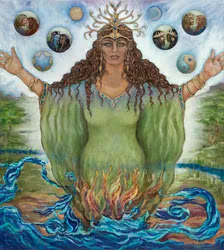
She is honored during the changing of seasons, with smoke
from fir boughs evoking her presence.
She considers evergreens to be holy.


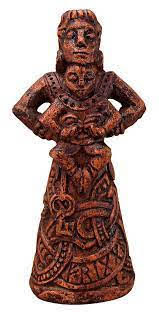
She is the patroness of matronesses and protects women and children.

Frigga is a seer who sees into all realms of reality and has the abilities of divination and prophesy; yet, she keeps her knowledge to herself.

She is the gods' ruler as Odin's wife.


To the Saxon and Germanic tribes, she was the goddess of spring.
Her name is derived from the old word eastre, which means
spring.
Eostre's celebration, when she was celebrated as a fertility goddess with decorated eggs and delicious delicacies, inspired the Christian
feast Easter.
Just as the heavens are commonly described as part of the masculine sphere, opposed to the feminine earth, so weather (especially storms with thunder and lightning) is often connected with male divinities and their powers.
Yet some cultures grant control of the weather to a powerful female divinity.
Often she is depicted as an aged woman, sometimes a giant, such as the Celtic Cailleach who stirred up storms at sea and covered the land with her cloudy cloak.
In Scotland and Ireland, this figure was con nected with high hills and mountains, around which clouds gathered and which even today bear her name.
She was a figure more feared than beloved, associated with bad weather rather than sunny spells, although she can appear in double form, as with Brit ains fearsome Black Annis and her corollary, Gentle Annie.
Among the Balts, the similar figure Ragana caused storms by waving a red wand.
Both these figures were seen as old, but sexually active, indeed somewhat predatory They favored strong and virile young men, whom they exhausted or even killed with their energy and sexual appetites.
The similar Hungarian witch, Szepasszony, was a frightening figure who kidnapped humans, often for sexual purposes.
The Russian witch Baba Yaga controlled the weather, brewing up storms to hide her raids on human settlements where she stole children.
Nearby, the dual Germanic goddesses Perchta and Holle not only controlled the weather but were also connected with sea sonal change, typically accompanied by a change in weather.
The distinction between a seasonal goddess and a weather-controller can be difficult to distinguish, with divinities like Georgian Tamar (see Slavic) serving in both capacities.
Storms include wind as well as rain, and goddesses whose special domain is the wind are not uncommon, although more typically associated with male divine figures (as is thunder).
At times these winds are drying, as with Egyptian Sekhmet who repre sents the desiccating desert wind as well as the heat of the sun.
African O ya controlled winds on the river named for her, while in the African diaspora, she continued to con trol wind, both gentle breezes and dangerous storms.
Similarly, the Haida figure Dju (see North America) controlled both soft and harsh winds by the height to which she raised her dress.
Sumerian Lilith (see Eastern Mediterranean) is another wind goddess, embodying a Cailleach-like sexual danger in a voluptuous form.
Because goddesses are often associated with water (see below), they can be described as having special power over rain.
An important example is Persian Anahita (see Eastern Mediterranean), who was seen as both earthly water and as rain that replenished streams and rivers.
These rain goddesses can appear as fertility figures like African Mujaji, for farmers depend upon rain at appropriate times in order for crops to thrive and ripen.
In northern climes, the goddess of precipitation was associated with snow rather than rain, as evidenced by Siberian Asiaq and Eskimo Kadlu (see Circumpolar for both).
One weather-related phenomenon typically associated with goddesses is the rain bow, which was in many lands seen as an airborne woman like the Greek Iris and Ochumare of the African diaspora.
In Australia, the rainbow was a female serpent flung across the sky (see Julunggul and Kunapipi).
The same connection is found in the African diaspora, where Aida Wedo is both rainbow and serpent in Haiti.
Other lands also saw a connection between rain and snakes or dragons, as Korean Aryong Jong, ‘‘queen of the dragon palace, suggests.
Similarly, the clouds that give birth to rain are depicted as goddesses, such as Indian Abhramu and Greek Nephele.
The connection of such goddesses to water seems primary, so they may be seen in bodies of water such as lakes and rivers, as well as in falling rain.
They can, as well, be associated with the oceans, as the Taiwanese goddess Ma-tsu attests.
She especially controlled the weather at sea, which impacted the fisherman who honored her (see China).
In Latvia (see Baltic), Mjer-jema was honored as a weather goddess who con trolled the storms at sea and thus assured or spoiled good fishing.
In Finland the god desses of air and weather ruled the healing arts (see Ismo).
You can learn more about Goddess Symbolism here.


They stand for the sunrise, noon, and sunset, as well as the
past, present, and future.
Zorya Utrennyaya, Zorya Vechernyaya, and Zorya Polunochnaya
are their names.

Depending on the myth, she could manifest as a single being known as "The Red Maiden" or as two or three sisters simultaneously. Zorya has many traits with the Proto-Indo-European goddess of the morning *H2éwss, despite their etymological dissimilarity.
She is often shown as Zvezda, the Morning Star, the Sun, the Moon, and Zvezda, the Moon's sister.
She resides in the Palace of the Sun, protects his white horses, opens the entrance for him every morning so he may go across the sky, and is also said to be a virgin. She stands in for the ultimate power invoked by a practitioner in the Eastern Slavic tradition of zagovory.
The all-Slavic term zora, which means "dawn, aurora," and its forms (from Proto-Slavic *zoà), have a common linguistic ancestor with the all-Slavic word zrti, which means "to see, observe" but may have originally meant "shine."
The term "zara" may have been influenced by the word "ar" (PS *ar), which means "hot." PS *zoà is derived from the unclearly etymological Proto-Balto-Slavic *ori (see Lithuanian 'arà, 'arijà).
*H2éwss is the hypothesized Proto-Indo-European name for the dawn goddess. Her name was reconstructed using a comparative method based on the names of Indo-European goddesses of the dawn, such as Greek Eos, Roman Aurora, or Vedic Ushas.
Likewise, the characteristics of the Proto-Indo-European goddess were reconstructed based on the characteristics of the goddesses of the dawn.
Even though the Zorya religion is only known through folklore, it has origins in Indo-European antiquity and the Zorya exhibits the majority of *H2éws' traits. Most goddesses of the dawn share the same traits with Zorya:
She makes an appearance with Saints George and Nicholas (interpreted as divine twins)
hues red, gold, yellow, and rose
She resides abroad on the Buyan Island.
opens the Sun's entrance.
A golden boat and a silver oar belonged to her.
These pictures have their roots in ancient ideas, ranging from the first fetishistic (the Sun as a ring or circle) to the later anthropomorphic. A miniature of two ladies may be found in the late 13th-century Chludov's Novgorod Psalter.
One of them, a fiery red woman identified as "dawn zora," holds a red sun in her right hand in the shape of a ring while holding a torch in her left hand that ends in a box from which a bright green stripe extending into a dark green stripe emerges.
This stripe is marked "evening zora" in green on the right hand of another lady, who is holding up her left sleeve to reveal a bird. This may be understood as the Morning Zorya setting the Sun on its course for the day and the Evening Zorya waiting for the Sun to rise.
In a cave temple from the second or third century AD in Nashik, India, a very similar design was discovered.
The bas-relief shows two ladies, one holding a torch to illuminate the Sun's circle and the other waiting for it to set. Ushas and Pratyusha, two morning deities, are seen in other bas-reliefs, and the Sun is often accompanied by dawns in hymns.
Images like the Psalter and Nashik's may be seen across Slavic regions, including: On a carved and painted gate of a Slovak peasant estate (village of Oová), the Morning Zora is depicted on one of the pillars with a golden head, a glow above her, and even higher is the Sun, which rolls along an arched road.
The Evening Zora is depicted on the other pillar with a setting sun above it. On this relief, there are also darker suns that may represent dead suns from Slavic legend. The Russian proverb "The sun will not rise without the Morning Zoryushka" also supports these themes.
A similar design may also be seen on the back of a 19th-century sled, where two Zoryas are shown standing in the doorway and the Sun is depicted as a circle, and on a peasant rushnyk from the Tver area, where two Zoryas are depicted riding up to the Sun, one in red and the other in green.
The luminary goddesses Vakarine and Ausrine are said to have a similar dual function in Lithuanian folklore: Vakarine, the Evening Star, made the bed for the sun goddess Saul, while Aurin, the Morning Star, kindled the fire for her as she prepared for another day's voyage.
According to various legends, Ausrine and Vakarine are the daughters of the male Moon (Meness) and female Sun (Saule), who take care of their mother's castle and her horses.
Each was to occupy a separate side of the Sun's throne made of gold.
When the Sun rose in the morning, the Morning Zorya opened the entrance of the celestial palace, and the Evening Zorya shut the gate when the Sun went to sleep. Buyan Island intended to serve as the home of Zorya's administration.
Three small sisters, or little Zorya, may be found in the sky: the morning, the evening, and the midnight. Their responsibility is to watch after a dog that is attached to the Little Bear constellation by an iron chain. The end of the world will occur when the chain snaps.
As shown by her frequent presence in wedding chants, Zorya also supported weddings and facilitated unions amongst the gods. She is specifically given credit for doing the following task in one of the Malo-Russian ballads when the Moon encounters Aurora while roving in the sky:
Ah, dawn, dawn! Where have you been, exactly?
Where have you been, exactly? Where do you plan to reside?
Where do I plan to call home? Why there at Pan Ivan's?
Located at Pan Ivan's Court
Both at his court and residence
And he enjoys two things in his home:
Getting his kid married is his first delight;
And the second pleasure was to marry his daughter.
In several iterations of the same zagovory storylines, Maria (Mother of God) and Zara-Zaranitsa (also known as "Dawn the Red Maiden") both make appearances as the ultimate power that a practitioner invokes.
In addition, she was prayed to as Zarya for fruitful crops and wellbeing:
Hey, you morning and evening Zaryas! fall onto my rye so that it might become as strong as an oak and as tall as a forest!
Mother Zarya of dawn, evening, and midnight [presumably twilight here]! As you softly fade away and vanish, may my illnesses and sorrows—those of the morning, evening, and midnight—quietly go from me, the servant of God!
According to Professor Bronislava Kerbelyt, the Zoryas were also summoned in Russian tradition to aid in birthing (under the name "орки арноки") and to cure the infant (by calling upon "ар-дeвиа," or "утренн ар араскаве" and "веерн ар оломоне").
Additionally, Zarya was summoned as a protectoress and to banish dreams and insomnia:
Заря, зарница, васъ три сестрицы, утренняя, полуденная, вечерняя, полуночная, сыми съ раба Божія (имя) тоску, печаль, крикъ, безсонницу, подай ему сонъ со всѣхъ сторонъ, со всѣхъ святыхъ, со всѣхъ небесныхъ.
In his book The Ancient Faith of the Serbs and the Croats, Croatian historian Natko Nodilo stated that Zora was known as a "shining maiden" ("svijetla" I "vidna" djevojka) by ancient Slavs, and that Russian riddles depicted her as a woman who resided in the sky ("Zoru nebesnom djevojkom").
Regarding the Dawn's parents, she is referred to as the "Sister of the Sun" and "sweet little Dawn" in a Russian hymn.
She is referred to as Zaranitsa (арана) or Zara-zaranitsa (ара-арана) in Belarusian folklore. In one of the sections, St. George and St. Nicholas, who in Indo-European myths are often brothers of the dawn goddess and, according to comparative mythology, serve as divine twins, meet Zaranica: "Saint George was traveling with Saint Nicholas and encountered Aurora."
Zara-zaranitsa, a stunning virgin, lost her keys as she was walking through the air. The moon saw them but made no comment. When the sun saw them, it raised them.
This has to do with the dew, which the moon ignores and which vanishes when the sun is present. Zaranica is a diminutive name that may be used to show reverence for Zara, who is most likely just the morning goddess and may be rendered as "Dawn."
The stars are sometimes referred to as zorki and zory in Belarusian culture. For example, Polaris is called Zorny Kol ('star pole') and polunochna zora ('star of midnight').
The three sister Zoras (Trzy Zorze) of Polish folklore are the Morning Zorza (Polish: Zorza porankowa or Utrenica), Midday Zora (Zorza poudniowa or Poudnica), and Evening Zora (Zorza wieczorowa or Wieczornica). These three Zoras occur in Polish folk charms and, according to Andrzej Szyjew Additionally, they serve as Rozhanitsy.
The Mother of God gathered golden foam while sailing on the sea;
When St. John saw her, he asked her, "Mother, where are you going?"
My little boy will be healed by me.
The zorzyczki, the zorzyczki
You three are here.
her in the morning
she of noon,
she of the night.
Take away my child's cries,
give him his sleep back.
Zorzeczeki, zorzecze!
All of you are my sisters!
Mount your crow horse.
also ride for my friend (lover).
He can't go without me, therefore
neither eats nor sleeps,
neither chat nor sit down.
In order for me to stand, work, and willingly satisfy him.
so that I may be grateful and amiable to both God and others,
together with my partner.
In a Polish magical love charm, the girl begs the dawn (or morning-star) to visit her lover and compel him to adore her alone:
Let's go now
Good morning, morning star.
Additionally, there are terms in the Ukrainian language that are derived from "Zorya," such "zrka" (dialectal "zira" and "ziry") and "zirnitsa" (or "zirnytsi," a lyrical phrase that means "tiny star," "aurora," and "dawn."
There are many stars (рок) in the sky, but only two Zori: the morning one (свтова) and the evening one (верн), according to a proverb gathered in "арквин" (Kharkiv Oblast).
The mourner declares in an orphan's lament that he will steal the "keys of the dawn" ("о в ор кл вла").
The girl calls upon the "three star-sisters" (also known as the "dawn-sisters") in a magical love charm:
You have three options: one nudna, one pryvitna, and one pechal'na.
You three sisters in the sky, the boring one, the inviting one, and the somber one, you dawn-stars.
In the Slovene folk ballad "Zorja prstan pogubila," the singer requests that her mother ("majko"), brother ("bratca"), sister ("sestro"), and beloved ("dragog") search for her missing ring.
According to professor Monika Kropej, the sun rises in the morning accompanied by the morning dawn known as Sonica (from the Slovene word for sun) and sets in the evening followed by the evening dawn known as Zarika (from the Slovene word for dawn, zarja).
Additionally, a Slovenian narrative folk song about their rivalry features these female characters. In addition, F. S. Copeland described another lyric with the name Ballad of Beautiful Zora and understood both characters as the legendary Sun and Dawn.
In his book on Slovene myths and folktales, Slovene folklorist Jakob Kelemina (sl) claimed that a Zora emerges as the Snake Queen's daughter (perhaps a manifestation of the night) in the so-called Kresnik Cycle.
Professor Daiva Vaitkevien claims that the Virgin Mary undoubtedly took the role of the goddess Zaria in East Slavic charms. In Russian charms, the Virgin Mary is often referred to as "Zaria."
The announcer mentions "Maria-the-Dawn" and "Maremiyaniya-the-Dawn" in a charm that was compiled in Arkhangelsky and published in 1878 by historian Alexandra Efimenko (ru).
Another charm uses the "Evening Star Mariya" and "Morning Star Maremiyana" to banish insomnia.
Additionally, charms for health are said to summon Goddess Zaria (or, alternatively, a group of three goddesses called Zori). This "is a very common theme of the Slavic charms," claims professor Daiva Vaitkevien.
As the name of a song performed by Colinda tori and the Romanian word for dawn, "zori," the term "Zorya" has become a loanword (zorile).
Venus is referred to as Zornjaa in Serbo-Croatian languages when it rises in the morning and Veernjaa when it sets.
The Dawn/Morning Star is portrayed as the bride of a masculine Moon in a folk song.
In several Croatian folk songs, which Rikardo Ferdinand Plohl-Herdvigov gathered and published in 1876, a "zorja" is used with the word "Marja" in the phrase "Zorja Marja prsten toi," and it is referred to as "Zorja, zorija" in the phrase "Marija sinku nainila koulju."
In Slavic tradition, Zorya (which means "Dawn" and has various variations including Zarya, Zara, Zaranitsa, Zoryushka, etc.) represents dawn in a feminine form. Depending on the myth, she could manifest as a single being known as "The Red Maiden" or as two or three sisters simultaneously.
One of the Old Gods, Zorya Polunochnaya, is a figure from Slavic mythology. Zorya Vechernyaya, who symbolizes the Morning Star, and Zorya Utrennyaya, who represents the Midnight Star, are her sisters (Evening Star). They form the Zorya collectively.
In American Gods, three sisters are introduced. Zorya Vechernyaya (Evening/Twilight) Dawn/Morning Zorya Utrennyaya Zorya Polunochnaya (Midnight).
Origin and Meaning of Zorya: Zorya is a girl's name that means "star." The morning and evening stars, respectively, are referred to by the names Zorya Utrennyaya and Zorya Vechernyaya of the two star goddesses in Slavic mythology. In Russia and other nations with Slavic-based languages, it is used as a name.
