Showing posts with label West Africa. Show all posts

Goddess Yemaya


Yemaya, also known as Yemoja or Iemanja, is an African water goddess.

Yemaya is worshipped across West Africa and the Caribbean as the mother of the sea and the moon.

She is the keeper of the feminine secrets and a protector of women.

She assists in the conception of offspring and their births, guarding and blessing newborns until they achieve adolescence.

She is a goddess of healing who shows compassion and charity to people who are in need.

Yemaya, the goddess of rivers and bodies of water, is frequently depicted as a mermaid.


~Kiran Atma

Goddess Ngame


Ngame: Goddess of the Soul from West Africa.

Ngame is regarded as a moon goddess by the Akan people of Ghana, who believe she created the heavenly planets.

She imbued individuals with souls by firing moon rays into them with a bow and arrow at birth.

Girls who were supposed to be endowed with Ngame's supernatural abilities were nurtured as royalty and rose to become their people's reigning queens and priestesses.


~Kiran Atma


Goddess Nana Buluku


Nana Buluku: The goddess of manufacturing in West Africa.

Nana Buluku is revered by the Fon as the primordial creation goddess and gods' grandmother.

She is also regarded as the first Yoruba woman, having been given life into clay by the Great Gods.

She is shown with a basket full of bark and roots, ruling plants, spellcraft, and magick.

She considers mandrake root to be holy.


~Kiran Atma

Goddess Minona


Minona: West African goddess of protection.

The Fon people refer to Minona as the woman's guardian.

She bestows fertility to women and guards them from conception until death.

She can predict the future and teaches shamans how to utilize palm kernels for divination.


~Kiran Atma


Goddess Mawu


Mawu is a West African deity of the moon.

Mawu is the goddess of the moon and the night sky, and the Fon people revere her for the chilly temperatures she gives.

She is the epitome of motherhood, teaching her people to honor and cherish their elders' knowledge.

The sun god Liza is her twin and consort, and the two of them produced the seven pairs of twin deities that impact the planet.

Mawu worships cowrie jewelry.


~Kiran Atma


Goddess Gleti


Gleti is a West African deity of the moon.

Gleti is the mother of the stars and planets, and she is married to the sun deity, according to the Fon people.

Gleti is the goddess of light and love, and eclipses are thought to be the consequence of her mating with her spouse.

Goddess Gbadu


Gbadu is a West African deity of destiny.

Gbadu is a sympathetic goddess who uses her power to bring order to the world.

She teaches divination and oracular work to the Fon, or Dahomey, people of Benin.

Goddess Erzulie


Goddess of love from West Africa.

Erzulie, a goddess of Africa, is currently mostly venerated in the Afro-Carribean Voudun tribes.

She is a goddess of beauty, wealth, and the arts, particularly dancing.

She is feared and adored for her immense strength, as well as her erratic mood swings.

Followers of Erzulie believe that once you are in her good graces, you will never be in need again; but, if you offend her, your remaining days will be spent in her anger.

Prostitutes and any sexual activity are patronized by Erzulie.

She is usually summoned via ceremonial dancing or ritual baths with pricey oils and fragrances.


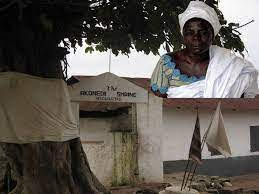
Goddess Akonadi


    Akonadi is the goddess of justice in West Africa. 


    • She is the Oracle, the teller of both visible and invisible facts. 
    • She utilizes her second sight to bring justice to all circumstances.
    • She is especially sympathetic to women's problems.


    Goddess Akonadi is a mythological figure in both African and Ghanaian mythology. 


    • As the goddess of justice, Akonadi or Akonedi, is revered and worshipped by the people of this region. 
    • She is also known as Akonandi, the goddess of prophesies in Ghana and West Africa.
    • She is particularly well-known in the Accra region, where she has a predictions temple and shrine dedicated to Her. 
    • She is revered for Her unique attribute of being both a goddess of justice and a woman's defender. 


    What is the Goddess Akonadi legend?


    Legend - Her function as a goddess of justice who protects mothers and children is shown by the following story: 


    Three brothers came to the Akonadi Shrine seeking counsel after their families experienced a series of fatalities. 

    Because their grandma was collaborating with a gang of criminals, I instructed them to go to their grandmother's home, where they would discover stolen items. 

    The boys returned to the home and discovered a metal box with valuables under their grandmother's bed. 

    They presented the goddess with the chest. 


    There will be no further fatalities if the stolen objects are no longer in their possession. 

    Soon later, two men approached the goddess and informed her that a chest containing treasures had been taken from their mother's land, and asked if she knew who the criminals were. 

    Her priestess replied that the box was at the shrine and that, although they were welcome to take it, they should leave it so that it may be used for charity for needy women and children. 

    The guys decided to leave the treasure box with the goddess to distribute to the poor, knowing how much agony it had caused. 


    Many Contemporary West Africans venerate her as a Ghanaian Oracular deity. 


    She has a well-known oracular shrine in Accra that is associated with this legend, practice and belief system.


    • Contemporary Western scholars have also discovered a relationship between the particular Goddess Akonadi spirit cult in the southern Ghanaian town of Akonedi and the African diaspora communities in the United States.
    • There have also been instances of cultural appropriation and a strong relationship between Afrocentric American devotees  of several Churches and the Ghanaian proprietors of the Akonedi shrine near Accra. 


    Scholars have also studied and observed how the Akonedi Shrine priests and priestesses participate in African traditional religion. 


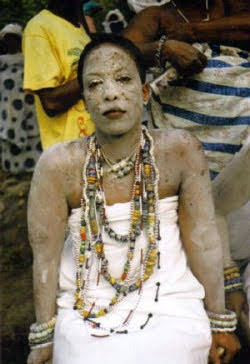
    • The main priestess of Goddess Akonadi presides over the shrine. 
    • She is possessed by the spirit of Goddess Akonedi, who died during childbirth. 
    • She attempts to assist and help individuals and worshippers through her powers derived from the spirit of Goddess Akonadi during the possession ritual. 


    References And Further Reading:


    • Fallon, Kathleen M. “Education and Perceptions of Social Status and Power among Women in Larteh, Ghana.” Africa Today 46, no. 2 (1999): 67–91. http://www.jstor.org/stable/4187268.