Showing posts sorted by relevance for query West Africa. Sort by date Show all posts

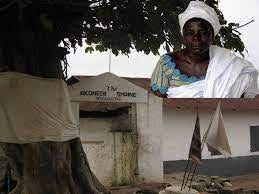
Goddess Akonadi


    Akonadi is the goddess of justice in West Africa. 


    • She is the Oracle, the teller of both visible and invisible facts. 
    • She utilizes her second sight to bring justice to all circumstances.
    • She is especially sympathetic to women's problems.


    Goddess Akonadi is a mythological figure in both African and Ghanaian mythology. 


    • As the goddess of justice, Akonadi or Akonedi, is revered and worshipped by the people of this region. 
    • She is also known as Akonandi, the goddess of prophesies in Ghana and West Africa.
    • She is particularly well-known in the Accra region, where she has a predictions temple and shrine dedicated to Her. 
    • She is revered for Her unique attribute of being both a goddess of justice and a woman's defender. 


    What is the Goddess Akonadi legend?


    Legend - Her function as a goddess of justice who protects mothers and children is shown by the following story: 


    Three brothers came to the Akonadi Shrine seeking counsel after their families experienced a series of fatalities. 

    Because their grandma was collaborating with a gang of criminals, I instructed them to go to their grandmother's home, where they would discover stolen items. 

    The boys returned to the home and discovered a metal box with valuables under their grandmother's bed. 

    They presented the goddess with the chest. 


    There will be no further fatalities if the stolen objects are no longer in their possession. 

    Soon later, two men approached the goddess and informed her that a chest containing treasures had been taken from their mother's land, and asked if she knew who the criminals were. 

    Her priestess replied that the box was at the shrine and that, although they were welcome to take it, they should leave it so that it may be used for charity for needy women and children. 

    The guys decided to leave the treasure box with the goddess to distribute to the poor, knowing how much agony it had caused. 


    Many Contemporary West Africans venerate her as a Ghanaian Oracular deity. 


    She has a well-known oracular shrine in Accra that is associated with this legend, practice and belief system.


    • Contemporary Western scholars have also discovered a relationship between the particular Goddess Akonadi spirit cult in the southern Ghanaian town of Akonedi and the African diaspora communities in the United States.
    • There have also been instances of cultural appropriation and a strong relationship between Afrocentric American devotees  of several Churches and the Ghanaian proprietors of the Akonedi shrine near Accra. 


    Scholars have also studied and observed how the Akonedi Shrine priests and priestesses participate in African traditional religion. 


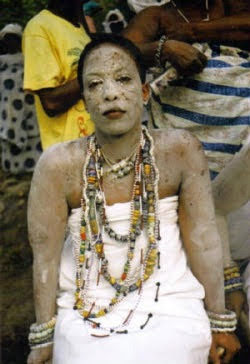
    • The main priestess of Goddess Akonadi presides over the shrine. 
    • She is possessed by the spirit of Goddess Akonedi, who died during childbirth. 
    • She attempts to assist and help individuals and worshippers through her powers derived from the spirit of Goddess Akonadi during the possession ritual. 


    References And Further Reading:


    • Fallon, Kathleen M. “Education and Perceptions of Social Status and Power among Women in Larteh, Ghana.” Africa Today 46, no. 2 (1999): 67–91. http://www.jstor.org/stable/4187268.


    Goddess Aja


      Aja is a West African woodland goddess. 


      • Her disciples learn herb knowledge from her, guaranteeing their bodily and spiritual well-being.


      Aja, Herbs, And Ritual Offerings


      When supernatural entities accept or reject ceremonial offerings, Osun and the Aje play a significant role. 


      When acknowledged, they strengthen and support herbal remedies; if not, they undermine their effectiveness and that of the ceremonial components. 

      Animals like ign (vultures) and aja (dogs), who eat the sacrificial sacrifices, are inspired by Aje. Consequently, they are revered by the babalawo and Eleerindınlogun. 

       Additionally, Chief Mrs. Elsoj made it clear that due to their close connection to and involvement with Osun, the Aje's leader, the Eleerindınlogun, herbs and roots are easily accessible to them as a result. 

      So, unlike diviners in other systems who must first pay particular devotion to the Aje in order for the elements to be effective, they are given the ability to employ ritual and herbal components at whim. 

      Before extracting herbs or roots for ritual preparation, they chant a number of praises to the Iyami and ask for their assistance. 

      The standing of Aje and Osun among them is agreed upon by every single one of my sources. 

      In the words of Ifa priest of Babalawo Oyegbad, this is summarized: 

      Aje, often referred to as Iyami, are strong as such that the cosmos has been entrusted to their protection by Olodumare. 

      They now have control and authority over its business thanks to him. The cosmos is firmly held together by them. They continue to keep the planet in order. 

      Osun is not only one of them; she is also their leader. In addition, Osun's function is essential in restoring harmony to any tense relationship. 

      Osun's standing among the spiritual beings explains why her influence over ritual procedures is crucial to the deity's plan for resolving disputes and crises. 

      The effectiveness of the ceremonial sacrifices suggested by diviners may be achieved by communication with all spiritual beings.

      Therefore, it is said that Osun, the head of the Aje, has the mystic ability to restrain or remove the violent acts of other deities as well as human potential and prosperity.


      Legends, Belief And Folklore Associated with Goddess Aja.


      Aja is an Orisha in Yoruba mythology, patron of the forest, its animals, and herbal healers, whom she taught their craft. 


      • Aja may also refer to a "wild wind" in Yoruba. 
      • If someone gets taken away by aja and later returns, it is said that he would become a strong "jujuman" (or babalawo). 
        • The voyage is said to last anywhere from 7 to 3 months, and the individual who is carried is said to have gone to the country of the dead or heaven (Orun)."  


      • She is a botanist who knows all there is to know about plants and is a master of potions and healing herbs. She taught this art to the Yoruba people, who continue to perform it now. 

      In Yoruba folklore and consequently in Santerian religious practice, Aja is a great healer. 


      • She is considered to be the spirit who taught all other healers how to do their jobs. 
      • She is a strong Orisha, and it is said that if she takes you away but lets you return after a few days, you will be bestowed with her magical abilities. 
      • A. B. Ellis said in Yoruba-Speaking Peoples of the Slave Coast of West Africa, published in 1894, that

        "Aja, whose name seems to mean "wild vine," whisks strangers away into the woods and educates them about the therapeutic powers of plants, but she never hurts them. 

      Aja is humanoid in appearance, although she is short, standing between one and two feet tall. 

      Women utilize the aja vine to treat enflamed breasts."  


      Aja is one of the most elusive Earth Gods and Goddesses since she chooses to show herself to humanity rather than hurt or fear them.


      Worshiping Aja is much rarer in the West, but it shouldn't matter since Aja symbolizes a global value of environmental care and preservation, regardless of religion or spiritual calling.

      Aja safeguards the woods, which are home to trees that provide oxygen and filter the air and water for all living creatures. 

      There would be more carbon dioxide in the atmosphere if trees were not safeguarding humans, and there would be no barrier to limit the speed of an already fast changing climate.


      Among the Nigerian Goddesses and Gods, Orisha is immensely popular. 


      Goddess Aja is the spirit of the forest and the animals that live there, as well as domestic healers. 

      Goddess Aja much like Goddess Diana of Europe  and Goddess Korravai of India is a woodland goddess, and also a goddess of animals.

      Goddess Aja always teaches us understanding empathy for the natural world, and a well-balanced empathy is the preventive strategy that prevents environmental degradation, destruction, and ecological anguish. 

      Thus Goddess Aja and Her true healing begins to unfold naturally and inevitably.


      Frequently Asked Questions:


      Who Is Goddess Aja?


      Aja is an Orisha, a spirit that inhabits the forest and its creatures, as well as herbal healers. She would search her woodlands for medical plants and combine the herbs, roots, and other plant components to develop treatments for the ill.


      Who is Africa's most powerful goddess?


      In Yoruba religion, Oshun is known as the river orisha, or goddess, and is linked with water, cleanliness, fertility, love, and sensuality. She is one of the most powerful orishas, yet she, like other gods, exhibits human characteristics including vanity, envy, and spite.


      What is the name of the African healer goddess?


      In Yoruba folklore and consequently in Santerian religious practice, Aja is a great healer. She is considered to be the spirit who taught all other healers how to do their jobs. She is a strong Orisha, and it is said that if she takes you away but lets you return after a few days, you will be bestowed with her magical abilities.


      What is the name of the African nature goddess?


      Asase Yaa is regarded as Mother Earth, the earth goddess of fertility, and the upholder of truth by the Akan people of West Africa.


      Which dark goddess is the most powerful?


      She's one of the most well-known and revered Orishas. Among the Yorùbá people, Oshun is a significant river god. Divinity, femininity, fertility, beauty, and love are all goddesses to her. She has a link to fate and divination.


      What are the seven African superpowers?


      Initiation into the Seven African Powers is another frequent initiation (Elegua, Obatala, Oggun, Chango, Yemaya, Oshun, and Orunmilla). Babalu-Aye is often substituted for Orunmilla by Cuban devotees. The Seven African Powers have been merged into a single eleke.


      What exactly are orisha?


      orisha, often written orixa or orisa, is a Yoruba deity who lives in southern Nigeria. The Edo of southern Nigeria, the Ewe of Ghana, Benin, and Togo, and the Fon of Benin all worship them (who refer to them as voduns).


      What is the maximum number of orishas you can have?


      According to Yoruba culture, there are 400 + 1 orisha, which is considered a holy number. According to some reports, the number is "as many as you can conceive of plus one more - an infinite number." Depending to the oral tradition, there are 400, 700, or 1,440 orisha.


      References And Further Reading:


      • Morton-Williams, Peter. “The Yoruba Ogboni Cult in [Uppercase Letter O with Vertical Line below]y[Lowercase Letter o with Vertical Line Below].” Africa: Journal of the International African Institute 30, no. 4 (1960): 362–74. https://doi.org/10.2307/1157598.
      • Dennett, R. E. “How the Yoruba Count (Continued).” Journal of the Royal African Society 17, no. 65 (1917): 60–71. http://www.jstor.org/stable/715685.

      • Drewal, Henry John, John Pemberton, and Rowland Abiodun. “Yoruba: Nine Centuries of African Art and Thought.” African Arts 23, no. 1 (1989): 68–104. https://doi.org/10.2307/3336802.
      • Yai, Ọlabiyi Babalọla. “In Praise of Metonymy: The Concepts of ‘Tradition’ and ‘Creativity’ in the Transmission of Yoruba Artistry over Time and Space.” Research in African Literatures 24, no. 4 (1993): 29–37. http://www.jstor.org/stable/3820251.
      • Matory, J. Lorand. “Rival Empires: Islam and the Religions of Spirit Possession among the Ọ̀yọ́-Yorùbá.” American Ethnologist 21, no. 3 (1994): 495–515. http://www.jstor.org/stable/645918.
      • Akínyemí, Akíntúndé. “Yorùbá Oral Literature: A Source of Indigenous Education for Children.” Journal of African Cultural Studies 16, no. 2 (2003): 161–79. http://www.jstor.org/stable/3559467.
      • Falen, Douglas J. “Vodún, Spiritual Insecurity, and Religious Importation in Benin.” Journal of Religion in Africa 46, no. 4 (2016): 453–83. http://www.jstor.org/stable/26358824.


      Goddess Erzulie


      Goddess of love from West Africa.

      Erzulie, a goddess of Africa, is currently mostly venerated in the Afro-Carribean Voudun tribes.

      She is a goddess of beauty, wealth, and the arts, particularly dancing.

      She is feared and adored for her immense strength, as well as her erratic mood swings.

      Followers of Erzulie believe that once you are in her good graces, you will never be in need again; but, if you offend her, your remaining days will be spent in her anger.

      Prostitutes and any sexual activity are patronized by Erzulie.

      She is usually summoned via ceremonial dancing or ritual baths with pricey oils and fragrances.


      Goddess Asase Yaa


      Asase Yaa is Africa's harvest goddess. 


      • Asase Yaa is known as "Old Woman Earth" by the Ashanti people of West Africa. 
      • Farmers call on her to bless their harvests in the fields. 
      • She is the ultimate harvest, assisting her children in reaping the benefits of the seeds they have sown throughout their lives. 
      • Asase Yaa is revered as humanity's mother, providing life for her offspring and reuniting them with them after death. 
      • She is the back bending, the sweat, the toil, and the final nourishing reward. 
      • Thursday is a holy day for her.

      Goddess Aida Wedo


      Aida Wedo is the goddess of rainbows in West Africa. 


      • Aida Wedo is a Yoruban and Voudoun goddess who takes the form of a rainbow python, a snake with iridescent scales. 
      • Her rainbow body encircles the world and the oceans, making her a cosmic guardian and the connection between heaven and earth. 
      • Water, wind, fire, rainbows, and serpents are all under her control. 
      • She is a benign deity who teaches her devotees honesty, strength, and mind-body-spirit unification. 
      • Her hue is white, since it is the manifestation of all colors, and her worshippers have traditionally given her rice, eggs, and milk.

      Goddess Nana Buluku


      Nana Buluku: The goddess of manufacturing in West Africa.

      Nana Buluku is revered by the Fon as the primordial creation goddess and gods' grandmother.

      She is also regarded as the first Yoruba woman, having been given life into clay by the Great Gods.

      She is shown with a basket full of bark and roots, ruling plants, spellcraft, and magick.

      She considers mandrake root to be holy.


      ~Kiran Atma

      Goddess Aje


      Aje is a riches goddess from West Africa. 


      • Aje is revered as the lord of riches in all of its manifestations. 
      • She is often portrayed as a bird clawing at the ground, and she is mostly known via Yoruban and Voudoun traditions. 
      • She is calm and collected, gently guiding people who are in need of financial wealth. 
      • She is the ruler of capitalism, profit, and commerce.


      Goddess Yemaya


      Yemaya, also known as Yemoja or Iemanja, is an African water goddess.

      Yemaya is worshipped across West Africa and the Caribbean as the mother of the sea and the moon.

      She is the keeper of the feminine secrets and a protector of women.

      She assists in the conception of offspring and their births, guarding and blessing newborns until they achieve adolescence.

      She is a goddess of healing who shows compassion and charity to people who are in need.

      Yemaya, the goddess of rivers and bodies of water, is frequently depicted as a mermaid.


      ~Kiran Atma

      Goddess Aha Njoku


      Aha Njoku, the yam goddess of West Africa. 


      • Aha Njoku is credited with the invention and cultivation of yams, a mainstay of the Nigerian Ibo people's diet. 
      • She keeps an eye on the yam harvest and protects the ladies who tend to the yams.


      Goddess Oshun


      Yoruba goddess of pleasure, Oshun.

      Oshun's worship traveled from West Africa to the New World, where Santerian traditions commemorate her.

      She is in charge of all bodies of water as well as all sensuous activities.

      Oshun, the patroness of ladies and Witches, is hedonistic in nature, participating in any action that promotes joy and pleasure.

      She considers jewelry, fragrances, dance, and seashells to be sacrosanct.

      Oshun is shown as a dark-skinned lady with wide hips in most depictions.

      Oba and Oya make a triad with her.


      ~Kiran Atma


      Goddess Odudua Or Odua


      Odudua, sometimes spelled Odua is a Yoruba deity of love.

      In West Africa, Odudua is revered as the mother of love and child raising.

      Her name means "Black One," and she is shown as a stunning beauty with obsidian-like complexion.

      She is the ruler of the directional and elemental south, as well as amorous devotion.

      Women honor Odudua's feast days by freely giving herself to male followers.


      ~Kiran Atma


      Goddess Ngame


      Ngame: Goddess of the Soul from West Africa.

      Ngame is regarded as a moon goddess by the Akan people of Ghana, who believe she created the heavenly planets.

      She imbued individuals with souls by firing moon rays into them with a bow and arrow at birth.

      Girls who were supposed to be endowed with Ngame's supernatural abilities were nurtured as royalty and rose to become their people's reigning queens and priestesses.


      ~Kiran Atma


      Goddess Ashiakle


      Ashiakle is a goddess of prosperity in Africa. 


      • Ashiakle is a West African goddess of riches and fertility who is adored across Ghana. 
      • She is the ruler of the sea and all of its riches.

      Goddess Worship In France


      How Prevalent Was Goddess Worship In France?

      Goddess has survived in quiet confidence, even though she was sometimes hidden, despite the rigors of patriarchy and the suffering of the Inquisition, which devastated many of those women and men who lived near to Goddess and her gifts of the land, animals, and the seasons

      The holy geometry of architecture and stained glass, which were made by the sweat and tenacity of people who revered her, incorporates the essence of the Divine Feminine

      Given that both Isis and Artemis of the Ephesians were referred to as "Our Lady," Gothic architecture and symbolism in the multitude of cathedrals that sprung up in the Middle Ages are devoted the Goddess in the guise of "Our Lady," the Virgin Mary, thus Notre Dame

      Some people think Gothic cathedrals' almond-shaped lancet windows and arches, which mirror female genitalia, depict the exact qualities of female anatomy

      Common images on stained glass windows with symbolism based in Goddess worship include roses, bees, and wheat

      The congregation was often thought of as the Bride of Christ, and the Church itself was frequently described in feminine terms

      The majority of what has been written about the Jesus of Gnostic scriptures, a proponent of the feminine and thought by many to be descended from consorts of the Goddess, would be impossible for him to recognize, much alone the Kingdom he proclaimed

      The natural feminine principle persisted in the metaphorical underworld, hidden beneath the veil of the Black Madonna, and in the persona of the Virgin Mary since patriarchal faiths were unable to eradicate the people's love and yearning for it or the love and stability the Goddess offered

      She may also be seen in locations in France's countryside that are linked to Mary Magdalene

      The reawakened herstory is fairly obvious when seen through the lens of our pilgrimage to holy places


      What Are Signs Of The Divine Feminine At Chartres?


      The Chartres Cathedral has a wide range of elements and ideas that personify the Feminine Divine unlike any other single building

      The location of the existing cathedral, which is devoted to the Virgin Mary, has long been revered by the Earth Mother

      Druids, originally known by the name Carnute, are said to have worshiped here in the sacred grove, honing their esoteric abilities at the holy spring while being in close proximity to nature

      According to legend, the indigenous tribes worshiped a goddess whose representation showed her giving birth

      The place was later selected as the location for a large Christian edifice, as was the case with so many important pagan sites

      Here, construction on a Romanesque cathedral began in 1020 but was abandoned when it was damaged by fire in 1194

      Only the west front, south tower, and crypt were left of this building

      Curiously, the Veil of the Virgin was the only part of the precious artifacts kept in this magnificent cathedral that had survived

      The old church was quickly replaced with a Gothic cathedral, which was finished in in 25 years, in 1250 CE

      The worshippers of the Goddess at Chartres simply started referring to her as the Virgin Mary after realizing that she was one and the same person

      According to writers Anneli Rufus and Kristan Lawson, Catholic authorities came up with the phrase "prefigurations of the Virgin" to describe representations of Mary made before her birth

      This is another another way in which Mary and the Goddess are assimilated

      The tremendous appeal of Chartres, often referred to be the greatest of the French Gothic cathedrals, communicates to the devout who have always been attracted here

      It is well known that renowned scholar and mythologist Joseph Campbell reflected on the profound effect this hallowed spot had on his psyche

      A Black Virgin, the garment of the Virgin Mary, the aforementioned holy well, the labyrinth on the floor, sacred geometry, feminine architecture, and the well-known rose stained glass windows are just a few examples of the extensive array of Goddess images found there

      The substantial subterranean crypt is a portion of the old pagan shrine that was on the location from the beginning and extends from below the building up

      Two galleries that run side by side and Saint Lubin's vault, which dates to the ninth century, are included in the biggest crypt in France

      Directly below the church nave is where the original figure of the Mother Goddess giving birth, now known as Our Lady Underground or Notre Dame de Sous-terre, may be found

      The duplicate that now stands in the crypt in place of the original statue, which is said to have been destroyed during the French Revolution

      She is categorized as a Black Madonna since she was carved in the Romanesque style from dark brown wood

      Another of her nicknames is Our Lady of the Crypt, and she is set onto the altar of that chapel

      The crypt is open for tours, but unlike in Malta, don't anticipate the guides to concentrate on the pagan origins of the well or statue

      As one moves farther inside the cathedral, they come to the second Black Virgin, Notre Dame de Pilier, whose name may relate to either the 10-foot (3-m) pillar she stands on or the pillar that formerly stood in the Temple of Solomon in Jerusalem

      She is only one of several Black Madonnas or Black Virgins that may be seen all across Europe

      (Notable Black Madonnas may also be found at Montserrat, Spain, and LePuy, France.) Because the Madonna and Child statues depict continuity between the pagan Goddess and the Virgin Mary, as well as how the Goddess persisted in peoples' public and spiritual life via Mary, these symbols are crucial to goddess spirituality

      Like the aforementioned early tribes, Mary and the Goddess are identical in the eyes of many Goddess supporters

      A further layer of assimilation between the symbolism of the enthroned Egyptian Goddess Isis holding her son Horus in her lap similarly to how Mary carries the infant Christ is the acceptance by many that Jesus is the son of the Goddess

      Jesus, who has been referred to as the son of Sophia, is readily integrated into the image of Horus

      The name of Isis has been discovered to remain on several of these Black Virgins' painted surfaces

      It's important for readers to keep in mind that Mary, Cybele, and Isis were all referred to as "Queen of Heaven" and had their sons via non-natural methods

      When church authorities are questioned about the Black Madonna's black complexion, they sometimes offer the ludicrous claim that the sculptures are dark because of candle smoke soot, never acknowledging any connection to the Goddess

      As subsequent site entries in this book will demonstrate, several of these monuments just "appeared" to farmers and fishermen in a magical way

      Some claim that these sculptures with black complexion were brought back by Crusader warriors

      There are several theories about the blackness of her complexion, with some academics suggesting that the Black and Brown Madonnas came from Africa or were related to the darker-skinned Isis and Artemis

      Goddess Spirituality practitioners often use her blackness as a metaphor for the Goddess' identity being "veiled" beneath Mary's persona

      Some believe that her blackness is a metaphor for the Gnosticism and alchemy she embodied, or for the unfathomable depths of Wisdom or Sophia, the dark, unknowable "knowing." When describing Chartres, scholar Margaret Starbird says that it developed into a "center of enlightenment, the center of a worship of Maria-Sophia, a goddess of knowledge." Her chthonic powers of regeneration may perhaps be linked with her blackness

      Her darkness is also connected to the Grail and Mary Magdalene legends that have become part of popular culture

      Whatever the particular causes of her darkness—and there were undoubtedly many—there was a rise of interest in and adoration for the Feminine, which explains why there were so many Madonnas and Cathedrals built throughout the Middle Ages

      As pilgrimages to these representations of the Divine Feminine gained popularity, great craftsmen like the Templars and Freemasons focused on creating cathedrals in her honor that incorporated holy geometry into their architecture

      One of these components is the spire, which has ties to the sun and moon and harmoniously unites the masculine and feminine

      Sacred geometry often included this cosmological link, attributing a divine balance and harmony, not to mention the order of the celestial bodies

      The design and building of Chartres, according to Starbird, were carried out by the Knights of the Temple, also known as the Knights Templar, who sought to reinstate the feminine element in medieval society

      The Templars "had access to the exoteric learning of the ancient world," according to the author, "perhaps preserved in Islamic literature that members of the order met in the Middle East." Their understanding of mathematics and engineering gave rise to the Gothic architectural style, which quickly expanded over Europe between 1130 and 1250 as if on purpose

      According to her, the guild that constructed Chartres was known as the Children of Solomon, which is a clear allusion to the King of Jerusalem who is believed to have penned the Song of Solomon, which serves as a metaphor for the "holy marriage." She shares an intriguing story about medieval Gypsies who thought the Notre Dame buildings in northern France were built to resemble the constellation Virgo in reverse

      Prior to the Inquisition, cathedral architecture and popular culture were thriving centers for the ancient arts and sciences of astrology, alchemy, mysticism, and psychology

      The images of the Virgin in stained glass, such as the rose windows connected to Mary Magdalene and the Grail stories, are imagery in which the Feminine dwells inside Chartres

      Some people think that Chartres' lancet windows symbolize the feminine vulva, the womb of conception and regeneration

      Thousands of pilgrims from the Middle Ages visited this location to venerate the garment and girdle that are believed to be those of the Virgin Mary

      Elinor Gadon claims that Mary was dressed in the tunic when Gabriel informed her that she would become the mother of God, and that the girdle fell from her body when she was taken up into heaven during the Assumption

      The 11-circuit labyrinth engraved on the church floor is the last component of Chartres to be discussed, despite the abundance of Mary-related artworks throughout the building

      It is claimed to be the same size as the aforementioned rose window and is 42 feet (13 m) wide

      While labyrinths were a common feature of medieval churches, this one is said to have a brass plaque at its center that features images of Theseus, the Minotaur, and Ariadne, all of whom are connected to Goddess legend from Minoan Crete (some interpret Ariadne guiding Theseus out of the labyrinth as a metaphor for rebirth)

      The term labrys, which refers to the Minoan people of Crete's holy double-sided ax, is closely related to the word labyrinth, which means "House of the Double Ax." The contemplative trip within is made even longer by the presence of four seven-circuit labyrinths

      The Church believed that this labyrinth either symbolized the Way of the Cross or a pilgrim's trip to Jerusalem and returned

      Each individual pilgrim was obliged to walk this road on their knees, which was often used as penance

      Labyrinths, which resemble swastikas in shape, have pre-Christian origins and could represent an inward journey or a return to rebirth

      It might be compared to the Native American kiva's symbolic significance

      There is just one path in and out of a labyrinth, unlike a maze, making it impossible to get lost

      It also represents a person's trip into the afterlife, where they could have a divine encounter

      It is a technique for meditation that aids in centering the mind

      The spiral-shaped labyrinth sign is similar to spirals seen on the Neolithic sites of Newgrange and Malta, which represent the ideas of death and rebirth

      Labyrinth walkers' "in-and-out" movements have been transformed into spiral dances, which devotees of Goddess Spirituality often include into ceremonies and celebrations (See Glastonbury, page 39)

      It's interesting to note that the labyrinth is said to have indicated the entrance to Cumae's Sybil, an oracle comparable to that of Delphi and Didyma

      This was a gateway to the underworld in paganism, but in the Christian setting, it was transformed into the entrance to hell


      How to go to Chartres?

      The famed Palace of Versailles is 20 miles (35 km) from the city of Chartres, which is located around 60 miles (97 km) southwest of Paris

      If you have never been to a place as quaint as Chartres, the author suggests exploring the town after seeing the Cathedral since it is a modest and beautiful place overall

      Paris, which is roughly an hour away by rail or bus, is where most visitors to Chartres arrive

      The cathedral is prominent and simple to locate in the town's historical district

      The railway station may be reached by foot from there with ease


      What Is The Mary Magdalene Legacy In France?

      Mary Magdalene has been a subject of debate for thousands of years, and people are still whispering about her today

      However, some scholars are still reluctant to accept the evidence found in the recently discovered Nag Nammadi Gnostic gospels from the second century CE, which were likely omitted from the Bible for both doctrinal and political reasons

      Many people are becoming aware of Mary's historical setting and how the account of her friendship with Jesus has been changed

      Scholars like Karen King think it's quite likely that Jesus and Mary were married, and novelist Margaret Starbird goes even farther, arguing that the Holy Grail was Mary Magdalene's growing womb, which gave birth to the lineal descendant of Jesus in France after his death

      The Church, as well as organizations like the Knights Templar and the Cathars, may have had a part in herstory, according to tantalizing and contentious evidence that has just come to light

      It also suggests that Mary and Jesus and the lineage of Christ may have had hidden links

      Those who hold these unconventional viewpoints are turning locations in France where the pregnant Mary is said to have fled after the crucifixion of Jesus into modern-day Mary Magdalene pilgrimage destinations

      Goddess supporters see her as more than simply Jesus' wife; they see her as the holy sexuality that is sorely lacking in the patriarchal Judeo-Christian society

      These locations in Provence, close to Aix-en-Provence, including Saint Maximin and Saint Vezelay

      Mary and Lazarus came at Marseilles, where they reportedly started to evangelize southern Gaul

      Some people think she gave birth to a daughter at this time

      She was supposedly taken by angels to Aix and the Saint Maximinus oratory there when she passed away

      The first time these artifacts are recorded is in 745 by the chronicler Sigebert, who records that they were relocated to Vezelay to be safe from Muslim invasion

      Charles II, King of Naples, built a monastery in the location of the former Saint Maximinus in 1279, naming it "Saint Baum." While building it, he stumbled across this Mary Magdalene martyrium and the shrine dedicated to her, as well as an inscription explaining why it had been kept a secret

      After being destroyed during the French Revolution, the church was rebuilt in 1814

      The "real relic" of Magdalene, including her skull, is said to be in the possession of the former Saint Maximin (now formally known as "Saint Maximin-la-ste-Baume"), which is celebrated on July 22

      Her skull is housed in a reliquary made of brass and gilded that dates to circa 1860

      Saint Baum is a vast monastery with a central courtyard that is surrounded by rolling hills and vineyards

      It also has a beautiful basilica with a Gothic apse from the fourteenth century

      The basilica is built atop an old tomb that served as the burial chamber for a Roman villa that originally stood on the spot

      This is the cave where, according to many, Mary spent her last hours before being buried beside Saint Maximin, the first bishop of Aix

      The Magdalene's genuine remains were kept at the enormous church in Vezelay, which is halfway between Paris and Lyons, until they were transferred to Saint Maximin

      The enigmatic sites of Rennes le Chateau and Saintes Maries de la Mer in southern France are on the pilgrimage route, as are the Church of La Madeleine in Paris with its exquisite depiction of Mary being carried up to heaven by angels

      According to the Eastern Church, Mary Magdalene traveled to Ephesus with the Apostle John and Mary, the mother of Jesus, and died there

      Leo the Wise subsequently sent Mary Magdalene's remains to Constantinople in 889

      Gregory of Tours, a renowned historian of the Franks who lived from 538 to 94 CE, agreed that Mary Magdalene passed away at Ephesus

      Pope Gregory the Great purposefully connected the biblical character Mary Magdalene with an unidentified prostitute in 591 CE, maybe as a political ploy to undermine female leadership within the Church, which saw intimate relationships as corrupting

      The Vatican didn't make the necessary correction for 1,378 years, but it did it in 1969

      Important facts, such as Mary's role and those of other early Church women leaders, had been overshadowed in the meantime

      The greatest of saints, a significant Apostle to whom Jesus first appeared after his resurrection, and maybe even his wife, Mary Magdalene, has been dubbed

      The following two quotations should be taken into consideration as food for thought, even if some experts refuse to acknowledge Mary Magdalene's existence and others question the validity of the evidence supporting this claim that Mary was Christ's wife

      When author Karen King, a graduate of both Harvard and Claremont Graduate University, says, "Sometimes religion is presented as being fixed or stable and we must accept it or reject it, but the fact is, religious traditions and certainly Christianity among them, are very diverse and filled with possibilities," she is serving as a reminder to readers of an important truth

      We must be accountable for the sort of religion we create because religion is flexible

      May we all maintain an open heart and mind.


      ~Kiran Atma