Showing posts sorted by relevance for query Mesopotamian. Sort by date Show all posts

Goddess Ningal


Ningal: Goddess of Languages in Sumerian mythology.

Ningal is the goddess of insight and interpretation.

She decodes forgotten languages and misunderstood texts, as well as the meanings of dreams and oracular phrases.

Ningal, who is also a love deity, transforms from the moon god's maiden bride to Inanna's mother, and embraces the role by teaching her daughter everything she knows about marriage, sexuality, and the feminine mysteries.

Ningal, whose name means "Great Queen" in Sumerian and which is also known as Nikkal in Akkadian, was a Mesopotamian goddess who was thought to be the spouse of the moon deity Nanna/Sin. 

She was especially connected to his two primary cult sites, Ur and Harran, but they were also venerated in tandem in other Mesopotamian towns. 

The Third Dynasty of Ur and subsequent Larsa rulers had a special reverence for her.

While Ningal was a significant goddess in the Mesopotamian pantheon and worship of her is documented from all eras of Mesopotamian history, academics claim that the majority of her personality was "passive and supportive." Along with her husband, she served as Ur's tutelary deity; she was sometimes described to as Ur's "woman" or "mother."


It has been hypothesized that Ningal, like her husband, was a part-time astral god based on certain of her epithets.

U5-bi2 was a kind of bird that may have been connected to Ningal, although the evidence is unclear. 

However, it is considered that even in Ur, sculptures of a goddess accompanied by a water bird of the species Anserini, widely known from digs, were more likely to symbolize Nanshe

Other suggested identities for this animal are the greylag geese and the whooper swan. 

Ningal was also known as zirru, which might refer to a female bird. 

Some of Nanna's en priestesses, particularly Enheduanna, the daughter of Sargon, were also known to as zirru.

Ningal was shown in a variety of ways, and her iconography is inconsistent. 

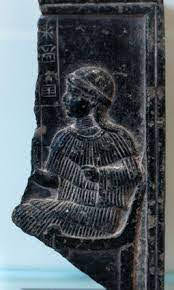
Ningal is seen sitting on her husband's lap on the Ur-Nammu stele. 

This kind of representation, which is also found for Bau and Ningirsu, was intended to stress the deities' capacity for cooperation and to show how closely they were connected. 

Ningal has also been shown resting on a lion's throne. 

In addition, it has been suggested that Ningal may appear in artwork as a sitting goddess holding her husband's sign, the moon crescent.


The phrase "hand of Ningal" was used to describe an unnamed skin condition. 

Similar titles have been used to describe a number of other deities, including Sin, Adad, Shamash, and Geshtinanna.

The goddess Ningikuga, also known as the "woman of the clean reed" in Sumerian, was the mother of Ningal. 

Although she is merely another goddess in Enki's circle in an Old Babylonian predecessor of the god list An = Anum, it immediately links her to Damkina. 

In a single balbale composition as well as in an emesal love song, she is specifically referred to as Ningal's mother. 

As "the clean one who purifies the world," Ningikuga might also be the name of a manifestation of Ningal.

Nanna, a moon deity, was Ningal's spouse (Akkadian Sin). 

Although less often than Adad and Shala or Shamash and Aya, they were sometimes mentioned as a pair in the inscriptions on cylinder seals. 

In Hurrian (Kusuh or Umbu), Hittite, and Ugaritic (Yarikh) accounts, derivatives of Ningal were seen as being wedded to various moon gods.

Their two most famous offspring were Utu/Shamash, who stood in for the sun, and Inanna/Ishtar, who stood in for the morning star. 

The most often reported legend about Inanna's ancestry is the idea that she was a daughter of Nanna and Ningal.

The Hurrian and Elamite goddess Pinikir is described as the daughter of Sin and Ningal in an Akkadian text that may be found in a corpus of Hurro-Hittite rites due to her identification with Inanna/Ishtar.

The goddesses Amarra-uzu and Amarra-he'ea, recognized from the god list An = Anum, Ningublaga (the city god of Ki'abrig), and Numushda are additional reasonably often documented offspring of Ningal and Nanna (the city god of Kazallu).

Manzat, an Akkadian and Elamite goddess of the rainbow, makes an appearance in a single Maqlû invocation as Shamash's sister and, therefore, as the child of Ningal and Sin.

Nuska was considered as the son of Ningal and her spouse in later accounts from Harran.


The god list An = Anum attests that Ningal was thought to have a sukkal (attendant deity), like many other deities, however the pronunciation of their name, dMEkà-kàME, is still up for debate. 

Manfred Krebernik believes that this god and the holy messenger Kakka are one and the same. 

Richard L. Litke notes that the gloss is unlikely to refer to a pronunciation of the sign ME that is otherwise unknown and suggests that the god mentioned was called Meme while Kakka was included in the same position in a different version of the list. 

He makes the assumption that Kakka in this context should be viewed as a different deity from the male messenger god who is often linked with Ninkarrak. 

Mari accounts mention a medicinal goddess by the name of Kakka who is connected to Ninkarrak and Ninshubur.

Ningal, who is described as "of Nippur," coexists in an inscription with the Nisaba-like scribe goddess Ninimma, also from that city.

The primary cult centers of her husband, Ur and Harran, as well as Babylon, Isin, Kisurra, Larsa, Sippar, Urum, and Tutub, all had shrines to Ningal. 

Her relationship with Ur was exceptionally strong; literary works have likened her and the city as a mother and her kid. 

She also shows up in laments for the city, lamenting its destruction. 

The Ur-Namma stele suggests that Ningal was probably the most revered deity in Ur's pantheon at the time of his rule.


Ningal was referred to as his mother by Shulgi of Ur. 

Additionally, he converted the Sumerian temple of Nanna in Ga'esh, Ekarzida, where she was referred to as Nin-Urimma, "lady of Ur," into a Ningal shrine.

The Gipar, the home of the high priestess of Nanna, and the temple of Ningal at Ur were united into an one structure during the Old Babylonian era. 

Her main sanctuary inside it was given the ceremonial name Egarku, which is Sumerian meaning "residence, holy boudoir," and can be seen in the inscriptions of monarchs like Nur-Adad and Warad-Sin. 

Eidlurugukalamma, restored by Silli-Adad, was another temple in the Gipar dedicated to her. 

Its Sumerian name translates to "home of the river ordeal of the land." Kurigalzu I constructed a second temple of Ningal at Ur during the Kassite era; its name is still unknown.

Kings of Larsa during the Isin-Larsa era, particularly Warad-Sin and Rim-Sin, actively worshiped Ningal and regarded Ur as a city of exceptional religious and political significance. 

Kings of the Manana dynasty of Kish were also patrons of a combined worship center of Sin and Ningal, the site of which is unknown.

According to letters from Ashurbanipal's reign, Ningal and Sin took over as Kissig's tutelary gods from Inanna and Dumuzi in later times.


Nereb (Al-Nayrab), near the present city of Aleppo, was an Aramaic center of the worship of Ningal that is documented from records from the first millennium BCE. 

It was most likely influenced by the Harran temple. According to records from Ashurbanipal's reign, there was a shrine of Ningal called Egipar in Harran itself, although it was a portion of Sin's Ehulhul rather than a distinct temple.

During the Neo-Babylonian era, Ningal was still revered in Ur. Nabonidus there constructed her temple. 

Ningal was also connected to a bt ili, "house of pressing," which is said to have been a pharmacy and a garden where the components for different medications were cultivated.

The religion of Ningal extended from Mesopotamia to various places, including as the Hittite Empire, Ugarit, and Hurrian kingdoms like Kizzuwatna. 

Cultures that included Ningal into their pantheons kept the idea that she was the moon god's wife and the sun god's mother.

There are a number of Hittite theophoric names that refer to her, with queen Nikkal-mati and her child Ashmu-Nikkal serving as significant examples. 

Ugarit provides comparable evidence.


The Ugaritic Nikkal, also known as Nikkal-wa-Ib, belonged to both the Ugaritic and Hurrian pantheons of the city and is documented as the spouse of both the Hurrian Kuu and the local moon deity Yarikh. 

She is linked to the otherwise unnamed deity rb in a Ugaritic tale, who may have been seen of as her father. 

He is believed to be of Hurrian descent, much like at least some of the composition's own components.

There are relatively few non-Hurrian non-Ugaritic Nikkal attestations from regions where West Semitic languages were spoken in the first and second millennia BCE, however this may be due to selective preservation.

Nikkal is only mentioned in one magical papyrus from Egypt, where she appears as a foreign divinity who is prayed to for help with a particular ailment.


Ningal was born to Ninhursag and Enki in the city of Ur, where the first cities in the marshes of southern Mesopotamia were constructed entirely out of reeds without the use of nails or wood. 

She goes by the name Nikkal and her name means The Great Lady.

She was the first to fall in love with Nanna, the moon god, when she first saw him flying over the night sky as a young, attractive female. 

She accepts his invitation to meet him by the marshes with joy. 

She can't resist him despite being a little bashful. 

She meets Nanna near the marshes, where they spend a number of private nights together while experiencing a passionate and honeyed-mooned love.


Ningal as the Moon God's Maiden Bride.

On the eve of the Dark Moon one night, Nanna bids Ningal farewell and makes a promise to see her again in two nights. 

He ascends to the sky to return home, but soon becomes impatient and returns to Earth in the disguise of a pilgrim to ask for protection. 

He knocks on Ningal's door and urges her to accompany him back in the marshes when she answers. 

Ningal has changed since then. She is no longer as subservient as she was when they first met since she has grown up. 

This time, she is firm and urges him to wait, stating that in order for their relationship to continue, he must first grant her a number of requests. 

Her demands, however, are not made out of self-interest but rather for the good of the marshes, the land, and the progeny of both wild and domestic animals.


~Kiran Atma


Goddess Amashilamma


    Sumerian fertility goddess Amashilamma. 


    • Amashilamma, is usually portrayed as a cow. 
    • Amashilamma bestowed wealth and lush fields to the Sumerians.


    Amashilama is also sometimes portrayed as a divine leech and the sister of the deity Damu, according to Mesopotamian mythology. 


    After her brother dies and goes to the underworld, their mother digs out his blood, chops it up, and feeds it to Amashilama along with a beer mixture in the hopes of resurrecting Damu. 


    Damu, however, understands he is dead after seeing their attempts and says that he is no longer in the "grass that will sprout for his mother again," nor in the "waters that will rise." 

    His mother blesses him, and Amashilama dies to join him in the afterlife, informing him that "the day that dawns for you will also dawn for me; the day you see, I will see."

    Elutil is her given name, which means "the temple (that provides) life to man." é meaning ‘house’ and lú ‘man’ meaning ‘temple’ and tìl meaning ‘life’.


    Ninazu and his wife Ningiridda had a son named Ningishzida. 


    A naccount of Ningirida and her son is one of the rare allusions to deities nursing in Mesopotamian literature. 

    Amashilama and Labarshilama were his sisters.


    Amashilama  according to the collection of laments, 'In the Desert by the Early Grass'. 


    Demons encourage Inanna to conquer the Underworld in 'Dumuzid and Geshtinanna'. 


    Rather, she surrenders Dumuzid to them. 

    Dumuzid's feet, wrists, and neck are bound in stocks, and he is tortured with hot pokers. 

    They strip him down to his underwear, perform "evil" on him, and cover his face with his own clothing. 

    Finally, Dumuzid asks Utu for assistance. 

    Utu changes Dumuzid into a half-eagle, half-snake monster, enabling him to return to Geshtinanna. 


    Dumuzid is pursued by the "seven terrible deputies of the netherworld" in The Most Bitter Cry, and while fleeing, he falls into a river. 


    He is taken into the Underworld beside an apple tree on the other bank, where everything "exists" and "does not exist," perhaps implying that they exist in insubstantial or immaterial forms.


    Damu, the "dead anointed one," is brought down to the Underworld by demons who blindfold him, bind him up, and stop him from resting, according to a collection of lamentations for Dumuzid titled In the Desert by the Early Grass. 

    Damu's mother attempts to accompany him into the Underworld, but he is now a ghost that "lies in" the winds, "in the lightnings, and in tornadoes." Damu's mother is similarly unable to consume or drink the food or water in the Underworld due to it being "bad." 

    Damu walks along the Underworld's Highway and meets a variety of ghosts. 


    He encounters the spirit of a tiny child, who informs him that the child has gone missing; the ghost of a singer offers to follow the child. 

    Damu requests that the spirits deliver a message to his mother, but they are unable to do so since they are dead, and the living are unable to hear the voices of the dead. 

    Amashilama, a heavenly leech and the sister of the deity Damu. 

    Damu dies and goes to the Underworld. Damu's mother digs out his blood and slices it up at her son's request. 


    She brings the congealed blood to Amashilama, who incorporates it into a beer concoction that Damu must consume in order to resurrect. 

    Damu, on the other hand, recognizes that he is no longer alive and asserts that he will not be found in the "grass that will grow for his mother again," nor in the "waters that will rise." 

    Amashilama dies to join Damu in the Underworld after Damu's mother blesses him. 

    "The day that dawns for you will likewise dawn for me; the day you see, I will also see," she says, alluding to how day in the world above is darkness in the Underworld.


    References And Further Reading:


    • Auset, P.B., 2009. The goddess guide: Exploring the attributes and correspondences of the divine feminine. Llewellyn Worldwide.
    • Ansky, S., 1992. The Harps that Once... In The Harps that Once.... Yale University Press.
    • Jacobsen, T., 1987. The Harps that once--: Sumerian poetry in translation. Yale University Press.
    • Shushan, G. ed., 2009. Conceptions of the afterlife in early civilizations: universalism, constructivism and near-death experience (Vol. 6). A&C Black.
    • Soares, L., 2019. Dicionário De Mitologia Mesopotâmica. Clube de Autores.


    Goddess Shamhat


    Shamhat: Mesopotamian erotic goddess.

    Shamhat, the High Priestess of Inanna who reigns over holy marriage ceremonies and sensual actions, is well-known throughout Mesopotamian society.

    She wields the heavenly secrets' power and oversees puberty's physical and mental metamorphosis.

    Shamhat teaches sensuality as well as the standards and etiquette expected in elite society.


    ~Kiran Atma

    Goddess Ereshkigal


    Goddess of the Underworld in Sumerian mythology.

    Ereshkigal was revered across Mesopotamia, with the majority of her followers in Sumer and Babylon.

    She is the goddess of Irkalla, the realm of the dead in the underworld.

    Ereshkigal, Inanna/older Ishtar's sister and counterpart, symbolizes the dark, the unseen, the shadow aspect of the soul.

    Only she has the ability to make laws, pronounce judgment, and wield power in the underworld.

    Nergal is her consort, and their love tale is often celebrated in Mesopotamian hymns.

    ~Kiran Atma


    Goddess Ninhursag


    Ninhursag: Great Sumerian goddess.

    Ninhursag is the primal mother who formed mankind from clay, and she is revered by all Mesopotamian societies and cults.

    She is associated with serpents and cows, and the milk from her breast feeds the cosmos.

    She is a goddess of healing who is in charge of herbal remedies and all sorts of vegetative fertility.

    Her name means "Lady of the Mountain" in English.

    Ningal was born to Ninhursag and Enki in the city of Ur, where the first cities in the marshes of southern Mesopotamia were constructed entirely out of reeds without the use of nails or wood. 


    ~Kiran Atma


    Goddess Lama


    Lama: Mesopotamian goddess of intercession.

    Lama was prayed to by the Sumerians for personal protection and development.

    She is the keeper of palaces and temples, transporting messages from the gods to humans.

    Regardless of society's ethical values, the Lama works for the greater good.

    She seems to be a lady dressed in a long, tiered skirt.


    ~Kiran Atma


    Goddess Nanshe


    Nanshe: Babylonian goddess of dreams.

    Nanshe is a Mesopotamian water goddess of prophecy who is revered across the region.

    She is known as the Dream Interpreter, and she bestows soothsaying talents to her priests.

    Water jars and fish are among Nanshe's emblems.


    ~Kiran Atma

    Goddess Aphrodite


    Aphrodite is the goddess of love and battle in Greek mythology. 


    • Aphrodite is the goddess of beauty, love, and pleasure, and she is the daughter of the sea. 
    • She is the goddess of clandestine affairs as well as marriages and the love that exists inside them. 


    • Aphrodite has long been linked with war and conflicts, and is said to have descended from the Mesopotamian deities Astarte and Ishtar


    • She is renowned for her fast and often unethical answers to requests, and she preaches devotion and self-love. 

    The ocean, doves, apples, flowers, and the mirror are her emblems.


    Goddess Ninsun


    Ninsun is the Mesopotamian goddess of wisdom.

    Ninsun is predominantly a Sumerian god, while some historians think she is a reincarnation of the Babylonian goddess Gula.

    Her name means "Lady Wild Cow," and farmers and herders prayed to her to bless their livestock and crops.

    Ninsun is portrayed as the hero's mother and mentor in the Gilgamesh Epic.

    She is a dream interpreter and the custodian of knowledge.


    ~Kiran Atma


    Goddesses Of Animals


    Both wild and domesticated animals appear as goddess images. 

    In at least one case, we find a wild and a domesticated version of the same animal representing separate god desses: Egyptian Bast (domesticated cat) and Sekhmet (lioness). 

    In all circumstances, however, the goddesss familiar animal was common in the area where she was wor shiped; goddesses are not represented by exotic or alien fauna. 

    One of the most important animal images for the goddess is the cow. 

    Domesticated in Egypt approximately 5,000 years ago from wild cattle (where cows were honored as images of the goddesses Hathor and Neith), the cows nourishing milk symbolically connects this animal to human mothers. 

    In a few cases, the goddess is seen associated with a bull. 

    Greek Europa was carried across the sky by a bull, Mesopotamian Innana owned the bull of heaven (see Eastern Mediterranean), Irish Medb kidnapped a mag ical bull (see Celtic). 

    But most commonly, the milch cow serves as a symbol of the abundant and nurturing goddess. 

    In Scandinavia, the cow was a primal being, Audhumbla, who freed the first beings from the primordial ice in which they were frozen. 

    Among the Irish Celts, we find Boand, ‘‘she of the white cows, who brought fertility to the land through the waters of the river that bears her name (Boyne). 

    Honoring the ‘‘sacred cow, embodiment of the Hindu goddess Prthvı, in India gives religious support for respecting the cows economic and nutritional importance. 

    In the same culture, the goddess of wealth, Laks˛mı, appears as a beautiful cow, and cows are called by her name. 

    In Egypt, Hathor was depicted with the horned head of a cow, which had huge wings rising from her shoulders; in this shape, she gave birth to the universe. 

    Anahita (see Eastern Medi terranean) was embodied in herds of cows on whose brows moons were branded. 

    Nearby, Ugaritic Anat took on the form of a cow to mate with her beloved brother, the god Baal. 

    The cow was not only an earthly creature but was imagined as heavenly as well. 

    When a greedy person milked Irelands Glas Ghaibhleann (see Celtic) into a sieve, the animal was so insulted that she levitated into the heavens where she walks the ‘‘White Cows Path, the Milky Way. 

    The Greeks connected this broad band of stars with the cow goddess Hera, who sprayed the heavens with milk while feeding her son Heracles. 

    In some Christian narratives, the starry road was formed from the milk of the virgin Mary (see Eastern Mediterranean). 

    The Egyptians saw the sky as a great cows belly, with the sun rising between the horns of the solar cow Hathor. 

    Another domesticated animal that provided meat and milk, as well as skin for leather, was the goat, whose usefulness became part of her symbolic importance. 

    The hollow horn of Greek Amaltea became the cornucopia, symbol of abundance. 

    The Scandinavian heavenly goat Hedrun provided endless intoxicating mead that fed heroes in the afterlife. 

    Goats were offered as sacrifices to Hittite Wurusemu (see Eastern Mediterranean). 

    Other goddesses to whom goats are sacrificed are Tibetan Tara (see India) and Ethiopian Atete (see Africa). 

    Used less often for food than for transportation, the horse appears connected with goddesses prominently in the mythologies of most Indo-European cultures as well as that of other lands. 

    Goddesses can appear in horse form, accompanied by or riding horses, or drawn by them in a chariot. 

    Many are associated with celestial powers, including the sun and moon. 

    Celtic Epona and A ine may have represented the sun that speeds across the sky in a chariot drawn by horses; the folkloric English figure Lady Godiva (see Celts) may descend from a horse goddess. 

    The feminine solar horse appears in India as well, in the figures of Samjn a and the dawn maiden Usas, who drove a chariot pulled by red horses. 

    Two divine horses pulled the chariot of Scandina vian Sol, while Hungarian Xatel-Ekwa rode three horses simultaneously. 

    Occasion ally, a lunar goddess was associated with the horses that pull the moons silver chariot; Greek Selene rode in such a chariot. 

    Persian Anahita (see Eastern Mediterra nean) rode in a chariot drawn by four white horses signifying her control over the weather. 

    Although typically connected with light, horses can also be associated with goddesses of darkness. 

    A nightmarish horse, Russian Mora (see Slavic), killed people as they slept. 

    In Scandinavia, the goddess Nott drove black horses that pulled the dark ness across the sky at nightfall. 

    As horses were often used in battle, it is not surprising to find goddesses of war associated with this animal. 

    In Greece, horses were connected with the warrior women called Amazons, who bore horse-names like Hippolyta and Melanippe. 

    In Scandina via, a similar group of horsewomen, the Valkyries, brought dead heroes from the battlefield to heaven. 

    In Ireland, the war goddess Macha was identified with horses, for she could outrun them even when nine months pregnant. 

    Horses can represent transformation, as with Sumerian Ereshkegal (see Eastern Mediterranean), whose horse rode the boundary between death and life, or Greek Medusa who gave birth to the winged horse Pegasus, symbol of transformative poetry. 

    Medusa may be connected with an obscure form of the grain goddess Demeter, who was impregnated while wearing a horses head. 

    In the Baltic, the death goddess Giltine˙ drove two black horses, while in Wales the goddess Rhiannon rode a white horse from the Otherworld and was later forced to carry people on her own back like a mare. 

    In hunting societies, wild herd animals like deer and buffalo appear as divinities, sometimes pictured in whimsical fashion. 

    In Scandinavia, the Skogsfruen (see Busch frauen) herded wild animals and, when not otherwise occupied, liked to knit socks. 

    But the underlying image of the goddess of wild herds is as a cosmic game warden, controlling access to the beasts and thus to the meat they provide. 

    In southeastern Europe, Dali was goddess of mountain sheep who appeared as a nubile woman with whom male hunters had intercourse, which empowered them to become great hunters. 

    Yet, like other goddesses of the hunt, she put prohibitions on hunters and killed any who broke her commands. 

    The connection of goddesses with hunting is common, despite similarly common prohibitions on human women hunting. 

    Greek Artemis wanders through the forests accompanied by her Nymphs, tending to woodland creatures and helping animals safely bear their young. 

    Other such goddesses are Celtic Arduinna and Artio, Irish Flidais (see Celtic), Finnish Mielikki, Eskimo Sedna, and Siberian Umaj (see Circumpolar). 

    In North America, Wohpe, the white buffalo calf-woman of the North American Sioux, is not only a guide to correct behavior when hunting but a general power of order. 

    Such woodland goddesses set the rules and expectations for hunters, who were rewarded with success if they treated the goddess with respect. 

    Dogs often appear as goddess images, as do their wild counterparts, wolves. 

    Often the dog appears as a companion of the goddess rather than an embodiment of her, as with Celtic Nehalennia, Greek Hecate, and Hawaiian Pele (see Pacific Islands). 

    Eskimo Sedna (see Circumpolar) lived with a dog, described sometimes as her hus band. 

    Scandinavian Frau Goˆde (see Holle in Scandinavia) always traveled with a dog, which she used to annoy people who did not sufficiently respect her. 

    Babylonian Gula was always shown accompanied by dogs, and dogs were buried in her temple, suggesting that they were connected with her healing powers. 

    In rare cases, as with Irish Uirne, the divine figures are themselves canine in form, but more typically we find the dog by the goddesss side. 

    Wolf goddesses, by contrast, were embodied in wolf form rather than merely traveling in their company. 

    The related Roman figures of Rhea Silvia, Lupa, and Acca Larentia show the goddess in both human and lupine form. 

    Both as dog and as wolf, the goddess appears more protective than threatening, although as Brimwylf (see Scandinavian) she can appear monstrous to those who would threaten her child. 

    Like canines, felines can appear as both wild and tame in goddess iconography. 

    However, when the tame cat appears as the wild lion, she changes from an affectionate goddess (Egypts Hathor, with her cat ears; Scandinavias sensual Freya; Chinese Wu Lo, goddess of fertility) to a fierce one (Indias Durga, a warrior goddess; Babylonian Eriskegal, queen of death; Egypts raging Sekhmet). 

    At times, a complex but generally kindly goddess such as Cybele (see Southeastern Europe) or Chinas Xiwang Mu appeared accompanied by lions or tigers, which suggest the goddesss fiercer powers. 

    Among other wild animals that serve as goddess images or vehicles, the bear appears as both the goddess herself (Greek Callisto and Artemis, Celtic Artio) and as her mate (Tlingit Rhpisunt; see North America). 

    The goddess appeared as a fox in Japan (Inari), where she could transform herself into a beautiful woman to seduce and kill men. 

    Finally, occasional goddesses take on animal forms appropriate to a spe cific region, such as Egyptian Taweret (hippopotamus). 

    ~ Kiran Atma

    You can learn more about Goddess Symbolism here.


    Goddess Hebat, Or Kheba, Or Khepat


    Hebat (also Kheba, Khepat) was a Mesopotamian matron goddess.

    Hebat was venerated by the ancient Hurrians as the wife of the storm deity Teshub.

    She wields the sun's strength and light, as well as protecting women during times of conflict.

    Hebat is a domesticated lady who sits on a throne or stands on a lion.

    She is the embodiment of royalty and beauty.