Showing posts sorted by relevance for query Africa. Sort by date Show all posts

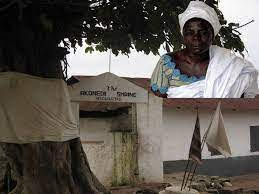
Goddess Akonadi


    Akonadi is the goddess of justice in West Africa. 


    • She is the Oracle, the teller of both visible and invisible facts. 
    • She utilizes her second sight to bring justice to all circumstances.
    • She is especially sympathetic to women's problems.


    Goddess Akonadi is a mythological figure in both African and Ghanaian mythology. 


    • As the goddess of justice, Akonadi or Akonedi, is revered and worshipped by the people of this region. 
    • She is also known as Akonandi, the goddess of prophesies in Ghana and West Africa.
    • She is particularly well-known in the Accra region, where she has a predictions temple and shrine dedicated to Her. 
    • She is revered for Her unique attribute of being both a goddess of justice and a woman's defender. 


    What is the Goddess Akonadi legend?


    Legend - Her function as a goddess of justice who protects mothers and children is shown by the following story: 


    Three brothers came to the Akonadi Shrine seeking counsel after their families experienced a series of fatalities. 

    Because their grandma was collaborating with a gang of criminals, I instructed them to go to their grandmother's home, where they would discover stolen items. 

    The boys returned to the home and discovered a metal box with valuables under their grandmother's bed. 

    They presented the goddess with the chest. 


    There will be no further fatalities if the stolen objects are no longer in their possession. 

    Soon later, two men approached the goddess and informed her that a chest containing treasures had been taken from their mother's land, and asked if she knew who the criminals were. 

    Her priestess replied that the box was at the shrine and that, although they were welcome to take it, they should leave it so that it may be used for charity for needy women and children. 

    The guys decided to leave the treasure box with the goddess to distribute to the poor, knowing how much agony it had caused. 


    Many Contemporary West Africans venerate her as a Ghanaian Oracular deity. 


    She has a well-known oracular shrine in Accra that is associated with this legend, practice and belief system.


    • Contemporary Western scholars have also discovered a relationship between the particular Goddess Akonadi spirit cult in the southern Ghanaian town of Akonedi and the African diaspora communities in the United States.
    • There have also been instances of cultural appropriation and a strong relationship between Afrocentric American devotees  of several Churches and the Ghanaian proprietors of the Akonedi shrine near Accra. 


    Scholars have also studied and observed how the Akonedi Shrine priests and priestesses participate in African traditional religion. 


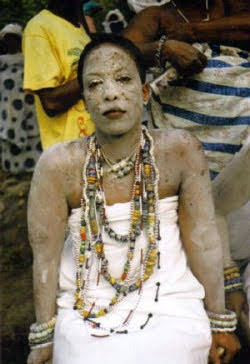
    • The main priestess of Goddess Akonadi presides over the shrine. 
    • She is possessed by the spirit of Goddess Akonedi, who died during childbirth. 
    • She attempts to assist and help individuals and worshippers through her powers derived from the spirit of Goddess Akonadi during the possession ritual. 


    References And Further Reading:


    • Fallon, Kathleen M. “Education and Perceptions of Social Status and Power among Women in Larteh, Ghana.” Africa Today 46, no. 2 (1999): 67–91. http://www.jstor.org/stable/4187268.


    Goddess Aja


      Aja is a West African woodland goddess. 


      • Her disciples learn herb knowledge from her, guaranteeing their bodily and spiritual well-being.


      Aja, Herbs, And Ritual Offerings


      When supernatural entities accept or reject ceremonial offerings, Osun and the Aje play a significant role. 


      When acknowledged, they strengthen and support herbal remedies; if not, they undermine their effectiveness and that of the ceremonial components. 

      Animals like ign (vultures) and aja (dogs), who eat the sacrificial sacrifices, are inspired by Aje. Consequently, they are revered by the babalawo and Eleerindınlogun. 

       Additionally, Chief Mrs. Elsoj made it clear that due to their close connection to and involvement with Osun, the Aje's leader, the Eleerindınlogun, herbs and roots are easily accessible to them as a result. 

      So, unlike diviners in other systems who must first pay particular devotion to the Aje in order for the elements to be effective, they are given the ability to employ ritual and herbal components at whim. 

      Before extracting herbs or roots for ritual preparation, they chant a number of praises to the Iyami and ask for their assistance. 

      The standing of Aje and Osun among them is agreed upon by every single one of my sources. 

      In the words of Ifa priest of Babalawo Oyegbad, this is summarized: 

      Aje, often referred to as Iyami, are strong as such that the cosmos has been entrusted to their protection by Olodumare. 

      They now have control and authority over its business thanks to him. The cosmos is firmly held together by them. They continue to keep the planet in order. 

      Osun is not only one of them; she is also their leader. In addition, Osun's function is essential in restoring harmony to any tense relationship. 

      Osun's standing among the spiritual beings explains why her influence over ritual procedures is crucial to the deity's plan for resolving disputes and crises. 

      The effectiveness of the ceremonial sacrifices suggested by diviners may be achieved by communication with all spiritual beings.

      Therefore, it is said that Osun, the head of the Aje, has the mystic ability to restrain or remove the violent acts of other deities as well as human potential and prosperity.


      Legends, Belief And Folklore Associated with Goddess Aja.


      Aja is an Orisha in Yoruba mythology, patron of the forest, its animals, and herbal healers, whom she taught their craft. 


      • Aja may also refer to a "wild wind" in Yoruba. 
      • If someone gets taken away by aja and later returns, it is said that he would become a strong "jujuman" (or babalawo). 
        • The voyage is said to last anywhere from 7 to 3 months, and the individual who is carried is said to have gone to the country of the dead or heaven (Orun)."  


      • She is a botanist who knows all there is to know about plants and is a master of potions and healing herbs. She taught this art to the Yoruba people, who continue to perform it now. 

      In Yoruba folklore and consequently in Santerian religious practice, Aja is a great healer. 


      • She is considered to be the spirit who taught all other healers how to do their jobs. 
      • She is a strong Orisha, and it is said that if she takes you away but lets you return after a few days, you will be bestowed with her magical abilities. 
      • A. B. Ellis said in Yoruba-Speaking Peoples of the Slave Coast of West Africa, published in 1894, that

        "Aja, whose name seems to mean "wild vine," whisks strangers away into the woods and educates them about the therapeutic powers of plants, but she never hurts them. 

      Aja is humanoid in appearance, although she is short, standing between one and two feet tall. 

      Women utilize the aja vine to treat enflamed breasts."  


      Aja is one of the most elusive Earth Gods and Goddesses since she chooses to show herself to humanity rather than hurt or fear them.


      Worshiping Aja is much rarer in the West, but it shouldn't matter since Aja symbolizes a global value of environmental care and preservation, regardless of religion or spiritual calling.

      Aja safeguards the woods, which are home to trees that provide oxygen and filter the air and water for all living creatures. 

      There would be more carbon dioxide in the atmosphere if trees were not safeguarding humans, and there would be no barrier to limit the speed of an already fast changing climate.


      Among the Nigerian Goddesses and Gods, Orisha is immensely popular. 


      Goddess Aja is the spirit of the forest and the animals that live there, as well as domestic healers. 

      Goddess Aja much like Goddess Diana of Europe  and Goddess Korravai of India is a woodland goddess, and also a goddess of animals.

      Goddess Aja always teaches us understanding empathy for the natural world, and a well-balanced empathy is the preventive strategy that prevents environmental degradation, destruction, and ecological anguish. 

      Thus Goddess Aja and Her true healing begins to unfold naturally and inevitably.


      Frequently Asked Questions:


      Who Is Goddess Aja?


      Aja is an Orisha, a spirit that inhabits the forest and its creatures, as well as herbal healers. She would search her woodlands for medical plants and combine the herbs, roots, and other plant components to develop treatments for the ill.


      Who is Africa's most powerful goddess?


      In Yoruba religion, Oshun is known as the river orisha, or goddess, and is linked with water, cleanliness, fertility, love, and sensuality. She is one of the most powerful orishas, yet she, like other gods, exhibits human characteristics including vanity, envy, and spite.


      What is the name of the African healer goddess?


      In Yoruba folklore and consequently in Santerian religious practice, Aja is a great healer. She is considered to be the spirit who taught all other healers how to do their jobs. She is a strong Orisha, and it is said that if she takes you away but lets you return after a few days, you will be bestowed with her magical abilities.


      What is the name of the African nature goddess?


      Asase Yaa is regarded as Mother Earth, the earth goddess of fertility, and the upholder of truth by the Akan people of West Africa.


      Which dark goddess is the most powerful?


      She's one of the most well-known and revered Orishas. Among the Yorùbá people, Oshun is a significant river god. Divinity, femininity, fertility, beauty, and love are all goddesses to her. She has a link to fate and divination.


      What are the seven African superpowers?


      Initiation into the Seven African Powers is another frequent initiation (Elegua, Obatala, Oggun, Chango, Yemaya, Oshun, and Orunmilla). Babalu-Aye is often substituted for Orunmilla by Cuban devotees. The Seven African Powers have been merged into a single eleke.


      What exactly are orisha?


      orisha, often written orixa or orisa, is a Yoruba deity who lives in southern Nigeria. The Edo of southern Nigeria, the Ewe of Ghana, Benin, and Togo, and the Fon of Benin all worship them (who refer to them as voduns).


      What is the maximum number of orishas you can have?


      According to Yoruba culture, there are 400 + 1 orisha, which is considered a holy number. According to some reports, the number is "as many as you can conceive of plus one more - an infinite number." Depending to the oral tradition, there are 400, 700, or 1,440 orisha.


      References And Further Reading:


      • Morton-Williams, Peter. “The Yoruba Ogboni Cult in [Uppercase Letter O with Vertical Line below]y[Lowercase Letter o with Vertical Line Below].” Africa: Journal of the International African Institute 30, no. 4 (1960): 362–74. https://doi.org/10.2307/1157598.
      • Dennett, R. E. “How the Yoruba Count (Continued).” Journal of the Royal African Society 17, no. 65 (1917): 60–71. http://www.jstor.org/stable/715685.

      • Drewal, Henry John, John Pemberton, and Rowland Abiodun. “Yoruba: Nine Centuries of African Art and Thought.” African Arts 23, no. 1 (1989): 68–104. https://doi.org/10.2307/3336802.
      • Yai, Ọlabiyi Babalọla. “In Praise of Metonymy: The Concepts of ‘Tradition’ and ‘Creativity’ in the Transmission of Yoruba Artistry over Time and Space.” Research in African Literatures 24, no. 4 (1993): 29–37. http://www.jstor.org/stable/3820251.
      • Matory, J. Lorand. “Rival Empires: Islam and the Religions of Spirit Possession among the Ọ̀yọ́-Yorùbá.” American Ethnologist 21, no. 3 (1994): 495–515. http://www.jstor.org/stable/645918.
      • Akínyemí, Akíntúndé. “Yorùbá Oral Literature: A Source of Indigenous Education for Children.” Journal of African Cultural Studies 16, no. 2 (2003): 161–79. http://www.jstor.org/stable/3559467.
      • Falen, Douglas J. “Vodún, Spiritual Insecurity, and Religious Importation in Benin.” Journal of Religion in Africa 46, no. 4 (2016): 453–83. http://www.jstor.org/stable/26358824.


      Goddess Erzulie


      Goddess of love from West Africa.

      Erzulie, a goddess of Africa, is currently mostly venerated in the Afro-Carribean Voudun tribes.

      She is a goddess of beauty, wealth, and the arts, particularly dancing.

      She is feared and adored for her immense strength, as well as her erratic mood swings.

      Followers of Erzulie believe that once you are in her good graces, you will never be in need again; but, if you offend her, your remaining days will be spent in her anger.

      Prostitutes and any sexual activity are patronized by Erzulie.

      She is usually summoned via ceremonial dancing or ritual baths with pricey oils and fragrances.


      Goddess Asase Yaa


      Asase Yaa is Africa's harvest goddess. 


      • Asase Yaa is known as "Old Woman Earth" by the Ashanti people of West Africa. 
      • Farmers call on her to bless their harvests in the fields. 
      • She is the ultimate harvest, assisting her children in reaping the benefits of the seeds they have sown throughout their lives. 
      • Asase Yaa is revered as humanity's mother, providing life for her offspring and reuniting them with them after death. 
      • She is the back bending, the sweat, the toil, and the final nourishing reward. 
      • Thursday is a holy day for her.

      Goddesses Of Water


      After earth, the symbol most commonly associated with goddesses is water, both as the fresh water of rivers and streams, and as the oceans salty waves. 

      The gendering of water as feminine is not invariable, however. 

      Some mythologies describe the oceans as masculine. 

      The Greeks had a sea god, Poseidon, while a similar figure among the Irish was Manannan mac Lir. 

      In both cases, the ocean was defined as masculine, as dis tinguished from fresh water, which was feminine. 

      Among the Greeks, who despite see ing the ocean as masculine pictured its waves as the innumerable feminine Oceanids, we find the freshwater Nymphs called the Nereids. 

      The Irish knew many river god desses such as Sınann, Berba, and Boand, while outside Ireland we find dozens of Celtic water goddesses including Abnoba, Aveta, Coventina, Natosuelta, and Sabrina. 

      This salt and fresh water distinction, however, is not universal. 

      Some goddesses were described as ruling the oceans, including the Scandinavian Ran who ruled the northern sea, and Chermiss Bu¨t aba and Finnic Mere-Ama (see Finno-Ugric), whose domains were similarly in the arctic waters. 

      Hebrew Miriam (see Eastern Mediterra nean) was connected with the ‘‘bitter waters or the salty seas, although a freshwater stream created by her brother Moses also bore her name. 

      The connection between the oceans salt water and female fertility is emphasized in the Hindu myth of Prakrti (see India), whose amniotic fluid became the oceans after she gave birth to the gods. 

      In many cultures, an ocean goddess controls the fish and mammals that live in her waters and on which humans depend for food. 

      An important example of such a figure is Inuit Sedna (see Circumpolar) who, thrown into the water as a sacrifice, thereafter receives sacrifices herself as the ‘‘great food-dish. 

      Finnish Vellamo (see Finno Ugric), too, is an ocean goddess who determines how many fish humans can take from her waters, taking advice from her many daughters, the waves of the sea. 

      Similarly, the South American sea-mother Mama Cocha brings fish and sea-mammals close to peo ple so that they can be harvested for food. 

      Fishermen often fall under the rulership of ocean goddesses, who like Ma-tsu (see China) protects them when they are faring on the waves. 

      In some cases, the oceanic goddess is depicted as a primordial mother or creatrix, one from whose depths life was born, as with Babylonian Tiaˆmat (see Eastern Mediterranean). 

      Finno-Ugric Luonotar, while not the ocean itself, is intimately con nected with it, having spent much of eternity floating on cosmic waters. 

      The sky woman of the American Iroquois, Ataensic, floated on the oceans waters until earth was created (see North America). 

      Wherever the waters of the Wintu goddess Mem Loimis fell, the earth grew fertile, while areas not endowed with her watery gift were left as desert (see North America). 

      Ocean goddesses could be charming and delightful. 

      Lithuanian Amberella tossed pieces of amber to the shore, to reward those who honored her, and Greek Aphrodite was ravishingly beautiful even when fickle. 

      But they could also be dangerous. 

      Mer maids and sirens, which appear in many mythologies as ocean-dwelling women of great beauty, are threatening water divinities who lure sailors to their death. 

      Such fig ures guarded the boundaries between water and land, like Siberian Sug Eezi (see Circumpolar) who like other mermaids had long hair that mimicked the rippling streams that she inhabited. 

      Celtic Korrigans danced each night, drawing victims to themselves and drowning them. 

      Greek Aphrodite was born of the oceans waves and, although beautiful, could also be pitiless, for love is never without possible threat of loss. 

      In China, the primary goddess Xiwang Mu controlled the worlds waters and was invoked when floods threatened, showing that the activities of such cosmic god desses could be damaging to humanity were she not ritually appeased. 

      Thus ocean goddesses represent both creative possibility and danger. 

      Goddesses associated with fresh water are powers of fertility. 

      Such watershed god desses can be seen as divinities of the land as well as the rivers that drain it. 

      In India, many rivers are imagined as goddesses of earthly abundance, none more so than the Ganges, whose powerful river drains much of the subcontinent and is seen as the actual body of the goddess Gan ga. 

      In Egypt, where the annual inundation of the land by the river Nile was typically associated with the god Osiris, we find the water goddess Anu ket representing the connection between water and the lands increased fertility. 

      In Africa, major rivers were goddesses (Yemaja, Oshun, O ya) who were sometimes in conflict with each other over their shared consort. 

      Such river goddesses were typically maternal forces, providing their human children with sustenance. 

      A similar goddess in Russia, Mokosh (see Slavic), was a motherly figure whose presence was most actively felt in budding springtime. 

      Smaller water sources such as springs and creeks could be seen as threatening rather than helpful. 

      In Slavic lands, supernatural women, once human, haunted quick-flowing streams. 

      Deprived by early death of a chance to have children, the Rusalki drowned sweet babies or fertile young people. 

      The Scandinavian Nixies were similarly danger ous. 

      In tribal India, the Nippong especially targeted young pregnant women, whom they caused to miscarry. 

      Such spirits were often most active in spring and may re present the possibility of flash floods. 

      Tribal Indian Bai Tanki, another destructive river goddess, spreads disease through her water—a mythic narrative with a firm basis in science, for polluted water can indeed spread disease. 

      Fountains and bedrock springs were often seen as locations of inspiration because of the goddesses who inhabited them. 

      The Greek Musae are still known as an image of the force that causes artists to create. 

      In India, the river goddess Sarasvatı was the source of inspiration as well as a cosmic creatrix. 

      Such inspiration could be legal and organizational as well as artistic. 

      Among the Roman water nymphs called the Camenae was Egeria, who oracularly dictated the first laws of Rome and whose name is still used to describe a wise woman advisor. 

      Freshwater goddesses, endowed with the gift of seeing the future, could help those who wished to practice the oracular arts. 

      Babylonian Nanshe (see Eastern Mediterra nean) was a fortune-tellers goddess celebrated at waterborne festivals. 

      Prophecy was not always seen as a gift; the Greek water Nymph Telphusa killed anyone who drank her prophetic waters. 

      Yet most often, prophecy was a positive act, connected with heal ing because the ill and infirm turn to oracles in hopes of receiving predictions of pos itive change. 

      So common was the connection between springs and healing among the Celts that the names of many of their goddesses have been lost, for they were renamed ‘‘Minerva Medici after the Roman goddess of healing, during Imperial occupation. 

      Healing was a common part of the domain of the freshwater goddess, a tradition that continues today with the prayerful use of water from the well at Lourdes, France, dedicated to the virgin Mary (see Eastern Mediterranean). 

      In Africa, we find the lake goddess Idemili and the water spirit Mammywata, both of whom offered healing to their worshipers. 

      The Hindu goddess Narmada (see India) was especially powerful against snakebite, while the healing offered by Gan ga extended beyond this life, for those who died in her waters were freed from the cycle of rebirth. 

      Some important goddesses controlled all water, whether found in rivers or in oceans. 

      Anahita, one of the most important Persian divinities (see Eastern Mediterra nean), ruled everything fluid in the universe, even those of the human body. 

      Similarly, among the Lithuanians (see Baltic), the water mother Jurat˙e controlled all the earths waters. 

      Aztec Chalchihuitlicue (see Mesoamerican) could be found in lakes, rivers, and the ocean. 

      Finally, some goddesses could be described as divinities of what science calls the water cycle, for they ruled the rain that falls on the land, the bodies of water (above ground and underground) that gather the rain and return it to the ocean, and the ocean where clouds are born to return water to the land. 

      Such goddesses connect air and water like the African sky woman Andriana who descended to earth to become a water goddess. 

      Rainbows, those bridges between sky and earth formed by water vapor, often symbolize such goddesses. 

      In Australia, the primal serpent Julunggul ruled ocean, rivers (especially waterfalls), and rain; she was embodied in the rainbow. 

      A similar rainbow-water-snake spirit found in Haiti was Aida Wedo (see African Diaspora). 

      ~ Kiran Atma

      You can learn more about Goddess Symbolism here.


      Goddesses Of Fish And Insects


      Those who live by fishing often honor a goddess who controls the sea life, such as the important Eskimo goddess Sedna (see Circumpolar), Celtic Nehalennia, or Finno-Ugric Avfruvva. 

      In South America, Mama Cocha was the ‘‘mother of whales because she brought the massive mammals close to hunters. 

      Polynesian Lorop (see Pacific Islands) lived under the earth, sending up food for her children in the form of fish. 

      In other cases, the goddess was seen not as controlling the sea creatures but as one of them, as with Celtic Lı Ban, transformed into a salmon, and Eastern Mediterranean Atargatis, who swam in the pool of her temple as a trout. 

      In India, the group of spirits called the D akinıs took on fish shapes to attend upon the goddess of death, Kalı. 

      In Africa, the heroine Chichinguane joined the fish people because her human kin were unkind to her. 

      Among insects, the industrious bee and the crafty spider are common goddess images. 

      Bees, whose hives are centered on a queen and whose female workers produce honey, appear as companions of goddesses associated with social life. 

      Lithuanian Aus t ˙eja was celebrated in an annual holiday dedicated to bees. 

      Artemis of Ephesus, goddess of the warrior Amazons (see Greece), was depicted surrounded by bees; her priestesses were called Melissae, also a name used of bee Nymphs. 

      Irish Gobnait (see Celtic) lived among bees that warned her of approaching danger. 

      Spiders, with their ability to weave intricately architectural webs from their own bodies, appear as creatrix figures in several cultures. 

      Hopi Kokyangwuti created human beings; Cherokee Kanene Ski Amai Yehi brought the sun to earth. 

      Greek Athena was connected to spiders because she made the first one from an insultingly competitive human girl, Arachne. 

      Finally, both butterflies (see Psyche, see Greece; Ix Chel, see Mesoamerica) and scorpions (South American Ituana, Egyptian Selkhet) appear as goddess images. 

      ~ Kiran Atma

      You can learn more about Goddess Symbolism here.


      Goddess Mboze


      Mboze: The goddess of agriculture in Central Africa.

      Mboze, the mother of Bunzi, is the force of rain, harvests, and agriculture.

      In the Democratic Republic of the Congo and Angola, she is revered as the mother of the Woyo people.


      ~Kiran Atma


      Goddesses Of The Sky


      The earths blue atmosphere rarely appears in mythology as divine, although the sky as an image of the upper world or heavens is found in many cultures, especially those that posit a multistory universe inhabited by different beings at different levels. 

      Although often gendered as masculine, the heavens also appear in female form, as with the Roman goddess Diana, originally a goddess of the open sky who was later limited to the moon, and Maori Mahora-nui-a-rangi (see Pacific Islands), a heavenly creatrix. 

      Such sky divinities can be connected with boundlessness (Indian Adıtı), because the sky seems to have no beginning nor ending. 

      Occasionally such goddesses represented the entire cosmos, earth and sky together (Eastern Mediterranean Tanit). 

      Because of the vastness of the sky, it was sometimes depicted as dual-sexed, as with African So (see Mawu), who was considered a goddess despite having a masculine aspect. 

      Although sky goddesses often have little personality and seem remote from human affections, the Egyptian sky goddess Nut was the mother to whom the dead returned and, as such, was painted across the inside lid of coffins, stretching out her starry body. 

      She was also a lusty goddess who had to be forcibly separated from her lover, the earth god. 

      The need to separate earth and sky, who remain otherwise in unending inter course, is a common mythic tale, although most of the sky divinities are male, the earth female. 

      The skys light, especially at dawn, was often pictured as a voluptuous and promis cuous goddess (Roman Aurora, Greek Eos, Indian Usas). 

      The lustful goddess is more typically pictured as the morning and evening star. 

      However, the goddess as a creator of light, and as light itself, is found in many cultures. 

      Some earth goddesses and divine ancestors appear as women who originally lived in the sky but descended to the earths surface, often because of love for an earthly man. 

      Thus African Nambi fled her sky home, bringing the food that humanity needed to survive down with her. 

      Andriambavirano of Madagascar (see Africa, Andriana) similarly became enamored of a human male, but her original descent was motivated by boredom and curiosity about the earth. 

      Finally, some figures are described as living in the sky but are not otherwise specifically associated with the heavens (see African Mbokomu and Nambi; Chinese Tai-hsu¨an Nu¨; Circumpolar Kadlu.) 


      ~ Kiran Atma

      You can learn more about Goddess Symbolism here.


      Goddess Aida Wedo


      Aida Wedo is the goddess of rainbows in West Africa. 


      • Aida Wedo is a Yoruban and Voudoun goddess who takes the form of a rainbow python, a snake with iridescent scales. 
      • Her rainbow body encircles the world and the oceans, making her a cosmic guardian and the connection between heaven and earth. 
      • Water, wind, fire, rainbows, and serpents are all under her control. 
      • She is a benign deity who teaches her devotees honesty, strength, and mind-body-spirit unification. 
      • Her hue is white, since it is the manifestation of all colors, and her worshippers have traditionally given her rice, eggs, and milk.

      Goddess Nana Buluku


      Nana Buluku: The goddess of manufacturing in West Africa.

      Nana Buluku is revered by the Fon as the primordial creation goddess and gods' grandmother.

      She is also regarded as the first Yoruba woman, having been given life into clay by the Great Gods.

      She is shown with a basket full of bark and roots, ruling plants, spellcraft, and magick.

      She considers mandrake root to be holy.


      ~Kiran Atma

      Goddess Mamlambo


      Mamlambo: African river goddess.

      In the Zulu religion of Africa, Mamlambo is the goddess of flowing streams.

      She is represented as a giant crocodile-like monster that adores thunderstorms and drowns the unwary.

      If Mamlambo is apprehended, she is claimed to provide her captors enormous prosperity and plenty.


      ~Kiran Atma