Showing posts sorted by date for query romance. Sort by relevance Show all posts

Goddess Chasca


    Chasca is the goddess of light in Peruvian mythology. 

    Chasca was revered by the Peruvian Inca as the morning and setting sun. 


    She protects virgins and young girls as the goddess of dawn and twilight. 

    She is regarded as the sun's servant, and it is via her light that flowers and plants may grow and flourish.


    Latest Release - The Hindu Pantheon Series by Kiran Atma

    Chasca, The Long-Haired Star.


    Chasca or Ch'aska, also known as "The Long-Haired Star," was a goddess of Venus and the planets of the dawn and dusk. 


    She is the young girls' and virgins' protector

    She is connected to rebirth and spring. 

    Chasca is a central figure in the Incan pantheon

    The Incans present her with floral offerings. 

    The planet Venus is ascribed to her. 

    The emblems for Goddess Chasca are the Sun, the Fire, and the Flora. 


    She is in charge of the early morning and late afternoon hours of the day. 

    The motifs of Chasca include the sun, fire, love, and divination. 

    The sun, fire, and flowers are some of her emblems. 

    The dawn and twilight, the most serene features of Nature, were created by this Goddess, according to Incan mythology. 


    The Incan goddess of dawn.


    The Incas revered Chasca as a lovely goddess who was connected to dawn and dusk. 


    She is symbolized by flowers, fire, and the sun. 

    Because of their strong collaboration with Inti, the sun deity, Chasca or Ch'aska is also connected to love. 

    Together, they made it possible for Chasca to extract sprouts from the ground and aid in the growth and blooming of flowers. 

    The Incas of antiquity thought she would speak to them via the weather, particularly the clouds. 


    Chasca was said to aid in regeneration and change. 


    The Incans would honor the beauty that Inti and Chasca had produced at the Peruvian Incan Festival of the Sun. 


    They would rejoice in the sun's radiance and the flowering of plants and flowers. 

    Giving gifts to the goddess Chasca and dancing the night away in front of a fire pit were both customary during the celebration. 

    In order to banish ill luck and bring about change for the future, it was also believed that the people would burn old objects in the fire, such as clothes. 


    Goddess Chasca Invocation.


    The goddess Chasca was invoked by the Incans to help transform negative energy into good energy. 


    Just glance to the heavens to invoke Chasca. 

    Look up at the sky and ask her a question. 

    You could come upon the precise solution you need! Goddess of the dawn and twilight, she is shown as a lovely young woman with waves in her hair. 


    Chasca is the Sun God Inti's servant and is connected to Venus. 


    She guards the young maidens as well. 

    She is, in other words, Venus. 


    In addition, she is a pretty young woman and the guardian of virgins, much like the Roman Venus. 

    We speculate that she prefers an especially vivid hue of pink as Chasca was revered as the goddess of dawn and twilight by the Inca people of Peru. 


    She was revered as the serene facets of the sun at dawn and dusk. 


    She is referred to as the lovely girl with waves, and as the sun's servant, it is because of her light that flowers and vegetation may develop and flourish. 


    She was credited for controlling the weather and guarding virgins and young girls in "incan" mythology. 

    Her other name, "the long-haired star (venus)," refers to the connection between "chasca" and the planet "venus". 

    According to folklore, she interacts with her people via the clouds and, as the mistress of the dawn, the dew she throws onto the earth. 

    She was the creator of the flowers, using her light to inspire blossoming and pull sprouts from the ground. 

    She has no totem animals; instead, she is married to the sun deity "Inti."


    ~Kiran Atma


    References And Further Reading


    • Littleton, C.S. ed., 2005. Gods, goddesses, and mythology (Vol. 1). Marshall Cavendish.
    • Farrar, J. and Farrar, S., 2012. The witches' goddess. David & Charles.
    • Lurker, M., 2015. A Dictionary of Gods and Goddesses, Devils and Demons. Routledge.
    • Auset, P.B., 2009. The goddess guide: Exploring the attributes and correspondences of the divine feminine. Llewellyn Worldwide.
    • Reddy, F., 2012. Morning Stars, Evening Stars: Venus and Mercury. In Celestial Delights (pp. 51-93). Springer, New York, NY.
    • Deeds, E., 2008. DE LAS COSTUMBRES ANTIGUAS DE LOS NATURALES DEL PIRU. Guide to Documentary Sources for Andean Studies, 1530-1900, 2, p.170.
    • Franklin, A., 2002. Midsummer: Magical Celebrations of the Summer Solstice (Vol. 7). Llewellyn Worldwide.
    • McElroy, D.R., 2020. Superstitions: A Handbook of Folklore, Myths, and Legends from Around the World. Wellfleet Press.
    • Hall, L.B., 2021. Chapter Six The Andean Virgin. In Mary, Mother and Warrior (pp. 137-168). University of Texas Press.
    • Siemens, W.L., 1975. Heilsgeschichte and the Structure of Tres tristes tigres. Kentucky Romance Quarterly, 22(1), pp.77-90.
    • Stahl, F.A., 1920. In the Land of the Incas. Pacific Press Publishing Association.


    Goddess Benten Or Banzaiten


      Japanese goddess of love, Benten, sometimes known as Benzaiten. 


      Benten is the ruler of love, music, and the arts, and is shown as a lovely lady with eight limbs riding a dragon. 


      Benzaiten (shinjitai: or; kyjitai:, or, lit. "goddess of eloquence"), also known as Benten (shinjitai:; kyjitai: /), is widely worshipped as a Japanese Buddhist goddess descended mostly from Saraswati, the Hindu goddess of speech, the arts, and learning, with some qualities derived from Durga, the warrior goddess


      Benzaiten is the only female of the seven fortunate gods, and she is as much a Buddhist as she is a Shinto deity. 


      Actors, airline hostesses, artists, beauticians, composers, dancers, designers, directors, dramatists, entertainers, gamblers, models, musicians, painters, photographers, sculptors, sword makers, and writers are among the jobs Chiba associated with her. 

      Author Brian Bocking compares Benzaiten to Ichikishima-hime-no-mikoto, the principal deity of the Enoshima Jinja's three major temples. 


      Benzaiten is named after the Hindu goddess Sarasvati, and it is derived from Chinese translations of Buddhist sutras

      Sarasvati is the Hindu Goddess of wisdom, music, and the arts, and she is claimed to have been the wife of Brahma and Vishnu, who along with Siva make up Hinduism's sacred trinity. 


      Sarasvati is first mentioned in the Rig Veda, one of Hinduism's four holy books, which was compiled between 1500 and 1000 BC. 


      This phrase from Hymn 41 is arguably the most appropriate in the Benzaiten context:

      Sarasvat, greatest Mother, best of Rivers, best of Goddesses We have no notoriety, as it were, and dear Mother, grant us renown.

      All generations have a home in thee, Sarasvat, heavenly.

      Benzaiten Jinja in Japan are virtually all located near the sea, rivers, or lakes, or have their own in-ground lakes. 


      The next sentence from Hymn 61 makes a more dubious allusion to Banzaiten:

      Yes, this exquisite Sarasvat, with her golden road, is dreadful.

      Our eulogy refers to you as a foe-slayer.


      Sarasvati's "foe-slayer" might be understood as a reference to Sarasvati's killing of Vritra, the Hindu mythology's three-headed serpent/snake. 

      However, there is no further mention of this, and the conventional story puts Indra as Vritra's killer. 

      The three-headed serpent/snake transforms into a white snake in the Benzaiten mythology, which acts as her messenger. 

      The Kami-shinmei-tenso Jinja is a nice example of this.


      The Most Important Shrines Dedicated To Goddess Banzaiten


      Enoshima Jinja     江島神社        

      Kanagawa-ken, Fujisawa-shi, Enoshima 2-3-8    

      神奈川県藤沢市江の島2-3-8         


      Zeniarai Benzaiten Ugafuku jinja   銭洗弁財天宇賀福神社   

      Kanagawa-ken, Kamakura-shi, Sasuke 2-25-16

      神奈川県鎌倉市佐助2-25-16                


      Kiyomizu Benzaiten Sha     清水弁財天社

      Nagano-ken, Saku-shi, Iwamurada

      長野県佐久市岩村田


      Tenkawa DaiBenzaiten Sha     天河大辯財天社

      Nara-ken,  Yoshino-gun, Tenkawa-mura Tsubo-no-uchi 107

      奈良県吉野郡天川村坪内107


      The Enoshima Island in Sagami Bay, the Chikubu Island in Lake Biwa, and the Itsukushima Island in the Seto Inland Sea (Japan's Three Great Benzaiten Shrines) are all shrines dedicated to Benzaiten, and she and a five-headed dragon are the central figures of the Enoshima Engi, a history of the shrines on Enoshima written by the Japanese Buddhist monk K According to Kkei, Benzaiten is the third daughter of Munetsuchi's dragon-king, who is known in Sanskrit as Anavatapta, the lake that is at the heart of the globe according to an old Buddhist cosmological theory.

      Shrine pavilions called benten-d or benten-sha, or even whole Shinto temples, such as Kamakura's Zeniarai Benzaiten Ugafuku Shrine or Nagoya's Kawahara Shrine, might be devoted to her.


      Sarasvati to Benzaiten, from India to Japan


      Sarasvati occurs in two sutras translated into Chinese: the Sutra of Golden Light (, Konkmy-ky) and the Lotus Sutra (, Myh-rengei-ky). 


      The former devotes a whole chapter (8) to her and is essentially a lengthy, drawn-out eulogy. 

      Her presence in the Lotus Sutra is referenced in almost every Benzaiten-related publication on the Internet, but I have been unable to locate it. 

      It's unknown when she initially emerged in Japan, although it was probably definitely during the 6th and 8th centuries AD. 

      Much of the Sutra of Golden Light, perhaps reflecting China's Confucian history, emphasizes the necessity for a knowledgeable ruler, and it was this component, defender of the state and people, with which Benzaiten was linked when she first arrived in Japan. 


      Originally, her name was spelled as  辯才天


      The first of these three characters denotes eloquence in speaking, and the second, gift. 


      Her name started to be recorded as she grew more naturalized, finally becoming one of the Seven Lucky Gods,  弁財天

      The first character of this name,, is a simplified version of and so signifies no meaningful difference, but the second character,, is completely distinct from and indicates wealth or riches, which is an admirably appropriate characteristic for a deity of luck. 

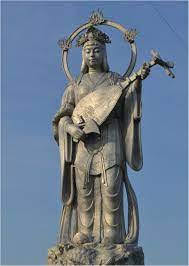
      Benzaiten is usually typically shown playing a biwa, which is a short-necked lute, and Lake Biwa, Japan's biggest freshwater lake, is one of her shrines. 


      Benzaiten was worshipped in Japan from the sixth to the ninth century, mostly via Classical Chinese translations of the Golden Light Sutra (Sanskrit: Suvaraprabhsa Stra), which has a portion dedicated to her. 


      Benzaiten became associated or even conflated with a number of Buddhist and local deities from the medieval period onwards, 

      1. including the goddess Kisshten (the Buddhist version of the Hindu Lakshmi, whose role as goddess of fortune was eventually ascribed to Benzaiten in popular belief), 
      2. the snake god Ugajin (the combined form of the two being known as 'Uga Benzaiten'), 
      3. and the kami Ichikishimahime. 

      She was also associated with nagas, dragons, and snakes because to her role as a water goddess. 


      She was later adored as a bestower of monetary prosperity and was included as one of the Seven Lucky Gods, in addition to being a patron of music and the arts (Shichifukujin).


      In Japanese art, Goddess Benzaiten is portrayed in a variety of ways. 


      She is often represented brandishing a sword and a wish-granting diamond (cintmai), similar to how Saraswati is pictured in Indian art with a veena. 

      Meanwhile, Durga's iconography is said to have inspired an iconographic formula depicting Benzaiten with eight arms wielding various weapons (based on the Golden Light Sutra). 

      Ugajin (a human-headed white snake) may also be seen above her head as Uga Benzaiten. 

      Finally, she is sometimes shown with the head of a serpent or a dragon.


      Benzaiten is a Shinto female kami with the name Ichikishima-hime-no-mikoto. 


      Tendai Buddhists believe she is the essence of the kami Ugajin, whose effigy she sometimes wears on her head with a torii. 

      As a result, she is often referred to as Uga Benzaiten or Uga Benten.

      Su, (typically read in Japanese as so) is the bja or seed syllable used to express Benzaiten in Japanese esoteric Buddhism, written in Siddha script. 


      Benzaiten's Mantras:


      Sanskrit: Oṃ Sarasvatyai svāhā

      Japanese: On Sorasobateiei sowaka

      Hiragana: おん そらそばていえい そわか[25]

      ~Kiran Atma


      References And Further Reading:


      1.  Ludvik, Catherine (2007). Sarasvatī: Riverine Goddess of Knowledge. From the Manuscript-carrying Vīṇā-player to the Weapon-wielding Defender of the Dharma. Brill. pp. 1–3.
      2. Kinsley, David (1998). Hindu Goddesses: Visions of the Divine Feminine in the Hindu Religious Tradition. Motilal Banarsidass Publishers. pp. 10–13.
      3. Ludvik (2007). pp. 35-39.
      4. Faure, Bernard (2015). Protectors and Predators: Gods of Medieval Japan, Volume 2. University of Hawaii Press. p. 164.
      5. Faure (2015). pp. 164-165.
      6. Ludvik (2007). p. 48.
      7. Griffith, Ralph T.H. (trans.). "Rig Veda, Book 6: Hymn LXI. Sarasvatī"Sacred Texts. Retrieved 2022-05-21.
      8. Griffith, Ralph T.H. (trans.). "Rig Veda, Book 10: Hymn CXXV. Vāk"Sacred Texts. Retrieved 2022-05-21.
      9. "金光明最勝王經 第7卷"CBETA Chinese Electronic Tripiṭaka Collection (漢文大藏經). Retrieved 2022-05-21.
      10. Faure (2015). pp. 165-166.
      11. Ludvik, Catherine (2004). "A Harivaṃśa Hymn in Yijing's Chinese Translation of the Sutra of Golden Light"Journal of the American Oriental Society124 (4): 707–734.
      12. "AryAstavaH - hymn to Arya"Mahabharata Resources Page. Retrieved 2022-05-21.
      13. Ludvik (2007). pp. 265-267.
      14. Faure (2015). pp. 168-169.
      15. "大毘盧遮那成佛神變加持經"CBETA Chinese Electronic Tripiṭaka Collection (漢文大藏經). Retrieved 2022-05-21.
      16. The Vairocanābhisaṃbodhi Sūtra(PDF). BDK English Tripiṭaka Series. Translated by Rolf W. Giebel. Bukkyō Dendō Kyōkai; Numata Center for Buddhist Translation and Research. 2005. pp. 33, 141.
      17. Faure (2015). p. 166.
      18. "大毘盧遮那成佛神變加持經 第1卷"CBETA Chinese Electronic Tripiṭaka Collection (漢文大藏經). Retrieved 2022-05-21.
      19. "大毘盧遮那成佛神變加持經 第2卷"CBETA Chinese Electronic Tripiṭaka Collection (漢文大藏經). Retrieved 2022-05-21.
      20. Pye, Michael (2013). Strategies in the study of religions. Volume two, Exploring religions in motion. Boston: De Gruyter. p. 279. ISBN 9781614511915OCLC 852251932.
      21. "大毘盧遮那成佛神變加持經 第4卷"CBETA Chinese Electronic Tripiṭaka Collection (漢文大藏經). Retrieved 2022-05-21.
      22.  Bocking, Brian (1997). A Popular Dictionary of Shinto - 'Benzaiten'. Routledge. ISBN 978-0-7007-1051-5.
      23.  Itō, Satoshi: "Ugajin"Encyclopedia of ShintoKokugakuin University, retrieved on August 15, 2011
      24.  Ludvik, Catherine. “Uga-Benzaiten: The Goddess and the Snake.” Impressions, no. 33, 2012, pp. 94–109. JSTOR,  www.jstor.org/stable/42597966.
      25. "弁財天 (Benzaiten)"Flying Deity Tobifudō (Ryūkō-zan Shōbō-in Official Website). Retrieved 2022-05-22.
      26. Faure, Bernard (2015). Protectors and Predators: Gods of Medieval Japan, Volume 2. University of Hawaii Press. ISBN 978-0824857721.
      27. Kinsley, David (1998). Hindu Goddesses: Visions of the Divine Feminine in the Hindu Religious Tradition. Motilal Banarsidass Publishers. ISBN 978-8-1208-0394-7.
      28. Ludvik, Catherine (2004). "A Harivaṃśa Hymn in Yijing's Chinese Translation of the Sutra of Golden Light"Journal of the American Oriental Society124 (4): 707–734.
      29. Ludvik, Catherine (2007). Sarasvatī: Riverine Goddess of Knowledge. From the Manuscript-carrying Vīṇā-player to the Weapon-wielding Defender of the Dharma. Brill. ISBN 978-9-0474-2036-1.