Showing posts sorted by relevance for query sea. Sort by date Show all posts

Goddesses Of Water


After earth, the symbol most commonly associated with goddesses is water, both as the fresh water of rivers and streams, and as the oceans salty waves. 

The gendering of water as feminine is not invariable, however. 

Some mythologies describe the oceans as masculine. 

The Greeks had a sea god, Poseidon, while a similar figure among the Irish was Manannan mac Lir. 

In both cases, the ocean was defined as masculine, as dis tinguished from fresh water, which was feminine. 

Among the Greeks, who despite see ing the ocean as masculine pictured its waves as the innumerable feminine Oceanids, we find the freshwater Nymphs called the Nereids. 

The Irish knew many river god desses such as Sınann, Berba, and Boand, while outside Ireland we find dozens of Celtic water goddesses including Abnoba, Aveta, Coventina, Natosuelta, and Sabrina. 

This salt and fresh water distinction, however, is not universal. 

Some goddesses were described as ruling the oceans, including the Scandinavian Ran who ruled the northern sea, and Chermiss Bu¨t aba and Finnic Mere-Ama (see Finno-Ugric), whose domains were similarly in the arctic waters. 

Hebrew Miriam (see Eastern Mediterra nean) was connected with the ‘‘bitter waters or the salty seas, although a freshwater stream created by her brother Moses also bore her name. 

The connection between the oceans salt water and female fertility is emphasized in the Hindu myth of Prakrti (see India), whose amniotic fluid became the oceans after she gave birth to the gods. 

In many cultures, an ocean goddess controls the fish and mammals that live in her waters and on which humans depend for food. 

An important example of such a figure is Inuit Sedna (see Circumpolar) who, thrown into the water as a sacrifice, thereafter receives sacrifices herself as the ‘‘great food-dish. 

Finnish Vellamo (see Finno Ugric), too, is an ocean goddess who determines how many fish humans can take from her waters, taking advice from her many daughters, the waves of the sea. 

Similarly, the South American sea-mother Mama Cocha brings fish and sea-mammals close to peo ple so that they can be harvested for food. 

Fishermen often fall under the rulership of ocean goddesses, who like Ma-tsu (see China) protects them when they are faring on the waves. 

In some cases, the oceanic goddess is depicted as a primordial mother or creatrix, one from whose depths life was born, as with Babylonian Tiaˆmat (see Eastern Mediterranean). 

Finno-Ugric Luonotar, while not the ocean itself, is intimately con nected with it, having spent much of eternity floating on cosmic waters. 

The sky woman of the American Iroquois, Ataensic, floated on the oceans waters until earth was created (see North America). 

Wherever the waters of the Wintu goddess Mem Loimis fell, the earth grew fertile, while areas not endowed with her watery gift were left as desert (see North America). 

Ocean goddesses could be charming and delightful. 

Lithuanian Amberella tossed pieces of amber to the shore, to reward those who honored her, and Greek Aphrodite was ravishingly beautiful even when fickle. 

But they could also be dangerous. 

Mer maids and sirens, which appear in many mythologies as ocean-dwelling women of great beauty, are threatening water divinities who lure sailors to their death. 

Such fig ures guarded the boundaries between water and land, like Siberian Sug Eezi (see Circumpolar) who like other mermaids had long hair that mimicked the rippling streams that she inhabited. 

Celtic Korrigans danced each night, drawing victims to themselves and drowning them. 

Greek Aphrodite was born of the oceans waves and, although beautiful, could also be pitiless, for love is never without possible threat of loss. 

In China, the primary goddess Xiwang Mu controlled the worlds waters and was invoked when floods threatened, showing that the activities of such cosmic god desses could be damaging to humanity were she not ritually appeased. 

Thus ocean goddesses represent both creative possibility and danger. 

Goddesses associated with fresh water are powers of fertility. 

Such watershed god desses can be seen as divinities of the land as well as the rivers that drain it. 

In India, many rivers are imagined as goddesses of earthly abundance, none more so than the Ganges, whose powerful river drains much of the subcontinent and is seen as the actual body of the goddess Gan ga. 

In Egypt, where the annual inundation of the land by the river Nile was typically associated with the god Osiris, we find the water goddess Anu ket representing the connection between water and the lands increased fertility. 

In Africa, major rivers were goddesses (Yemaja, Oshun, O ya) who were sometimes in conflict with each other over their shared consort. 

Such river goddesses were typically maternal forces, providing their human children with sustenance. 

A similar goddess in Russia, Mokosh (see Slavic), was a motherly figure whose presence was most actively felt in budding springtime. 

Smaller water sources such as springs and creeks could be seen as threatening rather than helpful. 

In Slavic lands, supernatural women, once human, haunted quick-flowing streams. 

Deprived by early death of a chance to have children, the Rusalki drowned sweet babies or fertile young people. 

The Scandinavian Nixies were similarly danger ous. 

In tribal India, the Nippong especially targeted young pregnant women, whom they caused to miscarry. 

Such spirits were often most active in spring and may re present the possibility of flash floods. 

Tribal Indian Bai Tanki, another destructive river goddess, spreads disease through her water—a mythic narrative with a firm basis in science, for polluted water can indeed spread disease. 

Fountains and bedrock springs were often seen as locations of inspiration because of the goddesses who inhabited them. 

The Greek Musae are still known as an image of the force that causes artists to create. 

In India, the river goddess Sarasvatı was the source of inspiration as well as a cosmic creatrix. 

Such inspiration could be legal and organizational as well as artistic. 

Among the Roman water nymphs called the Camenae was Egeria, who oracularly dictated the first laws of Rome and whose name is still used to describe a wise woman advisor. 

Freshwater goddesses, endowed with the gift of seeing the future, could help those who wished to practice the oracular arts. 

Babylonian Nanshe (see Eastern Mediterra nean) was a fortune-tellers goddess celebrated at waterborne festivals. 

Prophecy was not always seen as a gift; the Greek water Nymph Telphusa killed anyone who drank her prophetic waters. 

Yet most often, prophecy was a positive act, connected with heal ing because the ill and infirm turn to oracles in hopes of receiving predictions of pos itive change. 

So common was the connection between springs and healing among the Celts that the names of many of their goddesses have been lost, for they were renamed ‘‘Minerva Medici after the Roman goddess of healing, during Imperial occupation. 

Healing was a common part of the domain of the freshwater goddess, a tradition that continues today with the prayerful use of water from the well at Lourdes, France, dedicated to the virgin Mary (see Eastern Mediterranean). 

In Africa, we find the lake goddess Idemili and the water spirit Mammywata, both of whom offered healing to their worshipers. 

The Hindu goddess Narmada (see India) was especially powerful against snakebite, while the healing offered by Gan ga extended beyond this life, for those who died in her waters were freed from the cycle of rebirth. 

Some important goddesses controlled all water, whether found in rivers or in oceans. 

Anahita, one of the most important Persian divinities (see Eastern Mediterra nean), ruled everything fluid in the universe, even those of the human body. 

Similarly, among the Lithuanians (see Baltic), the water mother Jurat˙e controlled all the earths waters. 

Aztec Chalchihuitlicue (see Mesoamerican) could be found in lakes, rivers, and the ocean. 

Finally, some goddesses could be described as divinities of what science calls the water cycle, for they ruled the rain that falls on the land, the bodies of water (above ground and underground) that gather the rain and return it to the ocean, and the ocean where clouds are born to return water to the land. 

Such goddesses connect air and water like the African sky woman Andriana who descended to earth to become a water goddess. 

Rainbows, those bridges between sky and earth formed by water vapor, often symbolize such goddesses. 

In Australia, the primal serpent Julunggul ruled ocean, rivers (especially waterfalls), and rain; she was embodied in the rainbow. 

A similar rainbow-water-snake spirit found in Haiti was Aida Wedo (see African Diaspora). 

~ Kiran Atma

You can learn more about Goddess Symbolism here.


Goddess Worship In Cypress


Greek History And Culture In Cypress


There is at least 5,000 years' worth of historical evidence indicating a settlement close to Old Paphos, Cypress. 


Numerous female terra-cotta figures from the Archaic and Classical eras have been found during excavations. 


Although it is unclear exactly what name the Goddess was worshipped under, archaeologists think it was here before the Chalcolithic era (3800–2300 BCE). 

Wanassa, Paphia, and Golgia are just a few of the many names for this ancient goddess that have been suggested by the dedications found at the archaeological site. 

Some of the female miniatures showed ladies with raised arms, while others showed expectant women giving birth with raised arms. 

When the Greeks arrived, Paphos was already well-established as a center of religion. 

That is not to say that the Greeks did not leave their mark on Paphos, however, as archeological data seems to indicate that both the independent King Kinyras and the Arcadian King Tegea, who is best known for his exploits during the Trojan War, made contributions to the temple of Aphrodite's history. 


Paphos is the location of a holy forest and a large altar, according to Homer. 

The temple of Aphrodite had a significant role in the holy site's continued prominence in the ancient world up until Theodosius I forbade the practice of pagan worship in 391 CE. 


Goddess Worship At Palaepaphos.


At her temple close to Old Paphos, or Palaepaphos, a city famed throughout antiquity for its extravagant luxury and reputation as a major religious center, Aphrodite, who had been confused for too long as just the "Boudoir Babe," reveals her actual identity. 

Her temple reflected a fusion of Aegean and Oriental style, much like the Goddess. 

This was regarded as her most sacred site since it was thought that she was born here from sea foam, which served as a metaphor for her father's sperm. 


Aphrodite is very ancient, and many people thought that she existed from the beginning of existence. 

She was really a prehistoric global Mother Goddess who most likely came from the Near East and was not Indo-European in origin. 

One of her first temples, according to historical accounts, was in Syria. 

She is older than the Olympians and first appears in literature from Classical Greece before being identified as the daughter of Zeus, which is the position that popular culture today often gives her. 

The mix of customs that make up the Cypriac Goddess, who has been revered here for more than 1,500 years, were profoundly affected by the near vicinity of her temple in Cypress to Anatolia, Crete, and Mesopotamia. 

She is unquestionably more than simply a beautiful lady emerging from the sea foam, the seductress of Paris, or the adulteress Hephaistos' wife. 

Due to the conventional misconceptions that appears to be so ubiquitous, such as her representation in the adored television series Xena, Warrior Princess, her image definitely merits a reintroduction to modern visitors and readers! One thing is for sure: from her refuge on Cypress, Aphrodite is able to project a sharper picture. 

Aphrodite was born in an unusual way, as shown by her Greek name, aphros, which means froth. 


The Great Mother Earth, or Gaia, and her partner, Ouranos, the Heavens, soon gave birth to a large number of sons and daughters, according to the ancient poet Hesiod. 

However, Kronos, the youngest, detested their father. 

Ourano's genitalia were severed by Kronos one evening, and he flung them into the sea after borrowing a sickle from Gaia. 

With this brazen deed, Kronos tore apart Earth and Heaven, shedding light on the relationship between his parents. 

Foam sprang out of nowhere where Ouranos' genitalia had been dropped into the ocean, and a little while later, Aphrodite surfaced from the depths. 

Her birth therefore played a significant role in the early creation myths. 

Petra tou Remiou, also known as "Aphrodite's Rock," is located not far from her shrine in Paphos. 

It is said that here is where she initially emerged from the sea's froth and took her first steps onto land. 

According to legend, as soon as the Goddess's feet hit the ground, grass began to flourish. 

These three sizable boulders that protrude into the bay are visible to visitors. 

The Birth of Venus, a renowned artwork by the artist Botticelli, depicts Aphrodite emerging from a big scallop shell, a motif of female genitalia, as an artistic representation of this birth. 

It corresponds to a version of her birth narrative in which the Hours welcomed Aphrodite when she arrived through her shell on the beaches of Cypress. 

They continued to help her out of the river while dressing her in heavenly attire. 

This account of her birth was crucial to her devotees at the Paphos temple because it clarified some of the rites taking place there and revealed a far deeper significance. 


Her birth from the ocean came to be associated with the changing of the seasons, namely the rebirth of the Earth, which was represented by Aphrodite's virginity. 

Of course, if you were a Goddess, it wasn't impossible to restore virginity once lost! (Obviously, a Goddess' virginity had a different significance than that of a normal human.) In reality, the Hours were the seasons, who, with the help of the Graces, would help celebrate Aphrodite's birth as the Maiden, or a metaphor for spring. 

This was most likely performed by ritually washing and dressing an Aphrodite statue or Aphrodite's priestess, who served as the goddess' earthly embodiment. 

During the excavations, a terra-cotta bathtub was discovered in a religious structure. 

Aphrodite naturally shares characteristics with the Semitic Ashtoreth, Philistine Atargatis, Phoenician Astarte, and Babylonian Inanna/Ishtar due to the likelihood that she is of Oriental origin. 


The celestial planet Venus, or Aphrodite as she was known to the Romans, was seen as having three manifestations: Aphrodite, Isis, and Inanna/Ishtar. 

The tale of Aphrodite's son-lover Adonis is similar to that of Attis, Cybele's consort, as well as Dumuzi and Tammuz, the consorts of Inanna and Astarte, respectively. 

It is hardly surprising that she shares multiple titles given her closeness to the Middle East. 

She is once again linked to Asherah and Astarte since she is the daughter of Heaven and the Sea (Lady of the Sea). 

Aphrodite was a creatrix, just as life began in water. 

The Aphrodite rituals established here were observed during the time of the fish, or Pisces. 

Naturally, the net—typically worn over her robes or tied around her waist—became Aphrodite's other nautical symbol in addition to the fish. 

Her priestesses, in turn, often wore the same attire, but some were known to cover their heads with the nets. 

Doctor describes "The Language of the Goddess" According to Marija Gimbutas, the iconography on the internet is from the Neolithic period and may be connected to the vulva of the Sea Goddess. 

As a result, she starts to be associated with "Living Water," the revered primordial liquid from which all life first emerges. 

Particularly those around the eastern Mediterranean Sea beaches, many of her temples and shrines were covered with seashells. 

She shares both a title and a characteristic with the Egyptian goddess Isis. 

Her son Eros and spouse Adonis, both vegetative gods who occasionally appear as bulls and represent dying and emerging vegetation, are frequently likened to Isis' son Horus and Isis' husband/brother Osiris, respectively. 

It should be mentioned that Eros (Cupid), popularly known as the representative of Aphrodite who pierces his victims with enchanted arrows and wounds them with the gifts of desire and love, has older beginnings than Classical Greece. 

Some myths describe Eros as a much older god who arrived on the scene shortly after the beginning of creation rather than the child of Aphrodite, making his actual identity a little bit mysterious. 

Although the details are obscured by the passage of time, scholars have sometimes hypothesized that he, too, may have played the part of the son-lover. 

In order to maintain the fertility of life and the land, the worship of these deities by their people and the holy union or marriage between these Goddesses and their consorts, or Lords, came to signify a covenant between man and the Divine. 

Scholar Miriam Robbins Dexter offers another intriguing comparison between Aphrodite and Eros by comparing their frothy births in ancient myth and literature to that of Shri Lakshmi, the Hindu goddess, and Kamadeva, her son and the "love deity." The commonalities in belief across continents and ages become more apparent the more one examines. 

Although Aphrodite had several facets, by the fourth century BCE she had come to represent two distinct facets. 

She is connected to loftier aspirations, divine love, and soul-stirring inspiration in her Aphrodite Ourania side. 

Similar to Ishtar, she is worried with mundane issues pertaining to her people's survival as Aphrodite Pandemos. 

She is a Goddess whose priestesses perform holy prostitution since it is thought that she rules over the world of the lower chakras. 

It should be recalled that Paphos was known as such a temple of holy prostitution; yet, the context in which this phrase was used has nothing to do with what it means in modern use. 

No simple brothel, temple prostitution bore actual religious significance, whether conducted literally or metaphorically, to ensure reproduction, attaining enlightenment, or possibly a greater relationship with the Divine. 

Over time and space, her perception has changed. 

She and Astarte both appear in imagery with beards, suggesting that they may have traits in common with bisexuality. 

One depiction of Aphrodite shows her coming from a scrotal sac, which may be connected to her roots as a goddess of male genitalia (philomimedes), which means "to her belong male genitals." In the past, she was revered in Paphos as a conical stone, which historian Merlin Stone recalls was anointed during yearly Cyprian festivals. 

Her iconography often depicts her semi-naked, wearing exquisite robes with copious quantities of jewels, semi-naked with long, flowing locks in a bun, or completely nude. 

She appeared to have a special affinity towards jewelry. 

Similar to Artemis and Cybele, Mistress of the Animals, she is seen at Aphrodisias, Turkey, with a polos, or tower, on her head and a body covered with registries of animals. 

This moniker belongs to Aphrodite since it has been thought that she calms the wild animal and encourages breeding between them rather than predation. 

Animals are said to adore her and follow her across the wilderness. 

The dolphin, swan, goose, goat, and dove are her pets. 

She is often seen on the back of a huge bird, perched on a swan, or carrying a box containing the gifts she gives to the world. 

She develops ties to the Virgin Mary and the Holy Spirit via her bond with the dove, an animal that has long been associated with goddesses. 

Readers are brought full circle toward comprehending the gifts and attractions of a more real Aphrodite when they learn that she has a magical embroidered girdle, or kestos imas, that stimulates "beguilement, ardent discourse, desire, and love." She is the Goddess of Love, but not just any love—sacred, euphoric, heavenly love—the kind that can be lost in modern culture. 

She symbolizes "humanity's need for reunification with the entire," as well as "playful tenderness and exhilarating delight, combined with wonder and reverence," according to Anne Baring and Jules Cashford. 

They quote Erich Neumann, who claims that the patriarchal sexualization of the feminine has destroyed Aphrodite's divinity, leaving us to forget who she really is. 

Aphrodite is an unabashed love and sex appetite. 

She is the wisdom-wrapped, sweet-smelling gardenia. 

She elevates life and makes it lovely. 

She bestows her bright laughter onto humanity. 

Sappho's poems claim that she guards against the sorrows and tiredness of life. 

She represents the Sacred Feminine, the delightful aspect that was filtered away with the advent of Judeo-Christian ideology. 

Humanity was left with a loving mother who lacked sexuality, cutting them off from nature and the sensual and sexual joys of life, which are an essential aspect of Goddesses, especially Aphrodite. 


At Palaepaphos, excavations started in 1888, and they uncovered the earliest sanctuary, which was built about 1200 BCE. 

The Late Bronze Age complex, which according to archaeologists like Franz George Maier, who has authored numerous books on the location, has deteriorated over time, although it was formerly composed of a wide open temenos and a smaller, covered inner sanctum. 

The complex is further dated to the 12th century BCE by the discovery of Mycenaean pottery in tombs that are contemporaneous with the first hall and temenos. 

The religious complex, which includes a court sanctuary and includes such architectural features as horns of consecration, stepped capitals, and ashlar masonry, reflects these influences because this first Aphrodite had an unmistakably Oriental character. 


Paphos's megalithic temenos wall and the pillared hall that it stood next to to the north were two notable features. 

It is believed that it served as the storage location for the conical stone that represented the Goddess. 

When the earthquakes of 76–77 CE damaged the shrine, the Romans arrived and had it restored. 

The Late Bronze Age Sanctuary was only partially integrated into the Roman structure. 

The 86 × 73 yard (79 x 67 m) Roman Sanctuary of Aphrodite was constructed perhaps towards the end of the first century CE. 

It was originally made up of a complicated collection of structures from several eras, including a hall and a section of the temenos from the sanctuary from the Late Bronze Age. 

Romans also built raised platforms around banqueting halls with mosaic floors. 


There were several altars and sculptures in the temple, but the shrine lacked a statue of Aphrodite in human form; instead, it was assumed that her conical sign stood in the Roman Court or in the temenos of the former sanctuary. 

It is now housed at Kouklia's local museum. 

On Cypress, Aphrodite never had a traditional Greco-Roman temple. 

Even though it is not in its original position, the massive monolith that is seen at the temple site today was once a Bronze Age temple. 

Even though the temple is in ruins, it is holy and deserving of being included in our exclusive list of 108 places since Aphrodite is significant both historically and now. 


How to reach Palaepaphos. 


The third-largest island in the Mediterranean Sea, Cypress lies only 74 kilometers (51 miles) south of Turkey and is readily accessible by boat or airplane. 

The current settlement of Kouklia, which is 14 miles (21 km) southeast of the contemporary city of Paphos, and the Temple of Aphrodite are both situated on the western side of the island. 

The excavation site is home to two museums. 

Visitors must come by cab or private tour since there is no direct public transport service to Kouklia as of this writing. 

Be sure to stop by Aphrodite's Rock on the road between Paphos and Limassol, her baths, which are situated 8 miles (13 km) west of Polis, and an Astarte temple that is located right inside the city of Larnaca.


~Kiran Atma


Weather Goddesses And Storm Goddesses


Just as the heavens are commonly described as part of the masculine sphere, opposed to the feminine earth, so weather (especially storms with thunder and lightning) is often connected with male divinities and their powers. 

Yet some cultures grant control of the weather to a powerful female divinity. 

Often she is depicted as an aged woman, sometimes a giant, such as the Celtic Cailleach who stirred up storms at sea and covered the land with her cloudy cloak. 

In Scotland and Ireland, this figure was con nected with high hills and mountains, around which clouds gathered and which even today bear her name. 

She was a figure more feared than beloved, associated with bad weather rather than sunny spells, although she can appear in double form, as with Brit ains fearsome Black Annis and her corollary, Gentle Annie. 

Among the Balts, the similar figure Ragana caused storms by waving a red wand. 

Both these figures were seen as old, but sexually active, indeed somewhat predatory They favored strong and virile young men, whom they exhausted or even killed with their energy and sexual appetites. 

The similar Hungarian witch, Szepasszony, was a frightening figure who kidnapped humans, often for sexual purposes. 

The Russian witch Baba Yaga controlled the weather, brewing up storms to hide her raids on human settlements where she stole children. 

Nearby, the dual Germanic goddesses Perchta and Holle not only controlled the weather but were also connected with sea sonal change, typically accompanied by a change in weather. 

The distinction between a seasonal goddess and a weather-controller can be difficult to distinguish, with divinities like Georgian Tamar (see Slavic) serving in both capacities. 

Storms include wind as well as rain, and goddesses whose special domain is the wind are not uncommon, although more typically associated with male divine figures (as is thunder). 

At times these winds are drying, as with Egyptian Sekhmet who repre sents the desiccating desert wind as well as the heat of the sun. 

African O ya controlled winds on the river named for her, while in the African diaspora, she continued to con trol wind, both gentle breezes and dangerous storms. 

Similarly, the Haida figure Dju (see North America) controlled both soft and harsh winds by the height to which she raised her dress. 

Sumerian Lilith (see Eastern Mediterranean) is another wind goddess, embodying a Cailleach-like sexual danger in a voluptuous form. 

Because goddesses are often associated with water (see below), they can be described as having special power over rain. 

An important example is Persian Anahita (see Eastern Mediterranean), who was seen as both earthly water and as rain that replenished streams and rivers. 

These rain goddesses can appear as fertility figures like African Mujaji, for farmers depend upon rain at appropriate times in order for crops to thrive and ripen. 

In northern climes, the goddess of precipitation was associated with snow rather than rain, as evidenced by Siberian Asiaq and Eskimo Kadlu (see Circumpolar for both). 

One weather-related phenomenon typically associated with goddesses is the rain bow, which was in many lands seen as an airborne woman like the Greek Iris and Ochumare of the African diaspora. 

In Australia, the rainbow was a female serpent flung across the sky (see Julunggul and Kunapipi). 

The same connection is found in the African diaspora, where Aida Wedo is both rainbow and serpent in Haiti. 

Other lands also saw a connection between rain and snakes or dragons, as Korean Aryong Jong, ‘‘queen of the dragon palace, suggests. 

Similarly, the clouds that give birth to rain are depicted as goddesses, such as Indian Abhramu and Greek Nephele. 

The connection of such goddesses to water seems primary, so they may be seen in bodies of water such as lakes and rivers, as well as in falling rain. 

They can, as well, be associated with the oceans, as the Taiwanese goddess Ma-tsu attests. 

She especially controlled the weather at sea, which impacted the fisherman who honored her (see China). 

In Latvia (see Baltic), Mjer-jema was honored as a weather goddess who con trolled the storms at sea and thus assured or spoiled good fishing. 

In Finland the god desses of air and weather ruled the healing arts (see Ismo). 

~ Kiran Atma

You can learn more about Goddess Symbolism here.


Goddess Thalassa


Thalassa is a Greek sea goddess.

Thalassa is the ocean's primordial essence.

Her body and womb are thought to be the sea itself, and she is the mother of fish and sea mammals.


~Kiran Atma

Goddess Benten Or Banzaiten


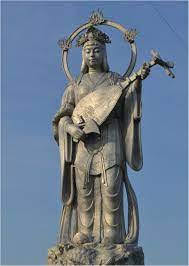
    Japanese goddess of love, Benten, sometimes known as Benzaiten. 


    Benten is the ruler of love, music, and the arts, and is shown as a lovely lady with eight limbs riding a dragon. 


    Benzaiten (shinjitai: or; kyjitai:, or, lit. "goddess of eloquence"), also known as Benten (shinjitai:; kyjitai: /), is widely worshipped as a Japanese Buddhist goddess descended mostly from Saraswati, the Hindu goddess of speech, the arts, and learning, with some qualities derived from Durga, the warrior goddess


    Benzaiten is the only female of the seven fortunate gods, and she is as much a Buddhist as she is a Shinto deity. 


    Actors, airline hostesses, artists, beauticians, composers, dancers, designers, directors, dramatists, entertainers, gamblers, models, musicians, painters, photographers, sculptors, sword makers, and writers are among the jobs Chiba associated with her. 

    Author Brian Bocking compares Benzaiten to Ichikishima-hime-no-mikoto, the principal deity of the Enoshima Jinja's three major temples. 


    Benzaiten is named after the Hindu goddess Sarasvati, and it is derived from Chinese translations of Buddhist sutras

    Sarasvati is the Hindu Goddess of wisdom, music, and the arts, and she is claimed to have been the wife of Brahma and Vishnu, who along with Siva make up Hinduism's sacred trinity. 


    Sarasvati is first mentioned in the Rig Veda, one of Hinduism's four holy books, which was compiled between 1500 and 1000 BC. 


    This phrase from Hymn 41 is arguably the most appropriate in the Benzaiten context:

    Sarasvat, greatest Mother, best of Rivers, best of Goddesses We have no notoriety, as it were, and dear Mother, grant us renown.

    All generations have a home in thee, Sarasvat, heavenly.

    Benzaiten Jinja in Japan are virtually all located near the sea, rivers, or lakes, or have their own in-ground lakes. 


    The next sentence from Hymn 61 makes a more dubious allusion to Banzaiten:

    Yes, this exquisite Sarasvat, with her golden road, is dreadful.

    Our eulogy refers to you as a foe-slayer.


    Sarasvati's "foe-slayer" might be understood as a reference to Sarasvati's killing of Vritra, the Hindu mythology's three-headed serpent/snake. 

    However, there is no further mention of this, and the conventional story puts Indra as Vritra's killer. 

    The three-headed serpent/snake transforms into a white snake in the Benzaiten mythology, which acts as her messenger. 

    The Kami-shinmei-tenso Jinja is a nice example of this.


    The Most Important Shrines Dedicated To Goddess Banzaiten


    Enoshima Jinja     江島神社        

    Kanagawa-ken, Fujisawa-shi, Enoshima 2-3-8    

    神奈川県藤沢市江の島2-3-8         


    Zeniarai Benzaiten Ugafuku jinja   銭洗弁財天宇賀福神社   

    Kanagawa-ken, Kamakura-shi, Sasuke 2-25-16

    神奈川県鎌倉市佐助2-25-16                


    Kiyomizu Benzaiten Sha     清水弁財天社

    Nagano-ken, Saku-shi, Iwamurada

    長野県佐久市岩村田


    Tenkawa DaiBenzaiten Sha     天河大辯財天社

    Nara-ken,  Yoshino-gun, Tenkawa-mura Tsubo-no-uchi 107

    奈良県吉野郡天川村坪内107


    The Enoshima Island in Sagami Bay, the Chikubu Island in Lake Biwa, and the Itsukushima Island in the Seto Inland Sea (Japan's Three Great Benzaiten Shrines) are all shrines dedicated to Benzaiten, and she and a five-headed dragon are the central figures of the Enoshima Engi, a history of the shrines on Enoshima written by the Japanese Buddhist monk K According to Kkei, Benzaiten is the third daughter of Munetsuchi's dragon-king, who is known in Sanskrit as Anavatapta, the lake that is at the heart of the globe according to an old Buddhist cosmological theory.

    Shrine pavilions called benten-d or benten-sha, or even whole Shinto temples, such as Kamakura's Zeniarai Benzaiten Ugafuku Shrine or Nagoya's Kawahara Shrine, might be devoted to her.


    Sarasvati to Benzaiten, from India to Japan


    Sarasvati occurs in two sutras translated into Chinese: the Sutra of Golden Light (, Konkmy-ky) and the Lotus Sutra (, Myh-rengei-ky). 


    The former devotes a whole chapter (8) to her and is essentially a lengthy, drawn-out eulogy. 

    Her presence in the Lotus Sutra is referenced in almost every Benzaiten-related publication on the Internet, but I have been unable to locate it. 

    It's unknown when she initially emerged in Japan, although it was probably definitely during the 6th and 8th centuries AD. 

    Much of the Sutra of Golden Light, perhaps reflecting China's Confucian history, emphasizes the necessity for a knowledgeable ruler, and it was this component, defender of the state and people, with which Benzaiten was linked when she first arrived in Japan. 


    Originally, her name was spelled as  辯才天


    The first of these three characters denotes eloquence in speaking, and the second, gift. 


    Her name started to be recorded as she grew more naturalized, finally becoming one of the Seven Lucky Gods,  弁財天

    The first character of this name,, is a simplified version of and so signifies no meaningful difference, but the second character,, is completely distinct from and indicates wealth or riches, which is an admirably appropriate characteristic for a deity of luck. 

    Benzaiten is usually typically shown playing a biwa, which is a short-necked lute, and Lake Biwa, Japan's biggest freshwater lake, is one of her shrines. 


    Benzaiten was worshipped in Japan from the sixth to the ninth century, mostly via Classical Chinese translations of the Golden Light Sutra (Sanskrit: Suvaraprabhsa Stra), which has a portion dedicated to her. 


    Benzaiten became associated or even conflated with a number of Buddhist and local deities from the medieval period onwards, 

    1. including the goddess Kisshten (the Buddhist version of the Hindu Lakshmi, whose role as goddess of fortune was eventually ascribed to Benzaiten in popular belief), 
    2. the snake god Ugajin (the combined form of the two being known as 'Uga Benzaiten'), 
    3. and the kami Ichikishimahime. 

    She was also associated with nagas, dragons, and snakes because to her role as a water goddess. 


    She was later adored as a bestower of monetary prosperity and was included as one of the Seven Lucky Gods, in addition to being a patron of music and the arts (Shichifukujin).


    In Japanese art, Goddess Benzaiten is portrayed in a variety of ways. 


    She is often represented brandishing a sword and a wish-granting diamond (cintmai), similar to how Saraswati is pictured in Indian art with a veena. 

    Meanwhile, Durga's iconography is said to have inspired an iconographic formula depicting Benzaiten with eight arms wielding various weapons (based on the Golden Light Sutra). 

    Ugajin (a human-headed white snake) may also be seen above her head as Uga Benzaiten. 

    Finally, she is sometimes shown with the head of a serpent or a dragon.


    Benzaiten is a Shinto female kami with the name Ichikishima-hime-no-mikoto. 


    Tendai Buddhists believe she is the essence of the kami Ugajin, whose effigy she sometimes wears on her head with a torii. 

    As a result, she is often referred to as Uga Benzaiten or Uga Benten.

    Su, (typically read in Japanese as so) is the bja or seed syllable used to express Benzaiten in Japanese esoteric Buddhism, written in Siddha script. 


    Benzaiten's Mantras:


    Sanskrit: Oṃ Sarasvatyai svāhā

    Japanese: On Sorasobateiei sowaka

    Hiragana: おん そらそばていえい そわか[25]

    ~Kiran Atma


    References And Further Reading:


    1.  Ludvik, Catherine (2007). Sarasvatī: Riverine Goddess of Knowledge. From the Manuscript-carrying Vīṇā-player to the Weapon-wielding Defender of the Dharma. Brill. pp. 1–3.
    2. Kinsley, David (1998). Hindu Goddesses: Visions of the Divine Feminine in the Hindu Religious Tradition. Motilal Banarsidass Publishers. pp. 10–13.
    3. Ludvik (2007). pp. 35-39.
    4. Faure, Bernard (2015). Protectors and Predators: Gods of Medieval Japan, Volume 2. University of Hawaii Press. p. 164.
    5. Faure (2015). pp. 164-165.
    6. Ludvik (2007). p. 48.
    7. Griffith, Ralph T.H. (trans.). "Rig Veda, Book 6: Hymn LXI. Sarasvatī"Sacred Texts. Retrieved 2022-05-21.
    8. Griffith, Ralph T.H. (trans.). "Rig Veda, Book 10: Hymn CXXV. Vāk"Sacred Texts. Retrieved 2022-05-21.
    9. "金光明最勝王經 第7卷"CBETA Chinese Electronic Tripiṭaka Collection (漢文大藏經). Retrieved 2022-05-21.
    10. Faure (2015). pp. 165-166.
    11. Ludvik, Catherine (2004). "A Harivaṃśa Hymn in Yijing's Chinese Translation of the Sutra of Golden Light"Journal of the American Oriental Society124 (4): 707–734.
    12. "AryAstavaH - hymn to Arya"Mahabharata Resources Page. Retrieved 2022-05-21.
    13. Ludvik (2007). pp. 265-267.
    14. Faure (2015). pp. 168-169.
    15. "大毘盧遮那成佛神變加持經"CBETA Chinese Electronic Tripiṭaka Collection (漢文大藏經). Retrieved 2022-05-21.
    16. The Vairocanābhisaṃbodhi Sūtra(PDF). BDK English Tripiṭaka Series. Translated by Rolf W. Giebel. Bukkyō Dendō Kyōkai; Numata Center for Buddhist Translation and Research. 2005. pp. 33, 141.
    17. Faure (2015). p. 166.
    18. "大毘盧遮那成佛神變加持經 第1卷"CBETA Chinese Electronic Tripiṭaka Collection (漢文大藏經). Retrieved 2022-05-21.
    19. "大毘盧遮那成佛神變加持經 第2卷"CBETA Chinese Electronic Tripiṭaka Collection (漢文大藏經). Retrieved 2022-05-21.
    20. Pye, Michael (2013). Strategies in the study of religions. Volume two, Exploring religions in motion. Boston: De Gruyter. p. 279. ISBN 9781614511915OCLC 852251932.
    21. "大毘盧遮那成佛神變加持經 第4卷"CBETA Chinese Electronic Tripiṭaka Collection (漢文大藏經). Retrieved 2022-05-21.
    22.  Bocking, Brian (1997). A Popular Dictionary of Shinto - 'Benzaiten'. Routledge. ISBN 978-0-7007-1051-5.
    23.  Itō, Satoshi: "Ugajin"Encyclopedia of ShintoKokugakuin University, retrieved on August 15, 2011
    24.  Ludvik, Catherine. “Uga-Benzaiten: The Goddess and the Snake.” Impressions, no. 33, 2012, pp. 94–109. JSTOR,  www.jstor.org/stable/42597966.
    25. "弁財天 (Benzaiten)"Flying Deity Tobifudō (Ryūkō-zan Shōbō-in Official Website). Retrieved 2022-05-22.
    26. Faure, Bernard (2015). Protectors and Predators: Gods of Medieval Japan, Volume 2. University of Hawaii Press. ISBN 978-0824857721.
    27. Kinsley, David (1998). Hindu Goddesses: Visions of the Divine Feminine in the Hindu Religious Tradition. Motilal Banarsidass Publishers. ISBN 978-8-1208-0394-7.
    28. Ludvik, Catherine (2004). "A Harivaṃśa Hymn in Yijing's Chinese Translation of the Sutra of Golden Light"Journal of the American Oriental Society124 (4): 707–734.
    29. Ludvik, Catherine (2007). Sarasvatī: Riverine Goddess of Knowledge. From the Manuscript-carrying Vīṇā-player to the Weapon-wielding Defender of the Dharma. Brill. ISBN 978-9-0474-2036-1.