Showing posts sorted by relevance for query warrior. Sort by date Show all posts

Goddess Bugady Musun


    Siberian mother of animals, Bugady Musun. 


    Bugady Musun is the ruler of all life and food, as well as the protector of all creatures and nature


    • She is shown as an elderly yet brawny lady who protects and guides vets. 
    • She is a shapeshifter who may appear as a reindeer or an elk to her petitioners.


    Bugady Musun is a Siberian divinity who was especially adored by the Evenki


    She was the protector of animals and the patron of nature


    She was generally a fierce elderly lady or a massive female elk or reindeer.

    Many Siberian peoples worship this deity. 


    Bugady Musun was the protector of animals and the patron of nature.
    The antlerless female elk (a symbol for the ever-renewing source of human nutrition) and a boat initially appeared in the Baykal Neolithic era as the deer (a metaphor for the passage of the soul into another world after death). 

    The Baykal Neolithic elk vanished in the late third or early second millennium BC (the Bronze Age), and a new group of representations (bull, cattle, deer, people in different ceremonial situations, cartwagon-wheeled vehicles) arose in South Siberia. 


    The female elk was replaced with a clearly female half-human, half-animal creature, who subsequently returned as a cow. 


    As a cow, this picture came from a tradition that had previously crowned her horns, and as a deer, it came from a northern tradition that had previously given her an elk's body. 


    Her indications and location as a woman connected her with life and death (at the Minusinsk monoliths, for example, this is expressed by the stones being rooted in the ground-the vertical axis-and their masks aligned towards the east). 

    On the higher reaches of the major Siberian rivers, Neolithic sanctuaries with petroglyphs such as the Baykal female elks have been discovered, as have Bronze Age ceremonial sites erected in large valleys surrounded by mountains. 

    Such a shift reflects a shift from relying on forest and river hunting and fishing to relying on pasture-based cattle farming. 


    Mongolia, the Sayan Altai Ridge, and the Minusinsk Basin formed a prominent cosmos during the Bronze Age. 


    There was a relationship with the Indo-European legendary tradition of a solar chariot and warriors in relation to the contemporaneous appearance of bull and cart representations in South Siberia. 

    Similarities between Yamna-Afanashevo (pit-grave) and Shrubnaya-Andronovo (timber-grave) civilizations are to blame for such alterations. 

    People with Indo-European heritage gradually migrated from the west and southwest into northern Kazakhstan, northern Altay, and Mongolia. 

    The elk continued to dominate late Bronze Age imagery in the shape of a deer, which was carved on rock walls and boulders, as well as around monolithic people in different ceremonial contexts. 


    This occurred in South Siberia and Mongolia around the first millennium BC. 


    The phenomena is particularly relevant to the region's so-called deer stones, and it complicates their interpretation. 


    There are two kinds of stones like this. 

    The Mongolian and Transbaykalian types, which feature deer in a recumbent position with exaggerated antlers, beak-like heads, graceful necks and bodies, short triangulated forelegs, and truncated hindlegs, are more common in Sayan-Altay. 

    We see carved chains of beads around the stone's neck, three parallel slanted lines at the side of the face, carved markings that seem like earrings, and a carved belt with hanging weapons or tools on both kinds of stones. 


    Carved depictions of animals, including deer, boar, horses, caprid, and crouching feline or wolf-like creatures, fill the gaps in between. 


    Wecan further examine what is known as the semantics of the deer stones, based on archeological data. 

    We can cast doubt on the widely held belief that the deer stones are linked to the Indo-European legend of an original masculine hero (a male warrior). 

    Comparisons of the Siberian stones' hanging instruments to the so-called Cimmerian Stelae and Scythian Baba seem to have led to the conclusion that they depict males, maybe even males as hunters or warriors. 

    Despite the presence of the hanging weapons/tools, no signs of belligerence are there. 

    These forms may be traced back to the Early Nomads' older symbolic forms, and that at least one of the three images central to the Scytho-Siberian artistic heritage came from South Siberia (the deer, the coiled feline, and a wolf-like animal). 

    The presence of weapon-like objects, as well as the correlation of these stones with the image of the deer, has led to the belief that the deer is a symbol for the warrior. 

    It is based on a connection between the masculine warrior and a solar complex of deer, gold, and horse. 

    This solar relationship did not always exist, and  the figure was more likely feminine in character, which is why it was associated with the image of a deer during the Early Nomads period.

    We can analyze the culture and mythology of the Paleo-Siberian Ket and the Tungusic Evenk in an effort to rebuild ancient mythological and ceremonial symbolic systems, considering this to be the richest and most important source for this purpose. 


    The Ket concept 


    The Ket concept of the Khosedam/Toman duality, as well as the Evenk concepts of Bugady Mushunin, "the mistress of the clan," and bugady enintyn, "the mistress-mother of the clan" (both combining the idea of woman and cow elk or wild cow reindeer [half-human, half-animal]), as well as beliefs and rituals associated with those deities. 


    To bridge the gap between archeological and ethnographic data, we can make many hypotheses and suggestions. 

    When it comes to the origins of shamanism, it is premature to explain the archeological traces of Siberian Neolithic, Bronze, and early Iron Age cultures with reference to shamanic practices that are only known from recent times, given that our evidence for the existence of shamanic institutions consists primarily of petroglyphic images of masks or horned figures. 

    The shaman's ability to complete the shamanic journey is reliant on items such as a drum that serves as the shaman's steed; a robe with a headdress adorned with imagery and amulets that simultaneously protect, empower, and transform the shaman; and, finally, a vertical axis, real or imagined, that serves as a pole linking the underworld, earth, correlating the signs and symbols connected with the shaman with the indicators of a trip beyond death found in Early Nomadic graves reveals that power was shifted from the early Iron Age. 


    Furthermore, the poems detailing the shaman's trip, as well as the voyage itself, have clear connections with zoomorphic imagery from the Early Nomads' time. 


    Despite this, the parallelism is just suggestive. 


    Early Nomads' Deer Image.


    The elaborate stone structures of the Early Nomads, as well as the enigmatic symbolic structures with which they laid their dead and their horses to rest, were the result of a process reflected in the Ket and Evenk mythic traditions and enclosing most archaic layers that continued through millennia. 


    Beginning with Ninhursag and concluding with Anahita/Nana, we can delve into the Pontic Scythian legendary legacy as told by Herodotus, as well as the greater history of Near Eastern goddesses. 

    The Scytho-Siberian aesthetic tradition in its ceremonial framework, as well as Siberian mythological traditions are seen in ethnography. 


    From this evidence that the Early Nomads' deer image, which they inherited and expanded into the heart of their symbolic systems, represented an ecosystem of belief. 


    Predatory animals were followed by the deer, which joined the Age of the Early Nomads as a reclining (or, more rarely, a standing) beast. 

    Predatory animals were then rejected due to an increased preoccupation with human iconography and realism. 


    The Deer As A Woman.


    The deer took on the appearance of a lady sitting before a man carrying a rhyton towards the conclusion of the Scytho-Siberian era (see for instance the North Pontic Chertomlyk, Karagodeuashk, the Merzhany plaques, the figures of the Prigradnaya "Scythian Baba," and the felt hanging from Altay Pazyryk). 

    However, it was eventually overshadowed as a woman, with only a male figure referring to her. 


    The deer was destined to survive solely via Siberian and Central Asian shamanic traditions when Scytho-Siberian society vanished. 

    The deer picture provides evidence for the birth and eventual extinction of a genuinely Siberian cosmogonic source: the Animal Mother, the source of life and death, rather than a solar hero or Indo-European ideals.


    ~Kiran Atma


    References And Further Reading


    • Jacobson, E., 2018. The deer goddess of ancient Siberia: a study in the ecology of belief. Brill.
    • Fitzhugh, W.W., 2009. Stone shamans and flying deer of northern Mongolia: Deer goddess of Siberia or chimera of the steppe?. Arctic Anthropology46(1-2), pp.72-88.
    • Bleeker, C.J., 1975. The Rainbow: a collection of studies in the science of religion (Vol. 30). Brill Archive.
    • Shigehiko, F., 1996. The Deer Goddess of Ancient Siberia: A Study in the Ecology of Belief.
    • Francfort, H.P., 1993. The Deer Goddess of Ancient Siberia. A Study in the Ecology of Belief (Studies in the history of religions [Numen Book Series] vol. LV).
    • Champouillon, L., 2012. Varieties of Deer Imagery: Gender and Cosmology in Prehistoric Belief Systems of Central Asia and South Siberia.
    • Fitzhugh, W.W., 2009. The Mongolian Deer Stone-Khirigsuur Complex: Dating and Organiation of a Late Bronze Age Menagerie. Current arc
    • Boucherit, G., 2011, August. A deer cult in Buile Suibhne. In XIV COMHDHÁIL IDIRNÁISIÚNTA SA LÉANN CEILTEACH XIV INTERNATIONAL CONGRESS OF CELTIC STUDIES.
    • Lymer, K., Fitzhugh, W. and Kortum, R., 2014. Deer Stones and Rock Art in Mongolia during the Second to First Millennia BC. Deer and People, p.159.
    • McFarland, R. and Schalaben, W., 1995. Placentas and Prehistoric Art. The Journal of Psychohistory23(1), p.41.
    • TATAR, S., The Legend of the Palóc Prince of Göcsej: Images of Bridled Deer and Antlered Horses. Cosmos: the yearbook of the Traditional Cosmology Society.
    • Diószegi, V. and Rajkay Babó, A., 1968. Tracing shamans in Siberia: the story of an ethnographical research expedition.




    Goddess Al-Uzza


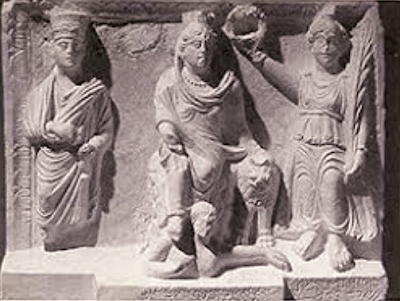
    Al-Uzza, Arabia's Virgin Warrior. 


    • Al-Uzza, together with her sisters al-Lat and Manat, is the youngest of the pre-Islamic trio. 
    • She is known as "the Most Mighty," and she is a fearsome warrior who fiercely defends what she claims as her own.
    • She is the goddess of fertility and wild creatures, and she used to be worshipped with animal and human blood sacrifices. 


    • Her influence over astrology and the change of seasons comes from her position as the morning and evening star. 
    • She is the protector of fish and dolphins as the goddess of the sea, and her name is invoked by travelers and sailors for safe travels. 
    • The acacia tree, clocks and watches, square-shaped stones, and granite are all emblems of Al-Uzza. 
    • She considers cows, felines, and dolphins to be holy.

    Goddesses Of Animals


    Both wild and domesticated animals appear as goddess images. 

    In at least one case, we find a wild and a domesticated version of the same animal representing separate god desses: Egyptian Bast (domesticated cat) and Sekhmet (lioness). 

    In all circumstances, however, the goddesss familiar animal was common in the area where she was wor shiped; goddesses are not represented by exotic or alien fauna. 

    One of the most important animal images for the goddess is the cow. 

    Domesticated in Egypt approximately 5,000 years ago from wild cattle (where cows were honored as images of the goddesses Hathor and Neith), the cows nourishing milk symbolically connects this animal to human mothers. 

    In a few cases, the goddess is seen associated with a bull. 

    Greek Europa was carried across the sky by a bull, Mesopotamian Innana owned the bull of heaven (see Eastern Mediterranean), Irish Medb kidnapped a mag ical bull (see Celtic). 

    But most commonly, the milch cow serves as a symbol of the abundant and nurturing goddess. 

    In Scandinavia, the cow was a primal being, Audhumbla, who freed the first beings from the primordial ice in which they were frozen. 

    Among the Irish Celts, we find Boand, ‘‘she of the white cows, who brought fertility to the land through the waters of the river that bears her name (Boyne). 

    Honoring the ‘‘sacred cow, embodiment of the Hindu goddess Prthvı, in India gives religious support for respecting the cows economic and nutritional importance. 

    In the same culture, the goddess of wealth, Laks˛mı, appears as a beautiful cow, and cows are called by her name. 

    In Egypt, Hathor was depicted with the horned head of a cow, which had huge wings rising from her shoulders; in this shape, she gave birth to the universe. 

    Anahita (see Eastern Medi terranean) was embodied in herds of cows on whose brows moons were branded. 

    Nearby, Ugaritic Anat took on the form of a cow to mate with her beloved brother, the god Baal. 

    The cow was not only an earthly creature but was imagined as heavenly as well. 

    When a greedy person milked Irelands Glas Ghaibhleann (see Celtic) into a sieve, the animal was so insulted that she levitated into the heavens where she walks the ‘‘White Cows Path, the Milky Way. 

    The Greeks connected this broad band of stars with the cow goddess Hera, who sprayed the heavens with milk while feeding her son Heracles. 

    In some Christian narratives, the starry road was formed from the milk of the virgin Mary (see Eastern Mediterranean). 

    The Egyptians saw the sky as a great cows belly, with the sun rising between the horns of the solar cow Hathor. 

    Another domesticated animal that provided meat and milk, as well as skin for leather, was the goat, whose usefulness became part of her symbolic importance. 

    The hollow horn of Greek Amaltea became the cornucopia, symbol of abundance. 

    The Scandinavian heavenly goat Hedrun provided endless intoxicating mead that fed heroes in the afterlife. 

    Goats were offered as sacrifices to Hittite Wurusemu (see Eastern Mediterranean). 

    Other goddesses to whom goats are sacrificed are Tibetan Tara (see India) and Ethiopian Atete (see Africa). 

    Used less often for food than for transportation, the horse appears connected with goddesses prominently in the mythologies of most Indo-European cultures as well as that of other lands. 

    Goddesses can appear in horse form, accompanied by or riding horses, or drawn by them in a chariot. 

    Many are associated with celestial powers, including the sun and moon. 

    Celtic Epona and A ine may have represented the sun that speeds across the sky in a chariot drawn by horses; the folkloric English figure Lady Godiva (see Celts) may descend from a horse goddess. 

    The feminine solar horse appears in India as well, in the figures of Samjn a and the dawn maiden Usas, who drove a chariot pulled by red horses. 

    Two divine horses pulled the chariot of Scandina vian Sol, while Hungarian Xatel-Ekwa rode three horses simultaneously. 

    Occasion ally, a lunar goddess was associated with the horses that pull the moons silver chariot; Greek Selene rode in such a chariot. 

    Persian Anahita (see Eastern Mediterra nean) rode in a chariot drawn by four white horses signifying her control over the weather. 

    Although typically connected with light, horses can also be associated with goddesses of darkness. 

    A nightmarish horse, Russian Mora (see Slavic), killed people as they slept. 

    In Scandinavia, the goddess Nott drove black horses that pulled the dark ness across the sky at nightfall. 

    As horses were often used in battle, it is not surprising to find goddesses of war associated with this animal. 

    In Greece, horses were connected with the warrior women called Amazons, who bore horse-names like Hippolyta and Melanippe. 

    In Scandina via, a similar group of horsewomen, the Valkyries, brought dead heroes from the battlefield to heaven. 

    In Ireland, the war goddess Macha was identified with horses, for she could outrun them even when nine months pregnant. 

    Horses can represent transformation, as with Sumerian Ereshkegal (see Eastern Mediterranean), whose horse rode the boundary between death and life, or Greek Medusa who gave birth to the winged horse Pegasus, symbol of transformative poetry. 

    Medusa may be connected with an obscure form of the grain goddess Demeter, who was impregnated while wearing a horses head. 

    In the Baltic, the death goddess Giltine˙ drove two black horses, while in Wales the goddess Rhiannon rode a white horse from the Otherworld and was later forced to carry people on her own back like a mare. 

    In hunting societies, wild herd animals like deer and buffalo appear as divinities, sometimes pictured in whimsical fashion. 

    In Scandinavia, the Skogsfruen (see Busch frauen) herded wild animals and, when not otherwise occupied, liked to knit socks. 

    But the underlying image of the goddess of wild herds is as a cosmic game warden, controlling access to the beasts and thus to the meat they provide. 

    In southeastern Europe, Dali was goddess of mountain sheep who appeared as a nubile woman with whom male hunters had intercourse, which empowered them to become great hunters. 

    Yet, like other goddesses of the hunt, she put prohibitions on hunters and killed any who broke her commands. 

    The connection of goddesses with hunting is common, despite similarly common prohibitions on human women hunting. 

    Greek Artemis wanders through the forests accompanied by her Nymphs, tending to woodland creatures and helping animals safely bear their young. 

    Other such goddesses are Celtic Arduinna and Artio, Irish Flidais (see Celtic), Finnish Mielikki, Eskimo Sedna, and Siberian Umaj (see Circumpolar). 

    In North America, Wohpe, the white buffalo calf-woman of the North American Sioux, is not only a guide to correct behavior when hunting but a general power of order. 

    Such woodland goddesses set the rules and expectations for hunters, who were rewarded with success if they treated the goddess with respect. 

    Dogs often appear as goddess images, as do their wild counterparts, wolves. 

    Often the dog appears as a companion of the goddess rather than an embodiment of her, as with Celtic Nehalennia, Greek Hecate, and Hawaiian Pele (see Pacific Islands). 

    Eskimo Sedna (see Circumpolar) lived with a dog, described sometimes as her hus band. 

    Scandinavian Frau Goˆde (see Holle in Scandinavia) always traveled with a dog, which she used to annoy people who did not sufficiently respect her. 

    Babylonian Gula was always shown accompanied by dogs, and dogs were buried in her temple, suggesting that they were connected with her healing powers. 

    In rare cases, as with Irish Uirne, the divine figures are themselves canine in form, but more typically we find the dog by the goddesss side. 

    Wolf goddesses, by contrast, were embodied in wolf form rather than merely traveling in their company. 

    The related Roman figures of Rhea Silvia, Lupa, and Acca Larentia show the goddess in both human and lupine form. 

    Both as dog and as wolf, the goddess appears more protective than threatening, although as Brimwylf (see Scandinavian) she can appear monstrous to those who would threaten her child. 

    Like canines, felines can appear as both wild and tame in goddess iconography. 

    However, when the tame cat appears as the wild lion, she changes from an affectionate goddess (Egypts Hathor, with her cat ears; Scandinavias sensual Freya; Chinese Wu Lo, goddess of fertility) to a fierce one (Indias Durga, a warrior goddess; Babylonian Eriskegal, queen of death; Egypts raging Sekhmet). 

    At times, a complex but generally kindly goddess such as Cybele (see Southeastern Europe) or Chinas Xiwang Mu appeared accompanied by lions or tigers, which suggest the goddesss fiercer powers. 

    Among other wild animals that serve as goddess images or vehicles, the bear appears as both the goddess herself (Greek Callisto and Artemis, Celtic Artio) and as her mate (Tlingit Rhpisunt; see North America). 

    The goddess appeared as a fox in Japan (Inari), where she could transform herself into a beautiful woman to seduce and kill men. 

    Finally, occasional goddesses take on animal forms appropriate to a spe cific region, such as Egyptian Taweret (hippopotamus). 

    ~ Kiran Atma

    You can learn more about Goddess Symbolism here.


    Goddesses Of Fish And Insects


    Those who live by fishing often honor a goddess who controls the sea life, such as the important Eskimo goddess Sedna (see Circumpolar), Celtic Nehalennia, or Finno-Ugric Avfruvva. 

    In South America, Mama Cocha was the ‘‘mother of whales because she brought the massive mammals close to hunters. 

    Polynesian Lorop (see Pacific Islands) lived under the earth, sending up food for her children in the form of fish. 

    In other cases, the goddess was seen not as controlling the sea creatures but as one of them, as with Celtic Lı Ban, transformed into a salmon, and Eastern Mediterranean Atargatis, who swam in the pool of her temple as a trout. 

    In India, the group of spirits called the D akinıs took on fish shapes to attend upon the goddess of death, Kalı. 

    In Africa, the heroine Chichinguane joined the fish people because her human kin were unkind to her. 

    Among insects, the industrious bee and the crafty spider are common goddess images. 

    Bees, whose hives are centered on a queen and whose female workers produce honey, appear as companions of goddesses associated with social life. 

    Lithuanian Aus t ˙eja was celebrated in an annual holiday dedicated to bees. 

    Artemis of Ephesus, goddess of the warrior Amazons (see Greece), was depicted surrounded by bees; her priestesses were called Melissae, also a name used of bee Nymphs. 

    Irish Gobnait (see Celtic) lived among bees that warned her of approaching danger. 

    Spiders, with their ability to weave intricately architectural webs from their own bodies, appear as creatrix figures in several cultures. 

    Hopi Kokyangwuti created human beings; Cherokee Kanene Ski Amai Yehi brought the sun to earth. 

    Greek Athena was connected to spiders because she made the first one from an insultingly competitive human girl, Arachne. 

    Finally, both butterflies (see Psyche, see Greece; Ix Chel, see Mesoamerica) and scorpions (South American Ituana, Egyptian Selkhet) appear as goddess images. 

    ~ Kiran Atma

    You can learn more about Goddess Symbolism here.


    Goddess Anath


    Canaanite goddess of love and battle, Anath. Anath was venerated across Mesopotamia as the Virgin, Mother, Warrior, and Wanton. 


    • "To respond," "strength of life," or "active will" are some of the meanings of her name. 
    • The deity Ba'al, or Bel, is her brother and consort. 
    • Her devotees beg her for war and reproductive issues since she has a voracious hunger for sex and blood. 


    • Women henna their hands, braid their hair, and dress up in the best adornments to pay homage to her during spring and harvest celebrations. 
    • Many of her stories and characteristics have been mixed together with those of Asherah and Astarte, and some academics believe Anath and Astarte were combined to create Atargatis
    • Anath is typically portrayed naked atop a lion, holding flowers in her hands, or as a young girl dressed in war attire.


    Goddess Benten Or Banzaiten


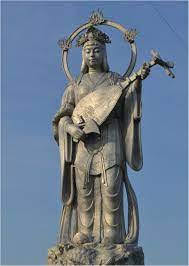
      Japanese goddess of love, Benten, sometimes known as Benzaiten. 


      Benten is the ruler of love, music, and the arts, and is shown as a lovely lady with eight limbs riding a dragon. 


      Benzaiten (shinjitai: or; kyjitai:, or, lit. "goddess of eloquence"), also known as Benten (shinjitai:; kyjitai: /), is widely worshipped as a Japanese Buddhist goddess descended mostly from Saraswati, the Hindu goddess of speech, the arts, and learning, with some qualities derived from Durga, the warrior goddess


      Benzaiten is the only female of the seven fortunate gods, and she is as much a Buddhist as she is a Shinto deity. 


      Actors, airline hostesses, artists, beauticians, composers, dancers, designers, directors, dramatists, entertainers, gamblers, models, musicians, painters, photographers, sculptors, sword makers, and writers are among the jobs Chiba associated with her. 

      Author Brian Bocking compares Benzaiten to Ichikishima-hime-no-mikoto, the principal deity of the Enoshima Jinja's three major temples. 


      Benzaiten is named after the Hindu goddess Sarasvati, and it is derived from Chinese translations of Buddhist sutras

      Sarasvati is the Hindu Goddess of wisdom, music, and the arts, and she is claimed to have been the wife of Brahma and Vishnu, who along with Siva make up Hinduism's sacred trinity. 


      Sarasvati is first mentioned in the Rig Veda, one of Hinduism's four holy books, which was compiled between 1500 and 1000 BC. 


      This phrase from Hymn 41 is arguably the most appropriate in the Benzaiten context:

      Sarasvat, greatest Mother, best of Rivers, best of Goddesses We have no notoriety, as it were, and dear Mother, grant us renown.

      All generations have a home in thee, Sarasvat, heavenly.

      Benzaiten Jinja in Japan are virtually all located near the sea, rivers, or lakes, or have their own in-ground lakes. 


      The next sentence from Hymn 61 makes a more dubious allusion to Banzaiten:

      Yes, this exquisite Sarasvat, with her golden road, is dreadful.

      Our eulogy refers to you as a foe-slayer.


      Sarasvati's "foe-slayer" might be understood as a reference to Sarasvati's killing of Vritra, the Hindu mythology's three-headed serpent/snake. 

      However, there is no further mention of this, and the conventional story puts Indra as Vritra's killer. 

      The three-headed serpent/snake transforms into a white snake in the Benzaiten mythology, which acts as her messenger. 

      The Kami-shinmei-tenso Jinja is a nice example of this.


      The Most Important Shrines Dedicated To Goddess Banzaiten


      Enoshima Jinja     江島神社        

      Kanagawa-ken, Fujisawa-shi, Enoshima 2-3-8    

      神奈川県藤沢市江の島2-3-8         


      Zeniarai Benzaiten Ugafuku jinja   銭洗弁財天宇賀福神社   

      Kanagawa-ken, Kamakura-shi, Sasuke 2-25-16

      神奈川県鎌倉市佐助2-25-16                


      Kiyomizu Benzaiten Sha     清水弁財天社

      Nagano-ken, Saku-shi, Iwamurada

      長野県佐久市岩村田


      Tenkawa DaiBenzaiten Sha     天河大辯財天社

      Nara-ken,  Yoshino-gun, Tenkawa-mura Tsubo-no-uchi 107

      奈良県吉野郡天川村坪内107


      The Enoshima Island in Sagami Bay, the Chikubu Island in Lake Biwa, and the Itsukushima Island in the Seto Inland Sea (Japan's Three Great Benzaiten Shrines) are all shrines dedicated to Benzaiten, and she and a five-headed dragon are the central figures of the Enoshima Engi, a history of the shrines on Enoshima written by the Japanese Buddhist monk K According to Kkei, Benzaiten is the third daughter of Munetsuchi's dragon-king, who is known in Sanskrit as Anavatapta, the lake that is at the heart of the globe according to an old Buddhist cosmological theory.

      Shrine pavilions called benten-d or benten-sha, or even whole Shinto temples, such as Kamakura's Zeniarai Benzaiten Ugafuku Shrine or Nagoya's Kawahara Shrine, might be devoted to her.


      Sarasvati to Benzaiten, from India to Japan


      Sarasvati occurs in two sutras translated into Chinese: the Sutra of Golden Light (, Konkmy-ky) and the Lotus Sutra (, Myh-rengei-ky). 


      The former devotes a whole chapter (8) to her and is essentially a lengthy, drawn-out eulogy. 

      Her presence in the Lotus Sutra is referenced in almost every Benzaiten-related publication on the Internet, but I have been unable to locate it. 

      It's unknown when she initially emerged in Japan, although it was probably definitely during the 6th and 8th centuries AD. 

      Much of the Sutra of Golden Light, perhaps reflecting China's Confucian history, emphasizes the necessity for a knowledgeable ruler, and it was this component, defender of the state and people, with which Benzaiten was linked when she first arrived in Japan. 


      Originally, her name was spelled as  辯才天


      The first of these three characters denotes eloquence in speaking, and the second, gift. 


      Her name started to be recorded as she grew more naturalized, finally becoming one of the Seven Lucky Gods,  弁財天

      The first character of this name,, is a simplified version of and so signifies no meaningful difference, but the second character,, is completely distinct from and indicates wealth or riches, which is an admirably appropriate characteristic for a deity of luck. 

      Benzaiten is usually typically shown playing a biwa, which is a short-necked lute, and Lake Biwa, Japan's biggest freshwater lake, is one of her shrines. 


      Benzaiten was worshipped in Japan from the sixth to the ninth century, mostly via Classical Chinese translations of the Golden Light Sutra (Sanskrit: Suvaraprabhsa Stra), which has a portion dedicated to her. 


      Benzaiten became associated or even conflated with a number of Buddhist and local deities from the medieval period onwards, 

      1. including the goddess Kisshten (the Buddhist version of the Hindu Lakshmi, whose role as goddess of fortune was eventually ascribed to Benzaiten in popular belief), 
      2. the snake god Ugajin (the combined form of the two being known as 'Uga Benzaiten'), 
      3. and the kami Ichikishimahime. 

      She was also associated with nagas, dragons, and snakes because to her role as a water goddess. 


      She was later adored as a bestower of monetary prosperity and was included as one of the Seven Lucky Gods, in addition to being a patron of music and the arts (Shichifukujin).


      In Japanese art, Goddess Benzaiten is portrayed in a variety of ways. 


      She is often represented brandishing a sword and a wish-granting diamond (cintmai), similar to how Saraswati is pictured in Indian art with a veena. 

      Meanwhile, Durga's iconography is said to have inspired an iconographic formula depicting Benzaiten with eight arms wielding various weapons (based on the Golden Light Sutra). 

      Ugajin (a human-headed white snake) may also be seen above her head as Uga Benzaiten. 

      Finally, she is sometimes shown with the head of a serpent or a dragon.


      Benzaiten is a Shinto female kami with the name Ichikishima-hime-no-mikoto. 


      Tendai Buddhists believe she is the essence of the kami Ugajin, whose effigy she sometimes wears on her head with a torii. 

      As a result, she is often referred to as Uga Benzaiten or Uga Benten.

      Su, (typically read in Japanese as so) is the bja or seed syllable used to express Benzaiten in Japanese esoteric Buddhism, written in Siddha script. 


      Benzaiten's Mantras:


      Sanskrit: Oṃ Sarasvatyai svāhā

      Japanese: On Sorasobateiei sowaka

      Hiragana: おん そらそばていえい そわか[25]

      ~Kiran Atma


      References And Further Reading:


      1.  Ludvik, Catherine (2007). Sarasvatī: Riverine Goddess of Knowledge. From the Manuscript-carrying Vīṇā-player to the Weapon-wielding Defender of the Dharma. Brill. pp. 1–3.
      2. Kinsley, David (1998). Hindu Goddesses: Visions of the Divine Feminine in the Hindu Religious Tradition. Motilal Banarsidass Publishers. pp. 10–13.
      3. Ludvik (2007). pp. 35-39.
      4. Faure, Bernard (2015). Protectors and Predators: Gods of Medieval Japan, Volume 2. University of Hawaii Press. p. 164.
      5. Faure (2015). pp. 164-165.
      6. Ludvik (2007). p. 48.
      7. Griffith, Ralph T.H. (trans.). "Rig Veda, Book 6: Hymn LXI. Sarasvatī"Sacred Texts. Retrieved 2022-05-21.
      8. Griffith, Ralph T.H. (trans.). "Rig Veda, Book 10: Hymn CXXV. Vāk"Sacred Texts. Retrieved 2022-05-21.
      9. "金光明最勝王經 第7卷"CBETA Chinese Electronic Tripiṭaka Collection (漢文大藏經). Retrieved 2022-05-21.
      10. Faure (2015). pp. 165-166.
      11. Ludvik, Catherine (2004). "A Harivaṃśa Hymn in Yijing's Chinese Translation of the Sutra of Golden Light"Journal of the American Oriental Society124 (4): 707–734.
      12. "AryAstavaH - hymn to Arya"Mahabharata Resources Page. Retrieved 2022-05-21.
      13. Ludvik (2007). pp. 265-267.
      14. Faure (2015). pp. 168-169.
      15. "大毘盧遮那成佛神變加持經"CBETA Chinese Electronic Tripiṭaka Collection (漢文大藏經). Retrieved 2022-05-21.
      16. The Vairocanābhisaṃbodhi Sūtra(PDF). BDK English Tripiṭaka Series. Translated by Rolf W. Giebel. Bukkyō Dendō Kyōkai; Numata Center for Buddhist Translation and Research. 2005. pp. 33, 141.
      17. Faure (2015). p. 166.
      18. "大毘盧遮那成佛神變加持經 第1卷"CBETA Chinese Electronic Tripiṭaka Collection (漢文大藏經). Retrieved 2022-05-21.
      19. "大毘盧遮那成佛神變加持經 第2卷"CBETA Chinese Electronic Tripiṭaka Collection (漢文大藏經). Retrieved 2022-05-21.
      20. Pye, Michael (2013). Strategies in the study of religions. Volume two, Exploring religions in motion. Boston: De Gruyter. p. 279. ISBN 9781614511915OCLC 852251932.
      21. "大毘盧遮那成佛神變加持經 第4卷"CBETA Chinese Electronic Tripiṭaka Collection (漢文大藏經). Retrieved 2022-05-21.
      22.  Bocking, Brian (1997). A Popular Dictionary of Shinto - 'Benzaiten'. Routledge. ISBN 978-0-7007-1051-5.
      23.  Itō, Satoshi: "Ugajin"Encyclopedia of ShintoKokugakuin University, retrieved on August 15, 2011
      24.  Ludvik, Catherine. “Uga-Benzaiten: The Goddess and the Snake.” Impressions, no. 33, 2012, pp. 94–109. JSTOR,  www.jstor.org/stable/42597966.
      25. "弁財天 (Benzaiten)"Flying Deity Tobifudō (Ryūkō-zan Shōbō-in Official Website). Retrieved 2022-05-22.
      26. Faure, Bernard (2015). Protectors and Predators: Gods of Medieval Japan, Volume 2. University of Hawaii Press. ISBN 978-0824857721.
      27. Kinsley, David (1998). Hindu Goddesses: Visions of the Divine Feminine in the Hindu Religious Tradition. Motilal Banarsidass Publishers. ISBN 978-8-1208-0394-7.
      28. Ludvik, Catherine (2004). "A Harivaṃśa Hymn in Yijing's Chinese Translation of the Sutra of Golden Light"Journal of the American Oriental Society124 (4): 707–734.
      29. Ludvik, Catherine (2007). Sarasvatī: Riverine Goddess of Knowledge. From the Manuscript-carrying Vīṇā-player to the Weapon-wielding Defender of the Dharma. Brill. ISBN 978-9-0474-2036-1.