How Prevalent Was Goddess Worship In Greece?
Although the Divine Feminine is the mountain itself, practitioners have also referred to caves as the Divine Feminine's holy vulva because of how comfortable they are there.
Women used to go inside to give birth and to carry out ceremonies honoring menarche and delivery as significant life events.
The cave served as a site of birth, death, and rebirth where women were engulfed inside the darkness of the Goddess' body, similar to Eileithyia on the island of Crete or Plouton at Eleusis.
It is said that those who have sounded and drummed in these mountain tunnels have formed holy bonds.
These holy caverns were the places where practitioners were carried ever closer toward contact with the Chthonic Mother.
They were ritually embellished with art and crimson ochre colors that signify the life giving blood of Goddess.
It's possible to see oneself being wrapped inside her deep crimson crevices—almost like an embryo within her live womb!
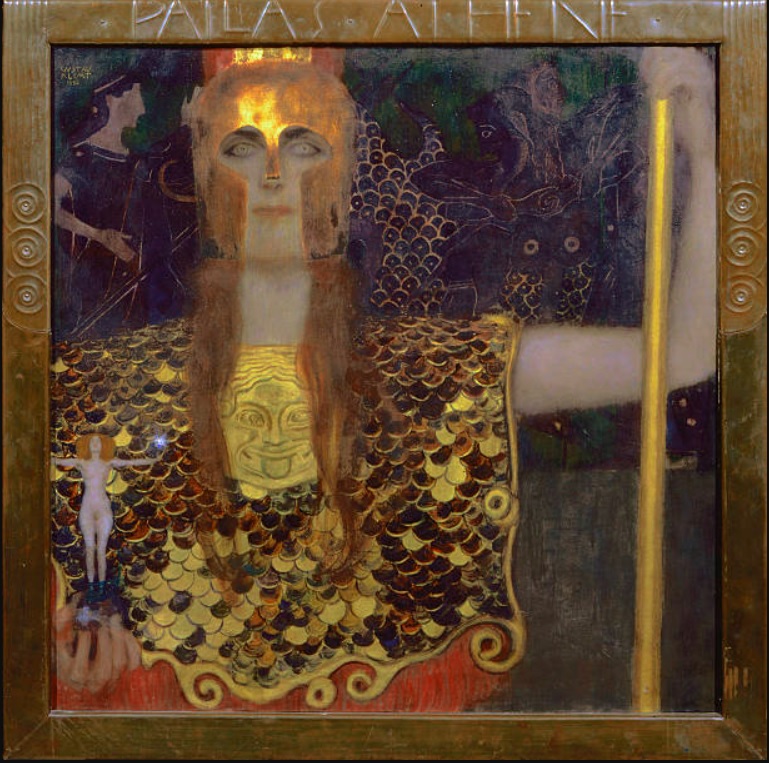
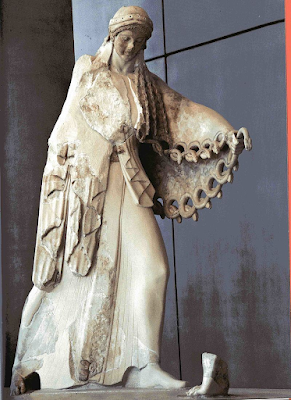
The Acropolis Before Athena, the protector of the city, Goddess of Wisdom, and a representation of military success, called the Acropolis home, a high hill towering above the bustling Greek capital Athens, a holy place of Goddesses, her residence there was long considered to be.
The Mycenaean or Minoan civilizations, both of which are known to have traded goods and ideas, are thought to have been the ancestors of Athena in the past.
Because of her apparent relationship to Neolithic snake emblems of renewal, Nilsson connects her to the Snake Goddess of Minoan Crete.
However, there is proof that she had roots in Mycenae, the ancient city that was previously inhabited by Indo-Europeans.
However, the Athena of classical Greece is the one who is most recognized in popular culture.
Athena, who was created from Zeus's head, is the ideal illustration of a Goddess absorbed by a patriarchal civilization.
She symbolized the pinnacle of that transformation from a Goddess mostly focused on the body to a Goddess primarily focused on the intellect here on the Acropolis.
Athena, according to Mircea Eliade, symbolizes "the sacrality of technological creativity and the myth of wisdom."
Athena, who is perched atop the Acropolis, has a commanding view over the city that gave rise to Western philosophy and thinking, a culture that prized the triumph of the intellect over the forces and rhythms of nature, and a society that started to value men above women.
As she and Poseidon competed for control of the city, Athena first became associated with Athens.
Each god presented the populace with suggestions and counterproposals.
The ladies chose Athena, while the males chose Poseidon.
When the populace eventually accepted Athena's gift of the olive tree and decided to name the Goddess as their protector, Athena narrowly prevailed by one vote.
One of the few instances of Athena behaving as a goddess of the soil or of plants was her donation of the olive tree.
Unfortunately, this choice had a cost.
Poseidon made the decision to completely submerge Attica, a region governed by Athens.
The Attican males punished women in three ways in an effort to placate the god's anger.
- They would not be able to vote, to start.
- Second, their children wouldn't have the same names as their mothers.
- Finally, they wouldn't be referred to as Athenians ladies.
In actuality, the patriarchy The Parthenon, a temple dedicated to the goddess Athena, is the most magnificent structure in all of ancient Greece.
Its splendor gave males a justification to oppress women, and female citizens lost their place in society.
But there were benefits to picking Athena as well.
She offered health, protection, and triumph in her three guises of Hygieia, Polias, and Nike, respectively.
She also taught the ladies how to weave and spin, and they later prayed to Athena for help giving birth.
She was also the goddess of the hero, giving strength, counsel, and help.
 |
| Athena killing a giant. |
She aided Agamemnon, the Spartans, Heracles, Odysseus, and Perseus when they encountered difficulty, as well as Achilles when he confronted Hector.
She also gave caution and composure throughout a struggle.
However, Athena represents a departure from the characteristics that have come to be identified with the Divine Feminine.
She even disputes the contribution of her mother, Metis, Goddess of Wisdom, in her birth, demonstrating just how far detached she is from her sexuality and womanhood.
In patriarchal Greek mythology, Athena refuses to acknowledge her mother, who was carrying her at the time she was eaten by Zeus and who was also pregnant with her.
A few months later, Athena was born from the head of the powerful monarch of all the gods.
Thus, Athena sprang from the patriarch's skull dressed for fight.
However, Athena is more than just a fighter; she is also the Goddess of Wisdom, a quality she inherited from her mother.
According to academic Miriam Robbins Dexter, Athena lacks the "strength inside" that results from a connection to the life force.
Instead, Athena supports the patriarchal mentality that rules in a "power over" mode of society.
Athena's celibacy reduced her autonomy, but in her state of virginity, she is a "storehouse" of energy that nurtures society and may transfer that power to man.
Athena had the capacity to retain untapped power and, as previously said, transfer it to the heroes of Classical Greek mythology since she was a virgin goddess (a phrase that had nothing to do with chastity but rather with inner-stored power or energy).
One may say that Athena served as a taming force for civilization.
According to scholar Walter Burkert, Athena gave the Athenians a cultivated olive tree rather than a wild olive tree.
She provided the bridle and chariot in response to Poseidon's gift of the horse so that humans may make use of the animal.
Poseidon raises the waves, while Athena gives a ship to navigate the tumultuous waters.
To make use of the flocks, Hermes multiplies them, and Athena teaches spinning and weaving.
Mentoring her heroes, Athena shows up when they need her.
Burkert quotes a tradition that says, "In alliance with Athena put your own hand to work," to explain Athena's ability to help, while Walter F. Otto refers to Athena as the "Goddess of Nearness," who makes the impossibly conceivable.
She is a representation of brilliance and success, yet she is cut off from the cycles and knowledge of Earth.
In her yearly festival known as the Panathenais Festival, which took place in the month of Hecatombion, Athena was revered at the Acropolis (July-August).
During this time, women wove the peplos, an embroidered holy Athena gown decorated with war scenes.
Winners of contests organized at the occasion would get oil from her holy olive trees.
The 40-foot (12-m) figure of Athena that Pheidias created in the Parthenon's core was covered in a saffron robe, according to historical accounts.
Although the statue's current location is unclear, we do know that it was designed to depict Athena with a helmet, shield, a serpent around her wrist, and an aegis on her breastplate.
In her right hand, she is holding a part of herself in the form of Nike, the goddess of victory.
Her sandals' rim featured an image from the Greek and Centaur War.
The holy procession and the giving of the peolos to Athena were shown on the building's east frieze, while the procession's departure was shown on the west.
Athena's birth was commemorated with a pediment that said, "She who was never nurtured in the gloom of the womb." There are four main structures that make up the Acropolis.
The 40-foot (12-m) figure of Athena, who is revered as Parthenos, or the Virgin, is located in the Parthenon.
It was referred to as the biggest cella, or holiest of holies, on the mainland of Greece.
All of the marble used in its construction came from neighboring quarries, making it the biggest Doric temple.
It was used in a variety of ways throughout time, including as a bank, a barracks for troops, and an ammunition storage facility.
The olive tree that Athena is said to have presented to Athens is believed to have grown in the Erechthion, which formerly stood where a temple to Poseidon had stood.
This modest, old structure is said to be the location of Athena's invitation to the Chthonic Furies to remain as comfort after their defeat in a legal proceeding.
They were looking seeking retribution for Clytemnestra's death at the hands of her son Orestes there.
It's interesting to note that this court case can be seen as a metaphor for the struggle for dominance between the usurping patriarchy of the Olympians and the archaic Chthonic forces of Goddess.
Here at the Erechthion, it was Athena who decided the case in favor of Apollo and the Olympians over the Furies.
The complete power of the Goddess is reduced as a result of Apollo's defense of Orestes during this trial and the male libido taking over the female's function as the generative force for reproduction.
Agamemnon and Clytemnestra had sacrificed their daughter before the Trojan War began in order to set the scene.
Clytemnestra murdered Agamemnon as vengeance.
After that, Orestes murdered Clytemnestra as retaliation for taking his father's life.
The female womb was nothing more than an incubator for the male seed, according to Apollo, who said that Agamemnon's murder was the worst of the two crimes since via his seed, Agamemnon, not Clytemnestra, was the actual father of their dead daughter.
Apollo was given the benefit of the doubt when Athena said in The Eumenides, "I am always for the man.
firmly on my father's sides and with all of my heart.
In fact, since Poseidon was seen as the husband of Earth, or Gaia, some people view Athena's win against Poseidon for the city's patronage as another victory for the Olympians over the Chthonic forces.
The Porch of the Maidens, which showcases female statues known as Karyatides, is the element that most readily associates with the Erechthion.
Visitors now, however, only see replicas of them.
According to some stories, this structure used to house snakes, which makes sense given Athena's associations with snakes dating back to the Neolithic era.
The white marble temple of Athena Nike is the third structure atop the Acropolis, which was formerly filled with monuments and shrines.
It is currently off-limits to tourists.
The Propylaia, where worshipers passed through to enter the holy realm of the deities, is located near the site's entrance.
According to Harrison Eiteljorg, the most revered Athena's statue on the Acropolis was directly east of the Propylaia, a hill that had been occupied since at least the Neolithic age.
The ordinary people revered the goddess under this form as Athena Promachos, or Defender of the City, reserving the inner sanctums of the temple for priestly usage.
Pausanias said that the sailors at the port of Piraeus, which is six miles or ten kilometers distant, were able to see this thirty-foot (9-m) tall bronze figure with silver detail because of how brilliantly it sparkled in the sunshine.
Athena's altar, which was located east of the Erechtheum and was another significant structure on the Acropolis, was where ceremonial burned sacrifices were made to the Goddess.
On the property, there is a lovely museum.
There have been plans to replace the lost Athena statue with a copy, but nothing has come of those plans as of yet.
How to reach the Acropolis.
The center of Athens' historic district is where you'll find the Acropolis, also known as the High Place.
Although the museum's hours are somewhat constrained, the location is open every day.
The most significant location in the tourist-heavy capital of Greece is this one.
From its high perch, it can be seen for miles in every direction.
All of Athens' ancient monuments, including the Acropolis site and museum, Ancient Agora, Theatre of Dionysos Kerameikos, Olympieion, and Roman Agora, are accessible with a General Admission ticket.
Attend a show in the outdoor theater at night for a wonderful pleasure.
just outstanding The goddess proponents see the rebuilt palace of Knossos on the island of Crete as the last and maybe finest illustration of what is possible in a matrifocal society in which the presiding deity is female.
Knossos offers a unique look at an advanced Neolithic Greek civilisation that was unaffected by invasion and Bronze Age disruption.
At its height, Knossos and neighboring towns on the island of Crete are said to have had a sophisticated and vibrant society, coexisting peacefully with the environment and one another, with gender equality, a plenty of food, material wealth, and a healthy interest in the arts.
This seemingly miraculous era sometimes provides as a sign of what can be possible in a partnership-based society as opposed to a dominator-based one where genders are in harmony with the rhythms of the Goddess.
A British archaeologist named Sir Arthur Evans purchased the land where the Palace of Knossos now stands in 1900.
He discovered the ruins of a sizable complex, and over the course of the next 25 years, amid considerable debate, he reconstructed the palace using contemporary materials.
His efforts prevented many significant structures from collapsing, and today's visitors may get a powerful idea of what life was like in Minoan Crete before it was completely devastated between 1450 and 1400 BCE.
The question of whether the eruption on nearby Thera Island truly led to the collapse of Minoan civilization is still hotly contested.
A reconsideration of the chronology of the Late Bronze Age and the accepted scholarship connected to the eastern Mediterranean may be necessary in light of challenging concerns raised by findings from excavations on Crete over the last several decades that have mostly gone unreported.
Although the origins of the occupants of the people of Crete are not entirely understood, Evans dubbed the civilization he encountered the Minoan in honor of the legendary King Minos.
Crete, a large island advantageously bordered by Asia, Africa, and Europe, is thought to have been settled by Anatolians circa 6000 BCE.
The Cretan civilization flourished for many thousand years.
They farmed, hunted, and kept cattle.
Over time, their culture became more sophisticated, but their devotion to the Goddess and their closeness to nature, which included an understanding of the cycle of life and death, remained a steadfast feature.
The goddess was revered as the Regeneratrix in caves during the Early Minoan period, when worshippers used female figurines, amulets, and talismans that often showed engraved pubic triads, emblems of the Earth Mother.
Peak sanctuaries were built on mountains during the Middle Minoan era, which began about 2200 BCE, when worship eventually became collective.
Archaeologists may learn from artifacts discovered in these locations that ancient devotees once tucked significant figures into rock fissures, as if to deposit them into the Mother herself.
One old seal found at Knossos depicts the Great Goddess having an epiphany on a mountain top, flanked by lions climbing the hill on each side of her, and put before her worshipper with arms lifted to the eyes, suggesting this devotee's capacity to behold the majestic goddess in her splendor.
As ritual and worship developed from the Early through Middle and into the Late Minoan eras, it grew more complex.
The later period is characterized by libations, sacrifices, music, dancing, processions, and bull leaping.
Some believe that the bull-jumping frescos from Knossos reflect the acceptance, comprehension, and communion of men and women with the laws of nature.
Peg Streep thinks that by taking on the risk of bull leaping, dancers are metaphorically taking on the Goddess's power to decide between life and death.
Bull-jumping is mentioned by other academics as a priests' and priestesses' initiation rite.
The Minoans maintained a strong connection to the ground, traditional values, and their Minoan Goddess, whose original name is unknown, despite the growth and complexity of their worship.
Gertrude Levy, whose description of religion as "unusually divorced from formal relationships, yet emotionally bound in its ceaseless quest to create communication with the elemental energies" is used by Streep, is cited in the quotation.
The Minoan clergy were believed to summon the Goddess by blowing a triton or by performing holy dances that would induce trance.
Priestesses may have worn holy attire that, when worn, indicates they represent the divinity in human form, according to experts who have studied artifacts of faience models of ritual clothes discovered in the Sanctuary of Knossos that are indicative of votive offerings.
This resembles the Kumari's collar or the menat collar used by Hathor priestesses.
It's fascinating to notice that the holy knot used to symbolize the Goddess on the island of Crete is very similar to the knots used to symbolize Inanna and Isis, perhaps representing the collective psyche of humanity.
According to academic Walter Burkert, the Minoan people did not build temples to their gods; instead, cult rooms were discovered in palaces and homes.
Additionally, worship persisted in the caves and peak sanctuaries atop the mountains that dot the landscape.
The subterranean labyrinth-like layout of the Palace of Knossos, which was made up of several pillars, led Sir Arthur Evans to speculate that the Minoans may have been members of a "Pillar Cult."
This was thought to be the famed Minotaur's subterranean lair, and some academics argue that it served as a metaphor for the holy union that took place at Knossos.
The palace contained restrooms with flushing toilets and other features that suggested purifying rituals.
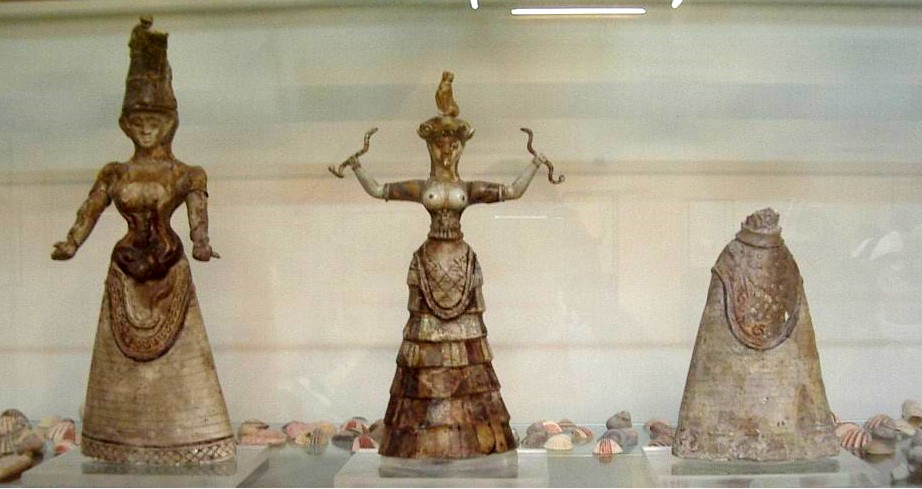
The well-known Snake Goddesses, which date to 1600 BCE, were discovered in Knossos' Central Palace Sanctuary.
The two most well-known Snake Goddesses are shown with naked breasts, small waists, flounced skirts, and an air of assured sensuality and fertile assurance.
With the coiled serpents—symbols of life and death—held in both of their extended hands and arms, they each symbolize a picture of the Goddess as regeneratrix.
While the second depiction of the Snake Goddess has additional snakes around her waist, the first includes a cat or lioness perched atop her headpiece.
One Snake Goddess has a net-like pattern on her skirt, suggesting that she is a part of or has control over the web of life.
It is said that her skirt's seven layers correspond to lunar occurrences.
According to researchers Evans and Nilsson, the Snake Goddess may have served as a domestic or household guardian since there are still traditions in the area where some people leave out bowls of milk for snakes in return for their care and protection.
The majority of what we know about Knossos and Minoan Crete comes from art and iconography that primarily draws from Neolithic sources.
The Minoan script has never been fully understood.
However, other intriguing connections are made through seals, frescoes, and ceramics, such as the fact that Crete is where the story of Demeter and Persephone originated.
The pillar and tree, as well as cave stalactites and stalagmites, birds, snakes, poppies, seashells, doves, butterflies, and—perhaps most frequently—the labrys, or double ax—were all representations of the Minoan Goddess.
The name "labyrinth" is derived from this Minoan sign rather than the maze connotation that is now widely accepted.
The House of the Double Ax at Knossos, also known as the Goddess' sanctuary, was well-known.
By pointing out that the butterfly symbolized characteristics of change and the labrys mirrored the "hourglass-shaped Goddess of Death and Regeneration," Marija Gimbutas draws a link between the butterfly, the ax, and the goddess.
The double ax is believed to have been a ceremonial tool that males never used, maybe in ritual bull sacrifice.
It's also crucial to realize that, in contrast to Indo-European cultures, where the bull symbolized masculine strength, here the bull's horns were thought to represent female regeneration powers, particularly in Catal Hüyük, Turkey, and some have even suggested that their shape is similar to that of female reproductive organs.
The symbolism of the consecration horns that have been discovered in and around Knossos and Crete further demonstrates the significance of the bull horns.
Sir Arthur Evans rebuilt these horns on the western wall of the Palace of Knossos after realizing their importance.
They are wonderful subjects for pictures! The ceremonial chopping of holy trees, another representation of the Goddess, was also considered to be done with an ax.
Another significant goddess emblem on the island of Crete was the bee.
It is generally known that the Minoans kept bees, and that the honey they collected was employed in ceremonies, as well as to embalm and preserve remains.
Priestesses of Demeter included bees or melissae as well as Artemis Ephesia, who, as was already noted, may have originated in Crete.
Bee buzzing was said to correspond to the Goddess' voice.
The majority of the discoveries made over decades of excavation at Knossos have remained unpublished, however in 1979, Peter Warren of Bristol University, who had spent more than thirty years working there, found child sacrifice bones.
He conjectured that in a ritual to avert impending doom, their flesh was torn off the bones and fried with snails.
To no avail, the volcanic explosion on the island of Santorini (Thera), which is situated north of Crete in the Mediterranean Sea, most likely marked the end of Minoan Crete.
At this period, all of the other palaces on Crete vanished, perhaps wiped out by tidal surges brought on by the largest volcanic eruption ever recorded.
While only Knossos managed to exist, this beautiful palace afterwards went into rapid decay and was never again erected or occupied.
The Palace of Knossos has many of the ancient Minoan mysteries, despite the original frescoes.
Visitors to the site may take in various recreated elements of the Knossos central palace, many of which are on display in the Athens museum and the Archaeological Museum of Heraklion in Crete, respectively.
Beautifully painted columns and walls feature the vibrant colors of the Minoans, including hues of gold, black, red, blue, and green.
Both the most well-known murals associated with Knossos, such as the "three sister priestesses," "bull jumping," and the "plumed prince," as well as walls depicting worshippers in procession, include copies of the genuine frescos from this period.
While touring the site, visitors may see the Throne Room and other fascinating spaces, such as the Queen's Megaron, which is claimed to have been home to the first flushing toilet.
Clay pipes still exist as evidence of the Minoans' drainage system knowledge.
More than a thousand chambers were discovered in the multi-story building when Evans uncovered it.
How to reach Knossos?
4 miles (6.4 km) southeast of Heraklion, on the northern shore of Crete, is where you'll find Knossos.
You may hire a private tour company with a guide on-site to explore Knossos.
People traveling alone may use the public buses that routinely leave from Heraklion's Liberty Square and El Greco Park.
It will be difficult to determine who is knowledgeable, and few may concentrate on the significance of the Goddess, so it is best to come prepared with a map and guidebook or to make plans to hire a guide who can be found at the entrance.
The site is open everyday, however it is preferable to arrive early in the morning or late in the afternoon after the main influx of tourists have left.
The shops on the roadway leading up to the site provide the greatest Snake Goddess statue shopping for visitors to Knossos.
Get what you need right here. Don't wait until Athens because there won't be as many options.
Delphi's Goddess Focus Oracle.
Only a few hours' drive from Athens lies the Greek town of Delphi, which is nestled along the slope of the magnificent Mount Parnassus.
Delphi, one of the most well-known oracle sites in antiquity, is a well-liked holy location today for both visitors and pilgrims.
According to academic James Rietveld, who cited The Eumenides, Gaia, also known as the Earth, was the originator of prophecy.
The legendary Oracle of Delphi was given to Gaia's daughter Themis long before it was acquired by the god Apollo.
Themis was an earlier chthonic goddess who had long been strongly tied with the Earth and death.
As a result, Delphi—whose landscape is covered with symbols of the Goddess—became regarded as the scene of conflict between the approaching Olympian gods and the previous order of chthonic goddesses.
In issues of life, death, and battle, leaders all throughout the Mediterranean world consulted the Pythia, or oracle priestess of Delphi.
She sat above the omphalos, considered to be the center of the universe, wearing white clothing and a gold headpiece.
She was breathing fumes that rose from the deep pit under her stool, which had a living snake coiling around its base.
According to ancient texts, the Pythia entered two separate trances, according to geologist Jelle Zeilinga De Boer and archaeologist John R. Hale doing study at Delphi:
Typically, she would be in "a benign semi-consciousness" that would enable her to respond to inquiries in "a curiously changed voice," or, less often, she would be in a "frenzied delirium marked by uncontrolled motions of the limbs, loud groans, and inarticulate screams."
The Pythia was commonly killed and replaced after the furious trance, according to Plutarch, who also said that after the benign trance, the Pythia was returned to a peaceful condition.
Due to claims that the divination by the Pythia was illogical, hazy, or unreliable, the counsel or prophesy she gave has been the focus of considerable discussion and conjecture.
The monks who assisted her in deciphering her prophesies are also thought to have had some effect on the responses.
Despite this, statues near the sanctuary's entry include inscriptions of gratitude for wars waged and victories, presumably on the Pythia's guidance.
Despite the claims made by ancient authors like Strabo and Plutarch (who served as an Apollonia priest at Delphi) that gaseous emissions caused the trance states, according to De Boer and Hale, modern academics did not think the prophesies were related to gaseous emissions.
De Boer and Hale, however, think that the Pythia's trance states were indicative of exposure to the hydrocarbon gas ethylene after a geo-logical investigation of the site in 1996 and with the help of toxicologist Henry Spiller.
Down from the sanctuary lies the Castalian Spring, thought to have been used by the Pythia to ritually wash before giving pronouncements, however other accounts indicate it is the spot travelers cleaned themselves before their session with the oracle.
600 feet (180 m) down from the spring and across the street lies the spherical Temple of Pronaia Athena.
According to legend, Athena helped to restore the power of the Goddess that the Olympians had stolen by guarding this holy place.
A beautiful museum is on-site as well as additional temples and monuments located on terraces around the slope of the archaeological site.
Goddess Worship At Eleusis.
The mystai, or initiates of the elusive Eleusian Mysteries, who took an oath of secrecy never to reveal the secrets of their religion, made the Sanctuary of Demeter at Eleusis famous.
They chose to remain silent, leaving modern researchers and practitioners with little more than flimsy proof for the majority of what happened within their ancient esoteric mysteries.
But some of the most significant analogies for the Goddess as Earth Mother, the cyclical vegetation cycles she symbolizes, as well as the life cycle reflected inside a single individual, are found in the myths and mysteries of Demeter and Persephone.
Pilgrims from all over the Mediterranean region came to Eleusis to participate in the mysteries that were taught there and celebrated, believing that doing so would open their eyes to the wonder of what life and death really entail.
Following the clergy, including a virgin priestess who carried the basket, or cista mystica, containing holy objects, or hiera, that would be used in the Greater Mysteries of Demeter once they reached their destination, hundreds, possibly thousands, of devotees traveled the 14 miles (22.4 km) from Athens to Eleusis and the Sanctuary of Demeter.
The narrative of Demeter and Persephone may be summarized as follows:
Persephone is collecting flowers with Athena and Artemis when all of a sudden, up from a fissure in the ground appears Hades, Lord of the Underworld on his chariot.
For awhile Hades had his eye on the Virgin Goddess and decided he coveted her for himself, scooped Persephone up and carried her away with him.
Demeter, Persephone’s mother, explored the globe for her daughter for nine days in her guise as the crone.
She was then hired by a king, much as Isis had been in Byblos.
She immerses the king's son in flames every night in an effort to give him the gift of immortality.
Unaware of Demeter's kind intentions, the queen happened to see this rite one night and immediately erupted in rage as any responsible mother would.
Then Demeter made her identity known to the royal pair and their people and asked that a temple be built at Eleusis for her.
They agreed.
Demeter still grieves over the loss of her daughter Persephone.
She is so depressed that the earth becomes barren, the vegetation stops growing, and the population is on the verge of famine.
In time Zeus urges that Hades restore Persephone to Demeter — because whose else would be left on Earth to serve the immortals? Hades grudgingly concedes, but trickster that he is, he tempts Persephone to ingest a pomegranate seed before she leaves the Netherworld, an act that compels her to return to him for one third of every year.
When Persephone is in Tartarus, or the underworld regions, Demeter yearly mourns, hence the crops do not grow.
When Persephone comes to the surface Demeter is happy and the seedlings shoot out and multiply, feeding the people and everyone lives happily for another year.
In a different telling of the tale, the Goddess Baubo dances in a lewd manner, exposing her yoni to the bereaved Demeter.
Demeter laughs at Baubo's ridiculous antics, and her holy light is made visible.
The crops grew quickly as the earth once again saw light, and daily life continued as normal.
Demeter was reminded of the strength of fertility and creation connected to the cycles of birth, life, death, and rebirth by the sight of Baubo's yoni.
The return of Persephone from the Underworld into her mother's waiting arms was also a metaphor for these ideas.
Persephone, the Virgin Goddess of possibility is connected with the seedling which will shoot forth new life.
As the cycle of life (and vegetation) progresses, they will grow, die, and be reborn, so the myths provide wisdom and comprehension of the cycles of life.
When Demeter and Persephone (or Kore) are considered as two components of a single entity, the three phases of a woman's existence—maiden, mother, and crone—can be understood as illustrative of the life cycle inside a single individual.
According to scholars, these secrets may have been present at numerous Eleusian Mysteries in the form of plays, festivals, and enactments.
The Middle Eastern and African locations linked with Inanna and Dumuzzi, Isis and Osiris, Aphrodite and Adonis, and, while being a contentious idea, Mary and Jesus all refer to the same motif of the dying and rising monarch.
According to religious expert James Rietveld, the cult of Demeter's religion has always been highly regarded.
Everett Ferguson, cited by the author, explains that the rites at Eleusis were originally private to one family but later became available to all residents of the town before being adopted by all of Attica.
The religion of Eleusis eventually expanded as it became accessible to people deemed "Barbarians," notably the residents of the Roman Empire, and it eventually became a worldwide religious system, available to anyone regardless of race or place of birth.
Women, slaves, and foreigners were allowed to the Eleusinian Mysteries, according to Walter Burkert, whereas Simon Price, another eminent researcher, claims that there is just one requirement for admission: "the applicant for initiation should be pure and not of incomprehensible speech."
An initiate only needed to overcome the obstacle of the travel expense of the undertaking once that requirement was met.
Traveling to Eleusis was costly, as was finding a sacrifice goat, not to mention the initiation price.
But where there is a will, there is a way.
On the 16th of Boedromion (the month of September), initiates, or mystes, cleaned themselves in the sea with their piglet, which would later be sacrificed as a sacrifice to Demeter.
This was one notably public ceremony of the Greater Mysteries of Demeter.
Some academics contend that the purification of the initiates was genuinely sanctified by the pig's blood.
This ocean plunge is compared by Rietveld to "Christian baptism," in which the society saw these external behaviors as signs of an inside change.
Author Jennifer Reif describes the feasts and festivities of Demeter and Persephone that corresponded to the life cycles of the grain and the agricultural season in her book "Mysteries of Demeter, Rebirth of the Pagan Way."
Depending on the geography of the area, Mother and Maiden, Demeter and Persephone were celebrated during the Chloaia Spring Festival anytime between February and March.
The harvest celebration was Thargelia, while the threshing festival was Kalamaia.
Reif sees the initial phase of the Skira Festival as Persephone's entry into the underworld, and the festival's final phase as the storing of the grain underground.
The Stenia Festival was a recreation of Baubo's sensual humor convincing Demeter to let go of her dark side and revert to the fruitful mother she once was at the Proerosia Festival, which dealt with preplowing ceremonies.
According to Reif's interpretation of the Arkichronia Festival, gifts from the immortals are mixed with the seed before any planting is done to create fertility talismans.
The last three festivals are Nestia, when Persephone departs Hades, Kalligenia, when Persephone (as Kore) ascends to Earth where the planting may begin, and finally Haloa, as mother and daughter pleasure in the beginning of the growth time.
According to writers Rufus and Lawson, the initiated Eleusian clergy, termed “epoptai,” together with initiates, assembled in the telesterion to witness the mysteries.
When they had finished their duty, they said: "I fasted; I drank the draught; I took from the chest; having done my task, I deposited in the basket; and from the basket into the chest."
This is known as the "formula of the Eleusian Mysteries," according to Clement of Alexandria (Exhortations to the Greeks, II.18).
Some people think that a vision of Persephone's homecoming may have come true or perhaps been seen as a "Great Light."
One papyrus fragment from the reign of Emperor Hardian (117–138 CE), in reference to the mysteries of Eleusis, reads: "I have seen the fire...
I have seen the Kore." Others claim that a corn ear that represented a complex array of meanings was offered to the crowd.
Some people still think that sexual rites may have played some role in the mysteries.
Without a doubt, the hierophant displayed the heira, or holy objects.
Suggestions for these items are offered by scholar Walter Burkert: mortar and pestle, assorted cakes, balls of salt, a serpent, pomegranates, fig branches, fennel stalks, ivy leaves, poppies, marjoram, a lamp, a sword, a woman’s comb and symbols of Ge Themis.
These holy items would be consistent with the mysteries' purported purpose of instructing initiates on the meaning of life and death because the pomegranate, stalks, and leaves served as symbols of rebirth while the poppies and serpent served as symbols of death.
Plutarch equates initiating into philosophy to seeing a brilliant light inside the inner sanctuary, and according to Professor Marvin Meyer, this may have been one of the mysteries.
The debate over whether Persephone was truly raped is another significant and fascinating component connected to this tale.
Reif disagrees with this patriarchal method of Persephone's dominance.
Even the pomegranate served as a tool for subduing the Goddess.
She thinks Persephone might have entered the Underworld, a terrifying place, with some apprehension but no fear of being raped.
(And keep in mind that she has Hekate to help her and guide her.) She argues that the mysteries had a focus on materialism and persisted during the patriarchal Greek era, and she points out that the majority of initiates were female.
The ancient order of the Goddess existed before the era of patriarchy, when female goddesses were ruled by the Olympians.
Readers should bear this in mind while they read about Demeter.
Reif is steadfast in her view that, “women would not adopt this concept of a relationship based on violence as the basis of their theology.” Other academics are starting to question the veracity of this rape version of the myth more frequently.
According to author Clarissa Pinkola Estes, "Women were directed to the Underworld at the period of the matriarchies by profound feminine energies," and according to Charleen Spretnak, there is evidence that the original myth did not include rape until the advent of patriarchy in society.
Today, visitors can see the Callichoros, the Eschara, a pit where sacrifices were made, and other parts of the Sacred Way.
The Ploutonium, a sacred cave thought to be where Persephone entered and left the Underworld in order to live with Hades/Pluto, and the well where it is thought that women danced and prayed.
The omphalos, the sacred navel that spans the chasm between heaven and earth, was located inside the cave, just as it was at Delphi.
Here, the players encountered a young boy who had been chosen by lot to serve as the "boy of the hearth" in place of Demophoon, the king's son, who had been purified into pure spirit by his concerned mother before being granted immortality by Demeter.
What's left of the Telesterion, where the initiations took place, is visible beyond.
Originally, this building's dimensions were 177 feet (54 meters) by 170 feet (52 meters), and it had 22 columns supporting the roof and tiers of stone stairs for seats all the way around the walls.
During ritual occasions, the peaked roof of the Telesterion would open up to form a chimney, permitting massive displays of fire and smoke to erupt from the enigmatic structure.
An intriguing side fact about the Priestess of Demeter is she was the only married woman authorized to watch the Olympics.
While married women were prohibited from attending the games under threat of death, maidens may watch the Olympics to perhaps scout possible partners.
Given that an old shrine and temple to Demeter was situated right in the midst of the stadium's seating area, Professor Thomas Scanlon hypothesizes that the priestess of Demeter may have had access to it.
How to go to Eleusis?
The landscape of Eleusis reflects the contours typically recognized as ideal holy sites that embody the Feminine, like many places selected in ancient times as sacred domains of Goddess.
Although it still enjoys a close proximity to water and mountains, the once-lush and fertile Eleusis is now situated in the unappealing industrial region of Elefsina in Attica.
However, given the significance of the location, it is necessary to ignore some recent developments that occasionally cause the air to become polluted and unpleasant.
Public bus # 853 or #862 service is available from Eleftherios Square in Athens, which is roughly an hour's drive away, to get you there.
After getting off the bus, go roughly three blocks in the direction of the water while observing the clearly defined signage.
On-site there is a museum.
THE "OTHER" ELEUSIS' RAPE.
Religion expert Marguerite Rigoglioso makes a very convincing case for Lake Pergusa in Sicily as the exact location for the abduction of the Maiden Goddess Persephone by Hades, Lord of the Underworld, cited in Classical Greek myths, in her tantalizing book in progress, The "Other" Eleusis Mysticism & Misogyny in the Navel of Sicily.
She also provides evidence from archaeology, history, linguistics, and anthropology that the cult honoring the mother-daughter goddesses Demeter and Persephone was formerly practiced at the ancient city of Enna near Lake Pergusa.
In contrast to the myth in which Persephone is raped by Hades, Rigoglioso suggests that Persephone's fall was one of initiation into the Female Blood Mysteries of menarche.
He provides compelling and thought-provoking evidence for this claim.
Finally, the author contends that Enna eclipsed even Eleusis in importance as a center of healing and a destination for women's mysteries.
Needless to say, enough has been presented to substantiate Lake Pergusa and the adjacent environs as an important and newly emerging sacred site, but why list Lake Pergusa under Gaia alert? Today Lake Pergusa looks more like a swamp than the sacred lake described as an Eden by historian Enrico Sinicropi as recently as 1958.
About the same time Sinicropi was enjoying the splendors of the region, construction began on a four mile autodrome or race track around the perimeter of the lake.
Over the years, the lake has gotten filled with silt, vegetative debris, and toxic runoff from the autodrome.
Lake Pergusa keeps drying up every year.
The lake was only three feet deep when last measured, down from its former 21-foot (6.4-meter) depth (0.9 m).
Its circumference has dropped from 5 miles (8 km) in diameter to 3 miles (4.8 km) as the lake vanishes.
Activists in the region have continuously experienced pushback from local politicians and “under world figures” more concerned with loss of money should the racetrack be removed than than the environmental effect of the racing track on the lake and neighboring animals.
As Nature is the Goddess, even the Feminine embodied, Rigoglioso compares this abuse, neglect and exploitation of Lake Pergusa, the womb of the Mother, to the rape of Persephone as the Divine Feminine.
Local environmentalists need a boost of morale, cash, and worldwide pressure to keep up their efforts.
If you desire to assist in any manner, go to www.lakepergusa.org to discover contact information with activists who speak English or Italian who would welcome your support.
Temple of Hera.
Located on a Greek island two miles off the Turkish mainland, the Temple of Hera on Samos, has been a holy shrine of Goddess since Neolithic times.
The Heraeum is home to eight layers of prehistoric remains dating back to 2500 BCE, making it, along with Argos, one of the most significant Hera temples in the Mediterranean region.
Over the centuries, there have been several temples dedicated to the Goddess that have burned down or been destroyed by floods, but in the first century CE, the historian Strabo recounts the scene that travelers would have seen as they approached the island.
Travelers would have been astonished by the Temple of Poseidon on a peninsula of Mount Mycale.
The Heraeum, the shrine, and the Temple of Hera would be visible to the left.
The temple precinct's small chapels were said to be filled with artwork, some of which were open to the sky where many statues were kept, and the shrine was said to have been a repository of numerous votive tablets.
Some of the most noteworthy sculptures inside the holy complex were those of Athena, Heracles and Zeus.
Hera's Temple was situated next to the Imbrasus River, where according to tradition Hera bathed yearly to restore her virginity and therefore restore the endless cycle of life.
In this respect, she is very much like Aphrodite who was yearly washed at her temple on the island of Cypress.
It was thought that their emergence or rebirth from the waters, their virginity restored, was associated with the advent of spring and all its blossoming potential.
The daughter of Thea and Cronos, Hera, is said to have been born beneath a sacred willow tree connected to her cult on the Imbrasus riverbank.
In this location, she was also believed to have wed the patriarchal Olympian Zeus, though legend has it that their marriage was never happy.
Hera is a very old goddess, having existed in Greece long before the Olympians did.
Patricia Monaghan speculates that since Hera roughly translates to "Our Lady," she may have actually gone by a different name.
She was a woman of independence and dignity before the Greeks turned her into a petulant and envious figure.
Hera's changing personae throughout the classical period represent a change in religion and society from the veneration of the old chthonic Goddess to a Goddess with a new image that was more in line with patriarchal values.
Goddesses were subject to male deities, frequently yielding their powers to them, even being created from male gods.
Monaghan states that Hera, the Goddess of women and sexuality, went through three periods of life: maiden, mother, and crone.
Each of them may be regarded as youth, prime, and old age, likewise portraying mortal females.
It is not surprising that female devotees of Hera participated in competitive games, similar to how female devotees of Artemis and Hekate did, given the temple's close proximity to Turkey.
Monaghan claims women worshipped Hera by enjoying these games held every four years, (perhaps yearly) which precedes the Olympics widely understood to have taken place in Greece purely among men.
The Heraea games were held, and the women who competed were the epitome of empowerment, independence, and strength.
According to a bronze figurine of a girl running from 560 BCE, they were wearing a short garment with a "off the shoulder chiton" that showed their right breast and shoulder.
Professor Thomas Scanlon explains that rather than being a garment worn by Amazon warrior women, this garment was an adaptation of a hot weather garment worn by men at the time.
According to Monaghan, the three age groups that took part in the Heraea corresponded to the three stages of a woman's life.
One of the games believed to have been played in Argos was the 160 yard sprint.
Monaghan reports there were three victors who earned an olive branch crown and a portion in the cow which was slaughtered during the event.
The cow was sacrificed in honor of Hera who was venerated by the people as their “cow-eyed sky queen.”
Competitors who prevailed also received the right to erect a statue of themselves in Hera's temple.
Scanlon reports that participants in a slightly different version of the games ranged in age from six to 18 years.
According to Scanlon, who cites the ancient author Pausanias, one competition, a footrace for maidens, had a course that was one-sixth the size of the men's track to account for the shorter stride of the female gender.
The winners' portraits were hung in niches inside Hera's Temple, and they also received an olive wreath crown and a portion of an ox that had been killed.
According to Monaghan, Hera personified the following three Goddesses over the three various eras of her existence.
She was Hebe or Parthenia as the virgin maid, which had nothing to do with propriety.
She was also known as Antheia, the "flowering one." She went by the names Nymphenomene or Teleia during her prime.
The first one denoted "looking for a partner," and the second, "the ideal partner." She was Theira in her final crone years, beyond motherhood, wise beyond her years, and guardian of the sacred bloods within her womb.
In the afore mentioned ceremony of regaining her virginity on the riverside, Hebe or Parthenia was her emerging essence when clerics washed her statue in ritual at the river.
Probably twice more throughout the year, as the season faded, her statue would be taken by her clergy down to the waters and it was assumed Hera would emerge in the corresponding mature or death/crone aspect of Teleia or Theira to match with the cycle of year presently being celebrated.
Prior to the invasion of Greece by the patriarchal tribes, Hera was said to have no partner, and Monaghan characterizes Hera's adoration as being intense.
She employs parthenogenesis, having produced and borne her son Hephaestos of herself.
Zeus, the patriarch of Olympia, and Hera eventually underwent a sort of marriage that started an iffy alliance between Goddess and God.
Monaghan accurately depicts her as “making a legendary nuisance of herself to the father emblem of the patriarchy.”
Hera’s temple precinct on Samos was demolished and rebuilt multiple times, but at its pinnacle, the holy structure was described as a forest of columns that held huge sculptures, shrines and temples to other goddesses.
The astounding length of the Sacred Way, which led to the Heraeum's entrance, was 15,750 feet (4,800 meters).
It was a profound temple, so much so that it served as the model for Ephesus' Artemis Temple, one of the Seven Wonders of the Ancient World.
Only a single column and a few shorter pillar stumps from Hera's once-massive temple remain today, in no way denoting the great Ancient Mother she once was.
To the east of the Great Temple are foundation remnants of a 5th century CE chapel dedicated to the Virgin Mary thus blending once again, as occurs so many times over, the essence of Goddess in pre-Christian times with that of her Christian descendent.
How to go to the Hera Temple?
Samos is part of a group of islands in the northeast Aegean that are closest to Turkey.
As evidenced by the somewhat irregular plane and boat schedules to the island, little tourism is practiced there.
Excursion boats, steamers, and hydrofoils occasionally, if not daily, depart from neighboring islands.
There are options for flights from Athens, as well as daily boat departures, but the boat trip takes 13 hours.
If arriving by aircraft, take an airline shuttle or cab from the airport into Samostown where a taxi may be booked to reach the major city of Pythagorian.
Bikes or cabs are possibilities to reach Hera’s temple from town.
One daily public bus travels the trip or walking may take a little more than an hour.
Try to view the museum in Samostown with its items devoted to Hera, as well as the Eupalinus Tunnel, an engineering wonder from ancient days that transported water into town.
This 105-meter (383-foot) underground tunnel is a "must see." Goddess Attention.
Delos – Sacred Archaeological Isle of Goddess.# As one journeys across the blue-green sea from Mykonos toward Delos, the gentle rocking of the boat and the island ahead getting ever closer creates a trancelike trip leading tourists from the ordinary world into the holy.
In ancient times Delos was described in Homer’s The Odyssey as a well-known religious site.
Inhabited now solely by French archaeologists and island caretakers working on the island, Delos with all its temples, mosaics, buildings, and great museum is a treasure trove of religious monuments devoted to a myriad of goddesses.
This isle is one place supposed to be where the pregnant Leto, paramour of Zeus, sought sanctuary from the envious Hera.
The other was at Ephesus.
Leto is claimed to have given birth to her twins, Apollo and Artemis, here under a palm tree.
Throughout its history, the island has undergone two purifications to rid it of the impure.
The dying and pregnant women were forbidden from entering the island, and the deceased were exhumed and reburied elsewhere.
Many cultures, such as the Egyptians, Syrians, Phoenicians, Palestinians, Jews, Greeks, and Romans, all settled nearby the harbor over time.
It seems sense that there would be temples to Athena, Artemis, Atargatis, Aphrodite, Hera, Demeter, Leto, and Tanit at a location where so many different cultures coexist.
One of the better repaired temples contains two Doric style columns and is dedicated to the Egyptian Goddess, Isis.
It is placed atop a high site and her headless statue is inside her shrine, which is near to an unrestored temple of ▲ The headless statue of Isis, who was the wife of the God Serapis, still remains at her temple on Delos Island in the Aegean Sea.
The Artemision, the temple of Artemis, which was originally one of the main places of devotion on the island, is another structure that has undergone repair.
According to scholar Walter Burkert, "the Horn Altar of Artemis on Delos, which was fashioned from goat horns and regarded as one of the wonders of the world," was a significant site of sacrifice.
Both temples provide stunning views of the island and the Mediterranean Sea beyond.
~Kiran Atma