Showing posts sorted by relevance for query forest. Sort by date Show all posts

Goddess Aja


    Aja is a West African woodland goddess. 


    • Her disciples learn herb knowledge from her, guaranteeing their bodily and spiritual well-being.


    Aja, Herbs, And Ritual Offerings


    When supernatural entities accept or reject ceremonial offerings, Osun and the Aje play a significant role. 


    When acknowledged, they strengthen and support herbal remedies; if not, they undermine their effectiveness and that of the ceremonial components. 

    Animals like ign (vultures) and aja (dogs), who eat the sacrificial sacrifices, are inspired by Aje. Consequently, they are revered by the babalawo and Eleerindınlogun. 

     Additionally, Chief Mrs. Elsoj made it clear that due to their close connection to and involvement with Osun, the Aje's leader, the Eleerindınlogun, herbs and roots are easily accessible to them as a result. 

    So, unlike diviners in other systems who must first pay particular devotion to the Aje in order for the elements to be effective, they are given the ability to employ ritual and herbal components at whim. 

    Before extracting herbs or roots for ritual preparation, they chant a number of praises to the Iyami and ask for their assistance. 

    The standing of Aje and Osun among them is agreed upon by every single one of my sources. 

    In the words of Ifa priest of Babalawo Oyegbad, this is summarized: 

    Aje, often referred to as Iyami, are strong as such that the cosmos has been entrusted to their protection by Olodumare. 

    They now have control and authority over its business thanks to him. The cosmos is firmly held together by them. They continue to keep the planet in order. 

    Osun is not only one of them; she is also their leader. In addition, Osun's function is essential in restoring harmony to any tense relationship. 

    Osun's standing among the spiritual beings explains why her influence over ritual procedures is crucial to the deity's plan for resolving disputes and crises. 

    The effectiveness of the ceremonial sacrifices suggested by diviners may be achieved by communication with all spiritual beings.

    Therefore, it is said that Osun, the head of the Aje, has the mystic ability to restrain or remove the violent acts of other deities as well as human potential and prosperity.


    Legends, Belief And Folklore Associated with Goddess Aja.


    Aja is an Orisha in Yoruba mythology, patron of the forest, its animals, and herbal healers, whom she taught their craft. 


    • Aja may also refer to a "wild wind" in Yoruba. 
    • If someone gets taken away by aja and later returns, it is said that he would become a strong "jujuman" (or babalawo). 
      • The voyage is said to last anywhere from 7 to 3 months, and the individual who is carried is said to have gone to the country of the dead or heaven (Orun)."  


    • She is a botanist who knows all there is to know about plants and is a master of potions and healing herbs. She taught this art to the Yoruba people, who continue to perform it now. 

    In Yoruba folklore and consequently in Santerian religious practice, Aja is a great healer. 


    • She is considered to be the spirit who taught all other healers how to do their jobs. 
    • She is a strong Orisha, and it is said that if she takes you away but lets you return after a few days, you will be bestowed with her magical abilities. 
    • A. B. Ellis said in Yoruba-Speaking Peoples of the Slave Coast of West Africa, published in 1894, that

      "Aja, whose name seems to mean "wild vine," whisks strangers away into the woods and educates them about the therapeutic powers of plants, but she never hurts them. 

    Aja is humanoid in appearance, although she is short, standing between one and two feet tall. 

    Women utilize the aja vine to treat enflamed breasts."  


    Aja is one of the most elusive Earth Gods and Goddesses since she chooses to show herself to humanity rather than hurt or fear them.


    Worshiping Aja is much rarer in the West, but it shouldn't matter since Aja symbolizes a global value of environmental care and preservation, regardless of religion or spiritual calling.

    Aja safeguards the woods, which are home to trees that provide oxygen and filter the air and water for all living creatures. 

    There would be more carbon dioxide in the atmosphere if trees were not safeguarding humans, and there would be no barrier to limit the speed of an already fast changing climate.


    Among the Nigerian Goddesses and Gods, Orisha is immensely popular. 


    Goddess Aja is the spirit of the forest and the animals that live there, as well as domestic healers. 

    Goddess Aja much like Goddess Diana of Europe  and Goddess Korravai of India is a woodland goddess, and also a goddess of animals.

    Goddess Aja always teaches us understanding empathy for the natural world, and a well-balanced empathy is the preventive strategy that prevents environmental degradation, destruction, and ecological anguish. 

    Thus Goddess Aja and Her true healing begins to unfold naturally and inevitably.


    Frequently Asked Questions:


    Who Is Goddess Aja?


    Aja is an Orisha, a spirit that inhabits the forest and its creatures, as well as herbal healers. She would search her woodlands for medical plants and combine the herbs, roots, and other plant components to develop treatments for the ill.


    Who is Africa's most powerful goddess?


    In Yoruba religion, Oshun is known as the river orisha, or goddess, and is linked with water, cleanliness, fertility, love, and sensuality. She is one of the most powerful orishas, yet she, like other gods, exhibits human characteristics including vanity, envy, and spite.


    What is the name of the African healer goddess?


    In Yoruba folklore and consequently in Santerian religious practice, Aja is a great healer. She is considered to be the spirit who taught all other healers how to do their jobs. She is a strong Orisha, and it is said that if she takes you away but lets you return after a few days, you will be bestowed with her magical abilities.


    What is the name of the African nature goddess?


    Asase Yaa is regarded as Mother Earth, the earth goddess of fertility, and the upholder of truth by the Akan people of West Africa.


    Which dark goddess is the most powerful?


    She's one of the most well-known and revered Orishas. Among the Yorùbá people, Oshun is a significant river god. Divinity, femininity, fertility, beauty, and love are all goddesses to her. She has a link to fate and divination.


    What are the seven African superpowers?


    Initiation into the Seven African Powers is another frequent initiation (Elegua, Obatala, Oggun, Chango, Yemaya, Oshun, and Orunmilla). Babalu-Aye is often substituted for Orunmilla by Cuban devotees. The Seven African Powers have been merged into a single eleke.


    What exactly are orisha?


    orisha, often written orixa or orisa, is a Yoruba deity who lives in southern Nigeria. The Edo of southern Nigeria, the Ewe of Ghana, Benin, and Togo, and the Fon of Benin all worship them (who refer to them as voduns).


    What is the maximum number of orishas you can have?


    According to Yoruba culture, there are 400 + 1 orisha, which is considered a holy number. According to some reports, the number is "as many as you can conceive of plus one more - an infinite number." Depending to the oral tradition, there are 400, 700, or 1,440 orisha.


    References And Further Reading:


    • Morton-Williams, Peter. “The Yoruba Ogboni Cult in [Uppercase Letter O with Vertical Line below]y[Lowercase Letter o with Vertical Line Below].” Africa: Journal of the International African Institute 30, no. 4 (1960): 362–74. https://doi.org/10.2307/1157598.
    • Dennett, R. E. “How the Yoruba Count (Continued).” Journal of the Royal African Society 17, no. 65 (1917): 60–71. http://www.jstor.org/stable/715685.

    • Drewal, Henry John, John Pemberton, and Rowland Abiodun. “Yoruba: Nine Centuries of African Art and Thought.” African Arts 23, no. 1 (1989): 68–104. https://doi.org/10.2307/3336802.
    • Yai, Ọlabiyi Babalọla. “In Praise of Metonymy: The Concepts of ‘Tradition’ and ‘Creativity’ in the Transmission of Yoruba Artistry over Time and Space.” Research in African Literatures 24, no. 4 (1993): 29–37. http://www.jstor.org/stable/3820251.
    • Matory, J. Lorand. “Rival Empires: Islam and the Religions of Spirit Possession among the Ọ̀yọ́-Yorùbá.” American Ethnologist 21, no. 3 (1994): 495–515. http://www.jstor.org/stable/645918.
    • Akínyemí, Akíntúndé. “Yorùbá Oral Literature: A Source of Indigenous Education for Children.” Journal of African Cultural Studies 16, no. 2 (2003): 161–79. http://www.jstor.org/stable/3559467.
    • Falen, Douglas J. “Vodún, Spiritual Insecurity, and Religious Importation in Benin.” Journal of Religion in Africa 46, no. 4 (2016): 453–83. http://www.jstor.org/stable/26358824.


    Goddess Leshachikha


    Leshachikha: Forest goddess in Slavic mythology.

    Leshachikha is regarded as a turbulent woodland god in Eastern Europe.

    She protects the forest's soil and creatures, punishing anyone who harm them.


    ~Kiran Atma


    Goddess Samovila


    Samovila: Slavic forest goddess.

    Samovila is the ruler of the forest and the protector of the creatures who reside there.

    Anyone who mistreats her pets will suffer greatly.

    She is a shapeshifter who can change into any animal and teaches the talent to the devout and dedicated.

    Samovila is a favorite among kitchen Witches because of her mastery of plants and herb remedies.


    ~Kiran Atma

    Goddess Ardwinna


    Ardwinna is a Celtic woodland deity. Ardwinna, a forest deity of the hunt, is linked to the Roman goddess Diana. 


    • She provides mankind with animal flesh and teaches respect for the woods and the life that exists inside them. 
    • Any animal slain within her realm must pay a tribute. 
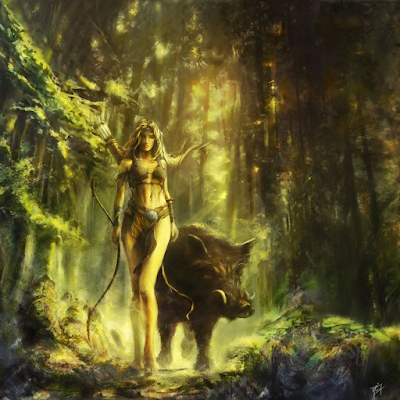
    • Ardwinna is often portrayed riding a wild boar through the woods.


    Goddess Dziewant Or Devana Or Diiwica.


    Dziewant to, also known as Devana and Diiwica.


    She is the Goddess of the hunt in Slavic mythology.

    Dziewant to, like the Roman Diana, was revered as the Maiden Goddess of the Forest across Eastern Europe.

    She is the spring goddess who influences agriculture and the weather, and she is especially revered by farmers.

    She is said to gallop across the mountains with wild dogs or wolves during the three nights of the full moon as a lunar deity.

    She is the endless virgin, or more accurately, an autonomous goddess who has many lovers but chooses none.


    Goddess Mahuika


    Mahuika: Maori fire goddess.

    Mahuika is a demon that resides in the underworld and is in charge of fire and earthquakes.

    She was duped into gifting mankind fire since she possesses flames for fingernails and toenails.

    She is linked to caverns and is the cause of forest fires.


    ~Kiran Atma


    Goddess Bugady Musun


      Siberian mother of animals, Bugady Musun. 


      Bugady Musun is the ruler of all life and food, as well as the protector of all creatures and nature. 


      • She is shown as an elderly yet brawny lady who protects and guides vets. 
      • She is a shapeshifter who may appear as a reindeer or an elk to her petitioners.


      Bugady Musun is a Siberian divinity who was especially adored by the Evenki. 


      She was the protector of animals and the patron of nature. 


      She was generally a fierce elderly lady or a massive female elk or reindeer.

      Many Siberian peoples worship this deity. 


      Bugady Musun was the protector of animals and the patron of nature.
      The antlerless female elk (a symbol for the ever-renewing source of human nutrition) and a boat initially appeared in the Baykal Neolithic era as the deer (a metaphor for the passage of the soul into another world after death). 

      The Baykal Neolithic elk vanished in the late third or early second millennium BC (the Bronze Age), and a new group of representations (bull, cattle, deer, people in different ceremonial situations, cartwagon-wheeled vehicles) arose in South Siberia. 


      The female elk was replaced with a clearly female half-human, half-animal creature, who subsequently returned as a cow. 


      As a cow, this picture came from a tradition that had previously crowned her horns, and as a deer, it came from a northern tradition that had previously given her an elk's body. 


      Her indications and location as a woman connected her with life and death (at the Minusinsk monoliths, for example, this is expressed by the stones being rooted in the ground-the vertical axis-and their masks aligned towards the east). 

      On the higher reaches of the major Siberian rivers, Neolithic sanctuaries with petroglyphs such as the Baykal female elks have been discovered, as have Bronze Age ceremonial sites erected in large valleys surrounded by mountains. 

      Such a shift reflects a shift from relying on forest and river hunting and fishing to relying on pasture-based cattle farming. 


      Mongolia, the Sayan Altai Ridge, and the Minusinsk Basin formed a prominent cosmos during the Bronze Age. 


      There was a relationship with the Indo-European legendary tradition of a solar chariot and warriors in relation to the contemporaneous appearance of bull and cart representations in South Siberia. 

      Similarities between Yamna-Afanashevo (pit-grave) and Shrubnaya-Andronovo (timber-grave) civilizations are to blame for such alterations. 

      People with Indo-European heritage gradually migrated from the west and southwest into northern Kazakhstan, northern Altay, and Mongolia. 

      The elk continued to dominate late Bronze Age imagery in the shape of a deer, which was carved on rock walls and boulders, as well as around monolithic people in different ceremonial contexts. 


      This occurred in South Siberia and Mongolia around the first millennium BC. 


      The phenomena is particularly relevant to the region's so-called deer stones, and it complicates their interpretation. 


      There are two kinds of stones like this. 

      The Mongolian and Transbaykalian types, which feature deer in a recumbent position with exaggerated antlers, beak-like heads, graceful necks and bodies, short triangulated forelegs, and truncated hindlegs, are more common in Sayan-Altay. 

      We see carved chains of beads around the stone's neck, three parallel slanted lines at the side of the face, carved markings that seem like earrings, and a carved belt with hanging weapons or tools on both kinds of stones. 


      Carved depictions of animals, including deer, boar, horses, caprid, and crouching feline or wolf-like creatures, fill the gaps in between. 


      Wecan further examine what is known as the semantics of the deer stones, based on archeological data. 

      We can cast doubt on the widely held belief that the deer stones are linked to the Indo-European legend of an original masculine hero (a male warrior). 

      Comparisons of the Siberian stones' hanging instruments to the so-called Cimmerian Stelae and Scythian Baba seem to have led to the conclusion that they depict males, maybe even males as hunters or warriors. 

      Despite the presence of the hanging weapons/tools, no signs of belligerence are there. 

      These forms may be traced back to the Early Nomads' older symbolic forms, and that at least one of the three images central to the Scytho-Siberian artistic heritage came from South Siberia (the deer, the coiled feline, and a wolf-like animal). 

      The presence of weapon-like objects, as well as the correlation of these stones with the image of the deer, has led to the belief that the deer is a symbol for the warrior. 

      It is based on a connection between the masculine warrior and a solar complex of deer, gold, and horse. 

      This solar relationship did not always exist, and  the figure was more likely feminine in character, which is why it was associated with the image of a deer during the Early Nomads period.

      We can analyze the culture and mythology of the Paleo-Siberian Ket and the Tungusic Evenk in an effort to rebuild ancient mythological and ceremonial symbolic systems, considering this to be the richest and most important source for this purpose. 


      The Ket concept 


      The Ket concept of the Khosedam/Toman duality, as well as the Evenk concepts of Bugady Mushunin, "the mistress of the clan," and bugady enintyn, "the mistress-mother of the clan" (both combining the idea of woman and cow elk or wild cow reindeer [half-human, half-animal]), as well as beliefs and rituals associated with those deities. 


      To bridge the gap between archeological and ethnographic data, we can make many hypotheses and suggestions. 

      When it comes to the origins of shamanism, it is premature to explain the archeological traces of Siberian Neolithic, Bronze, and early Iron Age cultures with reference to shamanic practices that are only known from recent times, given that our evidence for the existence of shamanic institutions consists primarily of petroglyphic images of masks or horned figures. 

      The shaman's ability to complete the shamanic journey is reliant on items such as a drum that serves as the shaman's steed; a robe with a headdress adorned with imagery and amulets that simultaneously protect, empower, and transform the shaman; and, finally, a vertical axis, real or imagined, that serves as a pole linking the underworld, earth, correlating the signs and symbols connected with the shaman with the indicators of a trip beyond death found in Early Nomadic graves reveals that power was shifted from the early Iron Age. 


      Furthermore, the poems detailing the shaman's trip, as well as the voyage itself, have clear connections with zoomorphic imagery from the Early Nomads' time. 


      Despite this, the parallelism is just suggestive. 


      Early Nomads' Deer Image.


      The elaborate stone structures of the Early Nomads, as well as the enigmatic symbolic structures with which they laid their dead and their horses to rest, were the result of a process reflected in the Ket and Evenk mythic traditions and enclosing most archaic layers that continued through millennia. 


      Beginning with Ninhursag and concluding with Anahita/Nana, we can delve into the Pontic Scythian legendary legacy as told by Herodotus, as well as the greater history of Near Eastern goddesses. 

      The Scytho-Siberian aesthetic tradition in its ceremonial framework, as well as Siberian mythological traditions are seen in ethnography. 


      From this evidence that the Early Nomads' deer image, which they inherited and expanded into the heart of their symbolic systems, represented an ecosystem of belief. 


      Predatory animals were followed by the deer, which joined the Age of the Early Nomads as a reclining (or, more rarely, a standing) beast. 

      Predatory animals were then rejected due to an increased preoccupation with human iconography and realism. 


      The Deer As A Woman.


      The deer took on the appearance of a lady sitting before a man carrying a rhyton towards the conclusion of the Scytho-Siberian era (see for instance the North Pontic Chertomlyk, Karagodeuashk, the Merzhany plaques, the figures of the Prigradnaya "Scythian Baba," and the felt hanging from Altay Pazyryk). 

      However, it was eventually overshadowed as a woman, with only a male figure referring to her. 


      The deer was destined to survive solely via Siberian and Central Asian shamanic traditions when Scytho-Siberian society vanished. 

      The deer picture provides evidence for the birth and eventual extinction of a genuinely Siberian cosmogonic source: the Animal Mother, the source of life and death, rather than a solar hero or Indo-European ideals.


      ~Kiran Atma


      References And Further Reading


      • Jacobson, E., 2018. The deer goddess of ancient Siberia: a study in the ecology of belief. Brill.
      • Fitzhugh, W.W., 2009. Stone shamans and flying deer of northern Mongolia: Deer goddess of Siberia or chimera of the steppe?. Arctic Anthropology, 46(1-2), pp.72-88.
      • Bleeker, C.J., 1975. The Rainbow: a collection of studies in the science of religion (Vol. 30). Brill Archive.
      • Shigehiko, F., 1996. The Deer Goddess of Ancient Siberia: A Study in the Ecology of Belief.
      • Francfort, H.P., 1993. The Deer Goddess of Ancient Siberia. A Study in the Ecology of Belief (Studies in the history of religions [Numen Book Series] vol. LV).
      • Champouillon, L., 2012. Varieties of Deer Imagery: Gender and Cosmology in Prehistoric Belief Systems of Central Asia and South Siberia.
      • Fitzhugh, W.W., 2009. The Mongolian Deer Stone-Khirigsuur Complex: Dating and Organiation of a Late Bronze Age Menagerie. Current arc
      • Boucherit, G., 2011, August. A deer cult in Buile Suibhne. In XIV COMHDHÁIL IDIRNÁISIÚNTA SA LÉANN CEILTEACH XIV INTERNATIONAL CONGRESS OF CELTIC STUDIES.
      • Lymer, K., Fitzhugh, W. and Kortum, R., 2014. Deer Stones and Rock Art in Mongolia during the Second to First Millennia BC. Deer and People, p.159.
      • McFarland, R. and Schalaben, W., 1995. Placentas and Prehistoric Art. The Journal of Psychohistory, 23(1), p.41.
      • TATAR, S., The Legend of the Palóc Prince of Göcsej: Images of Bridled Deer and Antlered Horses. Cosmos: the yearbook of the Traditional Cosmology Society.
      • Diószegi, V. and Rajkay Babó, A., 1968. Tracing shamans in Siberia: the story of an ethnographical research expedition.