Showing posts sorted by relevance for query South American. Sort by date Show all posts

Goddess Akewa


    Akewa is a South American sun deity. 


    • She is the sister and guardian of all earthbound women, rescuing them from patriarchal enslavement. 


    • She travels across the sky every day, warding devils out with her brilliant beams of light.


    The Matrilineal South American Toba Tribe's Mythology Of Akewa.


    Akewa is considered to be a sister to all Earthly women and the Goddess of the Sun. 


    • The matrilineal Toba of Argentina's solar myth depicted a primal country in the sky inhabited with lovely sun ladies, while the ground was populated by hairy males.
    • The sun ladies descended to the surface one day and left Akewa behind. 
    • When the hairy men ate their rope ladder, the sun maidens were stuck on Earth. 
    • The descendants of the sun ladies lived among men after that, staring up at Akewa, a big smiling lady who traversed the sky. 
    • In the summer, she got older, walking more slowly and prolonging the days, but in the winter, she became younger, and her quick stride made the days shorter. 


    References And Further Reading:


    • Auset, P.B., 2009. The goddess guide: Exploring the attributes and correspondences of the divine feminine. Llewellyn Worldwide.
    • Woodfield, S., 2014. Drawing Down the Sun: Rekindle the Magick of the Solar Goddesses. Llewellyn Worldwide.
    • Monaghan, P., 1990. " She Want It All": The Sun Goddess in Contemporary Women's Poetry. Frontiers: A Journal of Women Studies, pp.21-25.
    • Bonheim, J., 1997. Goddess: A celebration in art and literature. Stewart, Tabori & Chang.
    • Holland, E., 2005. Holland's Grimoire of Magickal Correspondence: A Ritual Handbook. Red Wheel/Weiser.
    • Heritage, H., IT'S RENEWAL TIME!.
    • Badikian, B., 1994. Mapmaker.(Original writing) (Doctoral dissertation, University of Illinois at Chicago).
    • Stone, M., 1979. Ancient mirrors of womanhood: our goddess and heroine heritage (Vol. 1). New Sibylline Books.
    • Stein, D., 2012. Casting the circle: a woman's book of ritual. Crossing Press.


    Queen Of Heaven - Goddess In The Stars


    The many stars in the night sky, which were so apparent to our forefathers before the development of artificial lighting, were sometimes referred to as spirits or minor divinities. 

    When they were female, they were commonly shown as lively young ladies (Slavic Zorya), and were frequently the children of the sun and/or moon goddess (Baltic Ausrin and Valkyrin). 

    Occasionally, a temptress occurs, such as African Morongo (see Massasi), who lusted for her son and, after her husband raped her, planned for his murder as a punishment. 

    A star goddess may appear as an elderly lady, as in the case of South American Ceiuci, or as a young woman, as in the case of Tibetan Goddess. 


    Traditionally, a few stars and star groupings have been noted for their prominence in the sky at various times. 

    In Egypt, the rise of the star Sirius in the springtime corresponded with the Niger River's land-renewing floods. The star was related with rebi and was the chariot of the goddess Sothis. 

    The morning and evening star, which we name Venus after a Roman goddess who was not originally related with the planet, occurs in numerous mythology (Eastern Mediterranean Ishtar and Astarte, North American Gendenwitha); she was usually connected with relationships and love. 

    The sexual relationship might be catastrophic at times, as with the Baltic Saul's Meita, the cherished sun daughter raped by her moon dad. 

    Occasionally, a star goddess is linked to a human enterprise other than lovemaking, such as when Celtic Sirona controlled the healing arts. 

    Many civilizations saw the Pleiades as a group of sisters or playmates (North American Chehiayam and Kusi'tawa'qari, for example). There are a variety of stories for how a group of girls became stars, including being punished for doing something banned (typically little, such as whistling) or developing from a mutual attraction for males who dwell in the area. 

    Violence or incest is occasionally invoked, as it was with Australian Abobi. Their father, a rapist, chased that goddess's daughters until she transformed them into s Some constellations, such as Andromeda, Cassiopeia, and Cyno, are named after Greek gods and heroines. 

    Finally, the goddess Tou-Mou emerged as the pole star or North Star in China.


    ~Kiran Atma

    You may also want to read more about Goddess Symbolism here.


    Goddesses Of The Earth


    The most common symbol for goddesses is the earth, although it can be argued that the symbolism goes the other way around: that goddesses symbolize earth, both as soil and as planet. 

    Whichever came first, the connection of goddess and earth is found through out the world. 

    It is not, however, invariable. The binary opposition of male/sky and female/earth is sometimes reversed. 

    Earth gods are found in some cultures, often asso ciated with sky goddesses, a subject that has not been sufficiently studied to determine its frequency. 

    Despite exceptions, however, earth and goddess are connected in many cultures, so much so that goddesses whose symbolism was originally other evolve into earth goddesses over time. 

    In some cases, however, writers unthinkingly and inap propriately use the term ‘‘earth goddess or ‘‘earth mother where the divinity in question is a celestial or cosmic figure. 

    Earth goddesses are often described as creating the earth (see also Creatrix, below); such goddesses can be described as self-creating. 

    In Korea, MaGo created the world by singing, while in Greece, the earth goddess Eurynome created the universe through dance. 

    Some earth goddesses do not create the land but populate it by creating humans and animals. 

    African Butan was the first creation of the double-sexed primary god. 

    She then populated the world without need of mate. 

    Earth goddesses often create vegetation from their bodies, the rich soil. 

    Because humans and animals require vegetation to survive, earth goddesses are envisioned as benevolent and generous. 

    In some cases, the connection between earth and nourish ment is made clear, as with Indian Basmoti who created rice by vomiting it forth. 

    This generosity can be seen in the name of the early Greek earth goddess Pandora, ‘‘all giver, or Danish Gefjion, ‘‘gift (see Scandinavia). 

    Such images tend to come from cultures that practice agriculture. 

    Where people live from fishing and hunting, the goddess of abundance is more typically connected with wildlife (see Animals, below). 

    Many earth goddesses are described as maternal forces, providing for the creatures of earth as a good mother provides for her children. 

    Some myths put special emphasis on the maternal feelings of the goddess, as in the Greek story of Demeter and her lost daughter Persephone. 

    Baltic Zˇ emyna appeared at the birth of every child, and Sibe rian Umay (see Circumpolar, Umaj) was the placenta that feeds the fetus as the earth feeds its creatures. 

    Other myths connect goddesses of earth with human fecundity. 

    Estonian Ma-Emma (see Finno-Ugric) was the fertile, endlessly pregnant earth, and as such controlled the wombs of young women, permitting them to bear children suc cessfully. 

    The Roman earth goddess Anna Perenna responded to the sexual activities of humans by growing more fertile. 

    Goddesses like Scandinavian Fulla and Roman Ops, from whose names the En glish words ‘‘full and ‘‘opulent derive, represent both bountiful vegetation and the abundant life expressed in human procreation. 

    African goddess Aje was similarly con nected with abundance of all sorts, including food, money, and beloved children. 

    She created the soil that bears crops by scratching at it in primordial times, when it was hard as rock and she wore the body of a chicken. 

    Hindu Laks˛mı, often represented by coins and bills, began as an earth goddess whose abundance created monetary wealth. 

    As an esoteric symbol, she represents spiritual wealth as well. 

    The earth has rarely been seen as a solitary divinity. 

    Rather, she is envisioned as part of a divine family that includes gods as well as other goddesses. 

    At times, the earth was part of a family headed by the maternal sun, as with Finno-Ugric earth goddess Mu kilˇsin-Mumi, whose sister was the sun, or Baltic Z˘ emyna, who was the suns daugh ter. 

    In other cases, we find the earth as mother of a clan that includes goddesses of cul ture and of food; the Pawnee earth divinity was Atira (see Native American), whose daughter was the corn goddess. 

    Often, the earth mother was the mate of a sky god. 

    In Polynesia, the earth goddess Papa lay in perpetual intercourse with her sky husband and had to be forcibly sepa rated from him in order for other life to emerge. 

    In Greek myth, earth mother Gaia birthed many children after mating with the sky god but finally grew weary of his end less sexual demands. 

    She convinced one of her sons to castrate him, thus ending their endless embrace, after which she gave birth parthenogenetically. 

    The Zun˜i goddess Awitelin Tsita lay in continual intercourse with the sky until she conceived the human race. 

    Her husband, the sky, solicitously attended upon Maka of the Lakota as she cre ated humanity (see Native American for both). 

    Although typically the earth goddess hungered for intercourse, a few earth god desses were unwilling sexual partners. 

    Hindu Tarı (see India) refused the solicitations of the sun god, whereupon he created human women to serve his sexual needs. 

    Even when the goddess is energetically sexual, many myths describe tensions among the divine family, with the earth mother siding with her children against her spouse. 

    The earth goddess is never described in fearsome or negative terms, although she can be seen as a strict keeper of order, as was the case with Greek Themis, who represented the force of law. 

    Judgmental goddesses sustain the natural laws and punish those who break them. 

    Such goddesses could be punitive, as when the Mongol earth goddess Etugen brought about earthquakes to purify the land of peoples wrongdoing. 

    Hindu P rthivi (see India) also showed her displeasure at human failing by shaking fiercely, as did South American Pachamama. 

    Because earth goddesses serve as all-seeing witnesses to what transpires on their surface, people turned to them when oaths were required. 

    Slavic people held a handful of soil while swearing by Zˇ emyna (see Slavic), and Romans pointed downward toward the earth goddess Tellus when they made a pledge. 

    African Ala was a force of social order, for she witnessed all promises and knew instantly when one was bro ken because there was nowhere on earth where one could hide from her. 

    Also in Africa, followers of Oddudua devote themselves to maintenance of social order. 

    Greek Demeter was known as the lawgiver (‘‘Thesmophoros), for she created the order of the ideal human society as she did for the rest of nature. 

    The connection between earth and human society can be detected in the name of the Scandinavian earth goddess Fjo¨rgynn, from which we derive both the words ‘‘earth and ‘‘hearth. 

    Just as she could see anything that happened on her surface, the earth goddess could see into the future. 

    Thus she represented the force of destiny. 

    Iranian A rmaiti (see Eastern Mediterranean) ruled both reproduction and fate, which in many cultures were seen as inextricably linked. 

    As the overseer of birth, the goddess was in the position to know the fate of each newborn. 

    Just as often, earth goddesses are connected to death, especially in cultures where the dead were entombed within the earth; the dark skin of Russian Mokosh (see Slavic) was not only the color of fertility but of the endless night of death. 

    The earth goddess was literally the earth beneath our feet. 

    Siberian Mou-Njami had soil for skin and green grass for hair. 

    In that culture, digging into the earth was forbid den, because to do so would be to injure the goddess. 

    Southeast Asian Ponniyamman is depicted as a rock head, sitting on the earth, which forms her body. 

    Some goddesses occupy specific and delimited areas of land—for example, mountains. 

    One of the worlds most famous peaks is named for the Hindu goddess Annapur˛na (see India). 

    Sometimes a single peak is designated as the embodiment or residence of the goddess, as in the Irish triad Bandba, Fodla, and E riu, or the Native American goddess Tacoma of the mountain that bears her name. 

    In other cases, goddesses occupied entire mountain ranges, such as Celtic Echtghe, after whom low hills in County Clare are named. 

    Occasionally the goddesss mountain is an imaginary one; Xiwang Mu of China was envisioned as occupying the supernatural Jade Mountain. 

    Volcanoes were commonly imagined as goddesses, but connected with fire rather than earth (see Fire, below). 

    Goddesses inhabited and embodied forests. 

    Because these forests were important sources of wild food, Celtic Ardwinna and Greek Artemis were connected with hunt ing, while Finno-Ugric Vir-Azer-Ava was associated with foraging for berries and mushrooms. 

    But dense forests could also be dangerous. 

    Thus threatening figures were described as ready to kidnap people who lost their way in the woods, like the Scandi navian Skogsnufvar (see Buschfrauen) who froze people to death for wandering in her domain. 

    Mountain and forest goddesses can be seen as specialized forms of the earth goddess. 

    Another category was the territorial goddess who represents not the entire planet but the region occupied by a single group. 

    The alternative name of the Roman Tellus was Italia, a name also given to the long mountainous peninsula she ruled. 

    In India, multiple goddesses called by the generic Gramadevata represent the land on which a villages people depended. 

    In Ireland, land goddesses often appear as god desses of the watershed, showing the necessary connection of earth and water for fer tility (see Celtic Aveta, Sequana, Berba, Boand, Sınann). 

    Given the frequency of association of goddess and earth, it is not uncommon to find earth goddesses also iden tified as goddesses of water, abundance, and creation. 

    ~ Kiran Atma

    You can learn more about Goddess Symbolism here.


    Goddesses Of Water


    After earth, the symbol most commonly associated with goddesses is water, both as the fresh water of rivers and streams, and as the oceans salty waves. 

    The gendering of water as feminine is not invariable, however. 

    Some mythologies describe the oceans as masculine. 

    The Greeks had a sea god, Poseidon, while a similar figure among the Irish was Manannan mac Lir. 

    In both cases, the ocean was defined as masculine, as dis tinguished from fresh water, which was feminine. 

    Among the Greeks, who despite see ing the ocean as masculine pictured its waves as the innumerable feminine Oceanids, we find the freshwater Nymphs called the Nereids. 

    The Irish knew many river god desses such as Sınann, Berba, and Boand, while outside Ireland we find dozens of Celtic water goddesses including Abnoba, Aveta, Coventina, Natosuelta, and Sabrina. 

    This salt and fresh water distinction, however, is not universal. 

    Some goddesses were described as ruling the oceans, including the Scandinavian Ran who ruled the northern sea, and Chermiss Bu¨t aba and Finnic Mere-Ama (see Finno-Ugric), whose domains were similarly in the arctic waters. 

    Hebrew Miriam (see Eastern Mediterra nean) was connected with the ‘‘bitter waters or the salty seas, although a freshwater stream created by her brother Moses also bore her name. 

    The connection between the oceans salt water and female fertility is emphasized in the Hindu myth of Prakrti (see India), whose amniotic fluid became the oceans after she gave birth to the gods. 

    In many cultures, an ocean goddess controls the fish and mammals that live in her waters and on which humans depend for food. 

    An important example of such a figure is Inuit Sedna (see Circumpolar) who, thrown into the water as a sacrifice, thereafter receives sacrifices herself as the ‘‘great food-dish. 

    Finnish Vellamo (see Finno Ugric), too, is an ocean goddess who determines how many fish humans can take from her waters, taking advice from her many daughters, the waves of the sea. 

    Similarly, the South American sea-mother Mama Cocha brings fish and sea-mammals close to peo ple so that they can be harvested for food. 

    Fishermen often fall under the rulership of ocean goddesses, who like Ma-tsu (see China) protects them when they are faring on the waves. 

    In some cases, the oceanic goddess is depicted as a primordial mother or creatrix, one from whose depths life was born, as with Babylonian Tiaˆmat (see Eastern Mediterranean). 

    Finno-Ugric Luonotar, while not the ocean itself, is intimately con nected with it, having spent much of eternity floating on cosmic waters. 

    The sky woman of the American Iroquois, Ataensic, floated on the oceans waters until earth was created (see North America). 

    Wherever the waters of the Wintu goddess Mem Loimis fell, the earth grew fertile, while areas not endowed with her watery gift were left as desert (see North America). 

    Ocean goddesses could be charming and delightful. 

    Lithuanian Amberella tossed pieces of amber to the shore, to reward those who honored her, and Greek Aphrodite was ravishingly beautiful even when fickle. 

    But they could also be dangerous. 

    Mer maids and sirens, which appear in many mythologies as ocean-dwelling women of great beauty, are threatening water divinities who lure sailors to their death. 

    Such fig ures guarded the boundaries between water and land, like Siberian Sug Eezi (see Circumpolar) who like other mermaids had long hair that mimicked the rippling streams that she inhabited. 

    Celtic Korrigans danced each night, drawing victims to themselves and drowning them. 

    Greek Aphrodite was born of the oceans waves and, although beautiful, could also be pitiless, for love is never without possible threat of loss. 

    In China, the primary goddess Xiwang Mu controlled the worlds waters and was invoked when floods threatened, showing that the activities of such cosmic god desses could be damaging to humanity were she not ritually appeased. 

    Thus ocean goddesses represent both creative possibility and danger. 

    Goddesses associated with fresh water are powers of fertility. 

    Such watershed god desses can be seen as divinities of the land as well as the rivers that drain it. 

    In India, many rivers are imagined as goddesses of earthly abundance, none more so than the Ganges, whose powerful river drains much of the subcontinent and is seen as the actual body of the goddess Gan ga. 

    In Egypt, where the annual inundation of the land by the river Nile was typically associated with the god Osiris, we find the water goddess Anu ket representing the connection between water and the lands increased fertility. 

    In Africa, major rivers were goddesses (Yemaja, Oshun, O ya) who were sometimes in conflict with each other over their shared consort. 

    Such river goddesses were typically maternal forces, providing their human children with sustenance. 

    A similar goddess in Russia, Mokosh (see Slavic), was a motherly figure whose presence was most actively felt in budding springtime. 

    Smaller water sources such as springs and creeks could be seen as threatening rather than helpful. 

    In Slavic lands, supernatural women, once human, haunted quick-flowing streams. 

    Deprived by early death of a chance to have children, the Rusalki drowned sweet babies or fertile young people. 

    The Scandinavian Nixies were similarly danger ous. 

    In tribal India, the Nippong especially targeted young pregnant women, whom they caused to miscarry. 

    Such spirits were often most active in spring and may re present the possibility of flash floods. 

    Tribal Indian Bai Tanki, another destructive river goddess, spreads disease through her water—a mythic narrative with a firm basis in science, for polluted water can indeed spread disease. 

    Fountains and bedrock springs were often seen as locations of inspiration because of the goddesses who inhabited them. 

    The Greek Musae are still known as an image of the force that causes artists to create. 

    In India, the river goddess Sarasvatı was the source of inspiration as well as a cosmic creatrix. 

    Such inspiration could be legal and organizational as well as artistic. 

    Among the Roman water nymphs called the Camenae was Egeria, who oracularly dictated the first laws of Rome and whose name is still used to describe a wise woman advisor. 

    Freshwater goddesses, endowed with the gift of seeing the future, could help those who wished to practice the oracular arts. 

    Babylonian Nanshe (see Eastern Mediterra nean) was a fortune-tellers goddess celebrated at waterborne festivals. 

    Prophecy was not always seen as a gift; the Greek water Nymph Telphusa killed anyone who drank her prophetic waters. 

    Yet most often, prophecy was a positive act, connected with heal ing because the ill and infirm turn to oracles in hopes of receiving predictions of pos itive change. 

    So common was the connection between springs and healing among the Celts that the names of many of their goddesses have been lost, for they were renamed ‘‘Minerva Medici after the Roman goddess of healing, during Imperial occupation. 

    Healing was a common part of the domain of the freshwater goddess, a tradition that continues today with the prayerful use of water from the well at Lourdes, France, dedicated to the virgin Mary (see Eastern Mediterranean). 

    In Africa, we find the lake goddess Idemili and the water spirit Mammywata, both of whom offered healing to their worshipers. 

    The Hindu goddess Narmada (see India) was especially powerful against snakebite, while the healing offered by Gan ga extended beyond this life, for those who died in her waters were freed from the cycle of rebirth. 

    Some important goddesses controlled all water, whether found in rivers or in oceans. 

    Anahita, one of the most important Persian divinities (see Eastern Mediterra nean), ruled everything fluid in the universe, even those of the human body. 

    Similarly, among the Lithuanians (see Baltic), the water mother Jurat˙e controlled all the earths waters. 

    Aztec Chalchihuitlicue (see Mesoamerican) could be found in lakes, rivers, and the ocean. 

    Finally, some goddesses could be described as divinities of what science calls the water cycle, for they ruled the rain that falls on the land, the bodies of water (above ground and underground) that gather the rain and return it to the ocean, and the ocean where clouds are born to return water to the land. 

    Such goddesses connect air and water like the African sky woman Andriana who descended to earth to become a water goddess. 

    Rainbows, those bridges between sky and earth formed by water vapor, often symbolize such goddesses. 

    In Australia, the primal serpent Julunggul ruled ocean, rivers (especially waterfalls), and rain; she was embodied in the rainbow. 

    A similar rainbow-water-snake spirit found in Haiti was Aida Wedo (see African Diaspora). 

    ~ Kiran Atma

    You can learn more about Goddess Symbolism here.


    Goddesses Of Fish And Insects


    Those who live by fishing often honor a goddess who controls the sea life, such as the important Eskimo goddess Sedna (see Circumpolar), Celtic Nehalennia, or Finno-Ugric Avfruvva. 

    In South America, Mama Cocha was the ‘‘mother of whales because she brought the massive mammals close to hunters. 

    Polynesian Lorop (see Pacific Islands) lived under the earth, sending up food for her children in the form of fish. 

    In other cases, the goddess was seen not as controlling the sea creatures but as one of them, as with Celtic Lı Ban, transformed into a salmon, and Eastern Mediterranean Atargatis, who swam in the pool of her temple as a trout. 

    In India, the group of spirits called the D akinıs took on fish shapes to attend upon the goddess of death, Kalı. 

    In Africa, the heroine Chichinguane joined the fish people because her human kin were unkind to her. 

    Among insects, the industrious bee and the crafty spider are common goddess images. 

    Bees, whose hives are centered on a queen and whose female workers produce honey, appear as companions of goddesses associated with social life. 

    Lithuanian Aus t ˙eja was celebrated in an annual holiday dedicated to bees. 

    Artemis of Ephesus, goddess of the warrior Amazons (see Greece), was depicted surrounded by bees; her priestesses were called Melissae, also a name used of bee Nymphs. 

    Irish Gobnait (see Celtic) lived among bees that warned her of approaching danger. 

    Spiders, with their ability to weave intricately architectural webs from their own bodies, appear as creatrix figures in several cultures. 

    Hopi Kokyangwuti created human beings; Cherokee Kanene Ski Amai Yehi brought the sun to earth. 

    Greek Athena was connected to spiders because she made the first one from an insultingly competitive human girl, Arachne. 

    Finally, both butterflies (see Psyche, see Greece; Ix Chel, see Mesoamerica) and scorpions (South American Ituana, Egyptian Selkhet) appear as goddess images. 

    ~ Kiran Atma

    You can learn more about Goddess Symbolism here.


    Goddesses Of Vegetation


    In some areas, vegetation is connected with a male god. 

    In Southeast Europe, for in stance, the mountain goddess Cybele took the tree god Attis for her lover. 

    In spring rit uals in the eastern Mediterranean, women planted gardens of Adonis, dedicated to the young lover of Greek Aphrodite who was killed in his prime, as the seedlings of the Adonis gardens were to die after a brief period of growth. 

    The connection of male divinity with vegetation has been described as the background for the image of the Christian savior Christ, meeting his death upon a dead tree. 

    Most cultures have connected plants with goddesses. 

    Such goddesses were typically associated with agriculture and represented the abundant food produced by the fertile fields. 

    Such vegetation goddesses can be forms of the earth mother (see above), for goddesses embodied in the fertile soil and those found in plants that spring from that soil can be difficult to distinguish, if indeed such a distinction was made by the god desss followers. 

    Goddesses of vegetation can be embodied in plants (African Abuk, who was a bean; Southeast Asian Hainuwele, who turned into a date-palm) or may tend them as gardeners (Hawaiian Hiiaka, African Mbokomu, South American Nugkui). 

    A cultures vegetation goddess reveals its mainstay foods, for which reason many goddesses are connected with grains rather than, for instance, leafy greens that do not store well and are available for only part of the year. 

    In the eastern Mediterranean, Ninlil and her mother Ninshebargunu ruled barley and other nourishing seeds. 

    In Rome, we find Ceres, from whose name we derive a term for grains. 

    Similarly, Greek Demeter and Slavic Z˘ emyna are connected with wheat and rye and barley, called ‘‘corn in old texts that use the term ‘‘maize for the yellow grain from the Americas. 

    In India and southeast Asia, goddesses were associated with the mainstay of the daily meal, rice, most famously embodied in the Hindu goddess of wealth, Laks˛mı, who appears in Bali and nearby islands as the primary goddess Dewi Shri. 

    A similar goddess was Basmoti, whose name we still use for a type of rice; in central India, Astangi Devı brought humans not only rice but bamboo, with its edible shoots. 

    In Japan, the rice goddess was the fox-woman Inari, a divinity who is still very popular today. 

    In central and north America, the goddess of agricultural plenty was connected with maize or corn; Cherokee Selu and Pawnee Uti Hiata are among the ‘‘corn moth ers of the Americas. 

    In South America, where the potato was a mainstay of life, the goddess of abundance was Pachamama. 

    In the Pacific, the goddess Pani was associ ated with yams, an important food plant. 

    Goddesses of vegetation could be divinities of birth as well, not only because farm ing reproduces plants but because sufficient food is necessary for women to become pregnant. 

    In Babylonia, the birth goddess Bau derives her name from a term meaning ‘‘giver of vegetables (see Eastern Mediterranean). 

    In Thailand, the primary goddess is Mae Phosop, deity of rice who appears as a pregnant woman when the grains swell to maturity and who gives birth to the new crops (see India). 

    In Australia, Imberom bera walked around creating life by giving birth and forming plants (see Mutjingga). 

    Not only were vegetation goddesses associated with birth; they were also connected with death. 

    In the cycle of the crops, farmers saw their own lives: flourishing in youth, reaching productive adulthood, finally dying. 

    This identification was reflected in myth. 

    African Asase, who claimed the dead, was primarily a goddess of vegetation. 

    Nambi, also from Africa, stole seeds to bring food plants to earth, but unwittingly opened the way for death to descend from the heavens. 

    In Egypt, the tree-living death goddess Ament offered food to the newly dead, the tasting of which kept them from returning to life. 

    Yet even in death, vegetation goddesses promise new life. 

    Egyptian Hekt was embodied in grain, which seems to ‘‘die before it sprouts. 

    Eating the fruit of Chinese Xiwang Mus magical peach tree transformed the deceased into an immortal. 

    Flowers and fruit both serve as goddess images. 

    Often the goddesses are depicted, respectively, as younger and older, with a nubile goddess envisioned as a deity of flow ers while a more mature goddess is the resulting fruit. 

    Among important flower god desses we find Romes Flora, divinity of prostitutes and sexuality; Bloduewedd in Wales (see Celtic), a heroine made completely of flowers; Greek Persephone (Roman Proserpina), a maiden goddess raped while picking crocuses; and the Aztec Xochi quetzel, the deity embodied in the marigold. 

    In India, the Apsaras were bedecked with flower garlands that, if offered to a human, indicated willingness to engage in intercourse. 

    In Russia (see Slavic), a young woman embodying Berehinia wore a crown of red flowers to represent the goddess. 

    As flowers are the genitalia of plants, they often symbolize the goddesss female organs. 

    The fruit that results from pollination of flowers becomes the symbol of mature god desses. 

    The most familiar is the apple associated withEve, ancestral mother of humanity (see Eastern Mediterranean). 

    The peach offered by Chinese Xiwang Mu brought immortality to the eater. 

    A pomegranate represented Hera, Greek goddess of womans power. 

    The apple was connected with Lithuanian Saule˙ (see Baltic). 

    Among goddesses of fruit we find several connected to intoxication, for sugary fruit naturally ferments into wine. 

    Sumerian Nikasi was embodied in strong grapevines (see Eastern Mediterranean). 

    African O ya was connected with palm wine; Greek Oeno, with wine from grapes. 

    The tree provided an image of the goddess as provider of food, with fruit trees espe cially regarded as feminine. 

    In Scandinavia, where fruit varieties were limited, Idunn was associated only with apples, while in Japan, Kono-Hana-Sakuya-Hime and Yaya-Zakura were goddesses of the cherry tree and Rafu-Sen of the plum. 

    Greek Carya ruled the walnut, Irish Buan the hazelnut (see Celtic), Roman Rumina the fig. 

    Even trees that do not bear edible fruit or nuts had goddess associations. 

    Many trees were described as inhabited by feminine spirits like Greek Dryads, tree-living Nymphs who died when their tree died. 

    Similarly, Scandinavians envisioned the for ests of northern Europe as inhabited by Askefruer, ash-tree women. 

    The Greeks con nected goddesses with specific tree species, as with the multiple Heliaces (poplar) and Meliae (ash), as well as the singular Daphne (laurel) and Carya (walnut). 

    Tree cults are attested in Greek religion, including one centered on Helen, who was ritually hung from a tree in ancient times. 

    Such goddesses could appear as ancestral figures; among the Scandinavians, Embla was said to have been the primordial woman, born of an ash tree. 

    Trees were the preeminent image of the Hebrew goddess Asherah, whose image was carved from a wooden plank. 

    The Arabic goddess Uzza was also honored in groves of trees (see Eastern Mediterranean for both). 

    ~ Kiran Atma

    You can learn more about Goddess Symbolism here.


    Goddesses Of Air


    Goddesses of air are uncommon, perhaps because air is not visible, audible, or tangible until it forms itself into wind and thus is difficult to imagine as having personality, much less gender. 

    Only one goddess represents the invisible atmosphere that envelops and sustains us. 

    The name of Inuit Sila (see Circumpolar) has been translated as ‘‘air, and this goddess embodies the entire cosmos that sustains life. 

    She is also associated with the visions of shamans, who traveled through the air without touching ground. 

    More commonly, a goddess might be associated with the air that she breathes into inert matter, thus vivifying it. 

    Examples of such breath-creatrixes are Egyptian Hekt, Sibe rian Ajysyt (see Circumpolar), Greek Aphrodite, Lakota Whope (see North America), and South American Amaru. 

    Flying goddesses, whose domain can be interpreted as including air, are quite common. 

    Most, like Scandinavian Frigg and Russian Baba Yaga (see Slavic), rode in some kind of vehicle: a chariot drawn by cats in the first case, a mortar rowed with a pestle in the second. 

    Persian Anahitas vehicle was drawn by four majestic white horses, Babylonian Ishtars by lions (see Eastern Mediterranean for both). 

    Wild boars pulled Indian Marıcı. 

    In some cases, such high-flying goddesses were connected with dawn or with the sun, as with Indian Usas and Scandinavia Sol. 

    Celestial goddesses are often difficult to distinguish from air goddesses, as both travel through the atmosphere. 

    Goddesses connected to birds can arguably be called air divinities. 

    In some cases, as with Southeast Asian Kinnarı or Hindu Yoginı (see India for both), the goddess can be embodied as a bird, rather than as a human female. 

    The same was true of Samoan Tuli (see Pacific Islands), who created the world in the form of a bird flying across the pri meval sea. 

    Sometimes the bird becomes the goddesss vehicle, as in Russia, where the air goddess Berehinia rode the magnificent Firebird (see Slavic). 

    More obvious air goddesses are connected to wind. 

    Such goddesses are not always violent or stormy. 

    The Greek breeze goddesses, the Litae, carried prayers to the gods. 

    In Finland, the helpful goddess Ismo blew out fires that threatened to burn down houses; her sisters were healing divinities who healed by blowing on wounds. 

    But some air goddesses are clearly dangerous, as with the Caribbean Guabancex, who caused hurricanes. 

    It can be difficult to distinguish storm goddesses from goddesses of weather (see above), who like African Mujaji and O ya control both stormy winds and the accompanying thunder, lightning, and rain. 

    ~ Kiran Atma

    You can learn more about Goddess Symbolism here.


    Goddess Bachue


    South American mother goddess Bachue is the primal mother of mankind and all of creation in Colombian mythology. 


    • She emerged from Lake Iguaque with her consort to give birth to mankind, depicted as a huge serpent or dragon. 
    • She returned to her home at the bottom of the lake after teaching the Colombians the skills they needed to survive.

    Goddesses Of Time And Seasons


    The concept of time appears as a goddess in several cultures. 

    In Hindu India, Nidra is the sleep of time, whose passage is beyond human control, while Kalı represents the many eras of the worlds life, with the final era named after her. 

    In North America, the Cherokee saw time as ruled by the sun goddess Unelanuhi, who divided night from day and thus invented all measurement. 

    Among the pre-Roman Etruscans, time was the goddess Nortia, in whose honor nails were pounded each year into her temple. 

    The later Roman Juno represented time as embodied in womens passage through lifes stages, with multiple Junos representing each woman as she aged. 

    Some time goddesses are also foretellers of fate, as was Arabic Manat (see Eastern Mediterra nean), Finally, many goddesses are associated with the period before day was divided from night. 

    These divinities appear in a primordial, often chaotic ‘‘time before time, and are often creatrixes who form the universe. 

    Many goddesses, especially earth goddesses, are associated with specific seasons that paralleled the seasons of a womans life. 

    Spring goddesses (Roman Flora, Greek Hebe, Slavic Kostrubonko, Scandinavian Rana Neida) are typically young and sex ually active or even promiscuous, unburdened by children. 

    They are kind and gener ous, beautiful and tender. 

    Often spring goddesses are associated with dawn, both representing the promise of new beginnings. 

    Just as dawn goddesses (see Light/Day, above) could be dangerous as well as desirable, so figures connected with spring, like Slavic Rusalki, could present themselves as threatening. 

    Spring was a time of hunger to subsistence farmers, who had devoured their stored crops and were awaiting new growth. 

    Even for gathering-hunting cultures, spring could be difficult, so in the Arctic we find Asiaq (see Circumpolar), to whom shamans made sacrifices if ice did not break up in the rivers, allowing fishing. 

    Thus maiden spring goddesses such as Greek Persephone were connected to death, an ever-present danger in hungry springtime. 

    Summer goddesses, by contrast, are typically maternal, indicative of the earth in its agricultural abundance. 

    Like Roman Ceres (from whom we derive the word ‘‘cereal), these goddesses are often associated with food plants, which flourish in summer weather (see also Vegetation, below). 

    In North America, such goddesses could be embodied in the important food-crop, maize or corn; see Selu and Oniata. 

    Such goddesses are typically depicted as mature and fertile, women in the prime of their reproductive years. 

    But in desert lands, summer goddesses could appear as threat ening, as with Egyptian Sekhmet who represents the scorching sun, or Sri Lankan Pattinı (see India) who began as a gentle woman but became rage-filled and destruc tive later. 

    It might be assumed that autumn goddesses would represent decline and death, but fall is a season for both harvest and the hunt. 

    Thus goddesses connected with autumn could be paradoxically both fertile and deadly. 

    Some, such as Irish Tailtu, were sacrificed in order to provide fertility to the land, while in other cases such as Slavic Baba Yaga, they threatened others with death by devouring. 

    In Mesoamerican ritual, a mature woman assumed the identity of Toci and was sacrificed and flayed at her har vest festival. 

    Other autumn goddesses (South American Pachamama, Greek Demeter, Roman Pomona) were goddesses of abundance, appropriate to harvest sea son. 

    These goddesses are typically shown as a woman past the prime of life but still vigorous. 

    With the Irish Cailleach, this vigor included sexual appetite; this divine female could exhaust and even kill young men with her demands. 

    Winter goddesses, typically envisioned as old women, are often threatening. 

    This is hardly surprising, as winter in earlier times was a time of hardship and want. 

    Winter goddesses are shown with the power to control the weather (see Weather, above). 

    Thus they were to be propitiated, lest they grow angry and bring on dangerous storms. 

    The Scandinavian winter goddess appeared as a pair, with friendly Holle shaking her feather beds to make snow and rewarding those pleasant to her with gold, while her twin Perchta roamed through the world looking for people to punish for minor infrac tions, bringing bitter cold with her. 

    Some winter goddesses are paired with a spring deity. 

    In Scotland, the Cailleach appeared with the girl Bride, who spent winter trying to escape the hags grasp. 

    Finally, some winter divinities are witches (Roman Befana, Finno-Ugric Louhi) who kidnap good weather and growth, holding it hostage until spring. 

    ~ Kiran Atma

    You can learn more about Goddess Symbolism here.


    Goddess Benten Or Banzaiten


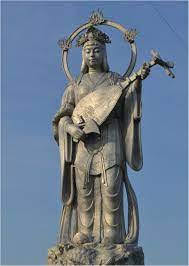
      Japanese goddess of love, Benten, sometimes known as Benzaiten. 


      Benten is the ruler of love, music, and the arts, and is shown as a lovely lady with eight limbs riding a dragon. 


      Benzaiten (shinjitai: or; kyjitai:, or, lit. "goddess of eloquence"), also known as Benten (shinjitai:; kyjitai: /), is widely worshipped as a Japanese Buddhist goddess descended mostly from Saraswati, the Hindu goddess of speech, the arts, and learning, with some qualities derived from Durga, the warrior goddess


      Benzaiten is the only female of the seven fortunate gods, and she is as much a Buddhist as she is a Shinto deity. 


      Actors, airline hostesses, artists, beauticians, composers, dancers, designers, directors, dramatists, entertainers, gamblers, models, musicians, painters, photographers, sculptors, sword makers, and writers are among the jobs Chiba associated with her. 

      Author Brian Bocking compares Benzaiten to Ichikishima-hime-no-mikoto, the principal deity of the Enoshima Jinja's three major temples. 


      Benzaiten is named after the Hindu goddess Sarasvati, and it is derived from Chinese translations of Buddhist sutras

      Sarasvati is the Hindu Goddess of wisdom, music, and the arts, and she is claimed to have been the wife of Brahma and Vishnu, who along with Siva make up Hinduism's sacred trinity. 


      Sarasvati is first mentioned in the Rig Veda, one of Hinduism's four holy books, which was compiled between 1500 and 1000 BC. 


      This phrase from Hymn 41 is arguably the most appropriate in the Benzaiten context:

      Sarasvat, greatest Mother, best of Rivers, best of Goddesses We have no notoriety, as it were, and dear Mother, grant us renown.

      All generations have a home in thee, Sarasvat, heavenly.

      Benzaiten Jinja in Japan are virtually all located near the sea, rivers, or lakes, or have their own in-ground lakes. 


      The next sentence from Hymn 61 makes a more dubious allusion to Banzaiten:

      Yes, this exquisite Sarasvat, with her golden road, is dreadful.

      Our eulogy refers to you as a foe-slayer.


      Sarasvati's "foe-slayer" might be understood as a reference to Sarasvati's killing of Vritra, the Hindu mythology's three-headed serpent/snake. 

      However, there is no further mention of this, and the conventional story puts Indra as Vritra's killer. 

      The three-headed serpent/snake transforms into a white snake in the Benzaiten mythology, which acts as her messenger. 

      The Kami-shinmei-tenso Jinja is a nice example of this.


      The Most Important Shrines Dedicated To Goddess Banzaiten


      Enoshima Jinja     江島神社        

      Kanagawa-ken, Fujisawa-shi, Enoshima 2-3-8    

      神奈川県藤沢市江の島2-3-8         


      Zeniarai Benzaiten Ugafuku jinja   銭洗弁財天宇賀福神社   

      Kanagawa-ken, Kamakura-shi, Sasuke 2-25-16

      神奈川県鎌倉市佐助2-25-16                


      Kiyomizu Benzaiten Sha     清水弁財天社

      Nagano-ken, Saku-shi, Iwamurada

      長野県佐久市岩村田


      Tenkawa DaiBenzaiten Sha     天河大辯財天社

      Nara-ken,  Yoshino-gun, Tenkawa-mura Tsubo-no-uchi 107

      奈良県吉野郡天川村坪内107


      The Enoshima Island in Sagami Bay, the Chikubu Island in Lake Biwa, and the Itsukushima Island in the Seto Inland Sea (Japan's Three Great Benzaiten Shrines) are all shrines dedicated to Benzaiten, and she and a five-headed dragon are the central figures of the Enoshima Engi, a history of the shrines on Enoshima written by the Japanese Buddhist monk K According to Kkei, Benzaiten is the third daughter of Munetsuchi's dragon-king, who is known in Sanskrit as Anavatapta, the lake that is at the heart of the globe according to an old Buddhist cosmological theory.

      Shrine pavilions called benten-d or benten-sha, or even whole Shinto temples, such as Kamakura's Zeniarai Benzaiten Ugafuku Shrine or Nagoya's Kawahara Shrine, might be devoted to her.


      Sarasvati to Benzaiten, from India to Japan


      Sarasvati occurs in two sutras translated into Chinese: the Sutra of Golden Light (, Konkmy-ky) and the Lotus Sutra (, Myh-rengei-ky). 


      The former devotes a whole chapter (8) to her and is essentially a lengthy, drawn-out eulogy. 

      Her presence in the Lotus Sutra is referenced in almost every Benzaiten-related publication on the Internet, but I have been unable to locate it. 

      It's unknown when she initially emerged in Japan, although it was probably definitely during the 6th and 8th centuries AD. 

      Much of the Sutra of Golden Light, perhaps reflecting China's Confucian history, emphasizes the necessity for a knowledgeable ruler, and it was this component, defender of the state and people, with which Benzaiten was linked when she first arrived in Japan. 


      Originally, her name was spelled as  辯才天


      The first of these three characters denotes eloquence in speaking, and the second, gift. 


      Her name started to be recorded as she grew more naturalized, finally becoming one of the Seven Lucky Gods,  弁財天

      The first character of this name,, is a simplified version of and so signifies no meaningful difference, but the second character,, is completely distinct from and indicates wealth or riches, which is an admirably appropriate characteristic for a deity of luck. 

      Benzaiten is usually typically shown playing a biwa, which is a short-necked lute, and Lake Biwa, Japan's biggest freshwater lake, is one of her shrines. 


      Benzaiten was worshipped in Japan from the sixth to the ninth century, mostly via Classical Chinese translations of the Golden Light Sutra (Sanskrit: Suvaraprabhsa Stra), which has a portion dedicated to her. 


      Benzaiten became associated or even conflated with a number of Buddhist and local deities from the medieval period onwards, 

      1. including the goddess Kisshten (the Buddhist version of the Hindu Lakshmi, whose role as goddess of fortune was eventually ascribed to Benzaiten in popular belief), 
      2. the snake god Ugajin (the combined form of the two being known as 'Uga Benzaiten'), 
      3. and the kami Ichikishimahime. 

      She was also associated with nagas, dragons, and snakes because to her role as a water goddess. 


      She was later adored as a bestower of monetary prosperity and was included as one of the Seven Lucky Gods, in addition to being a patron of music and the arts (Shichifukujin).


      In Japanese art, Goddess Benzaiten is portrayed in a variety of ways. 


      She is often represented brandishing a sword and a wish-granting diamond (cintmai), similar to how Saraswati is pictured in Indian art with a veena. 

      Meanwhile, Durga's iconography is said to have inspired an iconographic formula depicting Benzaiten with eight arms wielding various weapons (based on the Golden Light Sutra). 

      Ugajin (a human-headed white snake) may also be seen above her head as Uga Benzaiten. 

      Finally, she is sometimes shown with the head of a serpent or a dragon.


      Benzaiten is a Shinto female kami with the name Ichikishima-hime-no-mikoto. 


      Tendai Buddhists believe she is the essence of the kami Ugajin, whose effigy she sometimes wears on her head with a torii. 

      As a result, she is often referred to as Uga Benzaiten or Uga Benten.

      Su, (typically read in Japanese as so) is the bja or seed syllable used to express Benzaiten in Japanese esoteric Buddhism, written in Siddha script. 


      Benzaiten's Mantras:


      Sanskrit: Oṃ Sarasvatyai svāhā

      Japanese: On Sorasobateiei sowaka

      Hiragana: おん そらそばていえい そわか[25]

      ~Kiran Atma


      References And Further Reading:


      1.  Ludvik, Catherine (2007). Sarasvatī: Riverine Goddess of Knowledge. From the Manuscript-carrying Vīṇā-player to the Weapon-wielding Defender of the Dharma. Brill. pp. 1–3.
      2. Kinsley, David (1998). Hindu Goddesses: Visions of the Divine Feminine in the Hindu Religious Tradition. Motilal Banarsidass Publishers. pp. 10–13.
      3. Ludvik (2007). pp. 35-39.
      4. Faure, Bernard (2015). Protectors and Predators: Gods of Medieval Japan, Volume 2. University of Hawaii Press. p. 164.
      5. Faure (2015). pp. 164-165.
      6. Ludvik (2007). p. 48.
      7. Griffith, Ralph T.H. (trans.). "Rig Veda, Book 6: Hymn LXI. Sarasvatī"Sacred Texts. Retrieved 2022-05-21.
      8. Griffith, Ralph T.H. (trans.). "Rig Veda, Book 10: Hymn CXXV. Vāk"Sacred Texts. Retrieved 2022-05-21.
      9. "金光明最勝王經 第7卷"CBETA Chinese Electronic Tripiṭaka Collection (漢文大藏經). Retrieved 2022-05-21.
      10. Faure (2015). pp. 165-166.
      11. Ludvik, Catherine (2004). "A Harivaṃśa Hymn in Yijing's Chinese Translation of the Sutra of Golden Light"Journal of the American Oriental Society124 (4): 707–734.
      12. "AryAstavaH - hymn to Arya"Mahabharata Resources Page. Retrieved 2022-05-21.
      13. Ludvik (2007). pp. 265-267.
      14. Faure (2015). pp. 168-169.
      15. "大毘盧遮那成佛神變加持經"CBETA Chinese Electronic Tripiṭaka Collection (漢文大藏經). Retrieved 2022-05-21.
      16. The Vairocanābhisaṃbodhi Sūtra(PDF). BDK English Tripiṭaka Series. Translated by Rolf W. Giebel. Bukkyō Dendō Kyōkai; Numata Center for Buddhist Translation and Research. 2005. pp. 33, 141.
      17. Faure (2015). p. 166.
      18. "大毘盧遮那成佛神變加持經 第1卷"CBETA Chinese Electronic Tripiṭaka Collection (漢文大藏經). Retrieved 2022-05-21.
      19. "大毘盧遮那成佛神變加持經 第2卷"CBETA Chinese Electronic Tripiṭaka Collection (漢文大藏經). Retrieved 2022-05-21.
      20. Pye, Michael (2013). Strategies in the study of religions. Volume two, Exploring religions in motion. Boston: De Gruyter. p. 279. ISBN 9781614511915OCLC 852251932.
      21. "大毘盧遮那成佛神變加持經 第4卷"CBETA Chinese Electronic Tripiṭaka Collection (漢文大藏經). Retrieved 2022-05-21.
      22.  Bocking, Brian (1997). A Popular Dictionary of Shinto - 'Benzaiten'. Routledge. ISBN 978-0-7007-1051-5.
      23.  Itō, Satoshi: "Ugajin"Encyclopedia of ShintoKokugakuin University, retrieved on August 15, 2011
      24.  Ludvik, Catherine. “Uga-Benzaiten: The Goddess and the Snake.” Impressions, no. 33, 2012, pp. 94–109. JSTOR,  www.jstor.org/stable/42597966.
      25. "弁財天 (Benzaiten)"Flying Deity Tobifudō (Ryūkō-zan Shōbō-in Official Website). Retrieved 2022-05-22.
      26. Faure, Bernard (2015). Protectors and Predators: Gods of Medieval Japan, Volume 2. University of Hawaii Press. ISBN 978-0824857721.
      27. Kinsley, David (1998). Hindu Goddesses: Visions of the Divine Feminine in the Hindu Religious Tradition. Motilal Banarsidass Publishers. ISBN 978-8-1208-0394-7.
      28. Ludvik, Catherine (2004). "A Harivaṃśa Hymn in Yijing's Chinese Translation of the Sutra of Golden Light"Journal of the American Oriental Society124 (4): 707–734.
      29. Ludvik, Catherine (2007). Sarasvatī: Riverine Goddess of Knowledge. From the Manuscript-carrying Vīṇā-player to the Weapon-wielding Defender of the Dharma. Brill. ISBN 978-9-0474-2036-1.