Showing posts sorted by relevance for query Fortune. Sort by date Show all posts

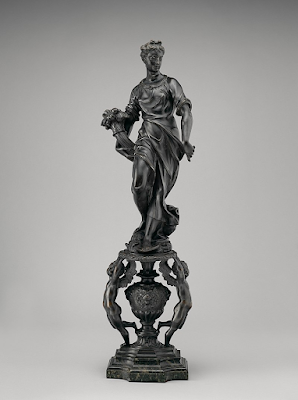
Goddess Fortuna


Fortune Goddess in Roman mythology.

Many sanctuaries in ancient Rome were dedicated to Fortuna.

She is the embodiment of good and ill luck, as well as the ruler of destiny, fortune, and divination.

Her presence has a beneficial impact on all aspects of life, and she bestows fertility on gardens and couples in love.

Fortuna is the patroness of bathhouses and is often portrayed blind and veiled.


~Kiran Atma


Goddess Tyche


Tyche: Fortune goddess in Greek mythology.

Tyche is the goddess of luck and fortune.

Her rule encompasses everything from commercial prosperity to gaming luck.

She is sometimes pictured alongside Nemesis, who balances the distribution of Tyche's blessings, while she oversees the world's financial issues.


~Kiran Atma

Goddess Copia, The Roman Divinity Of Abundance And Plenty


    Copia is the Goddess of prosperity in Roman mythology. 


    Copia bestows riches and plenty to her devotees. 


    Wine and food are offered in her honor, symbolizing the earth's abundant bounty. 

    She's seen holding a cornucopia full of fruits, grains, and gold money.

    The Roman goddess of plenty is called Copia. 

    Her name has extra connotations that include "resources," "wealth," and "opportunity," as well as "plenty" or "plenty." 


    She is one of several Roman goddesses that stand for a glorification of a virtue, like Concordia, the goddess of harmony, or Aequitas, Equity. 

    The cornucopia, also known as the "horn of abundance," was a large goat's horn that was filled with money and food. It was most often used to represent coopia. 


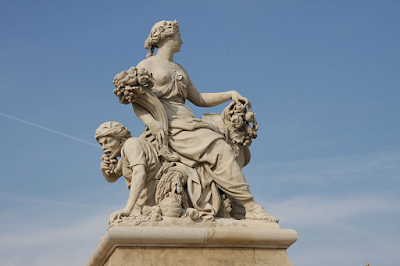
    A sculpture by Antoine Coysevox called L'Abondance par Coysevox is located at the Palace of Versailles.


    There was a town in southern Italy named Sybaris that the Greeks had founded in the eighth century BCE as a component of their colony known as Magna Graecia ("Greater Greece"). 

    The Greeks made Sybaris renowned for its lavish customs; the area was at the time highly fruitful, and the inhabitants there prospered to the extent that the term "sybarite" has come to mean someone who enjoys luxury and sensual pleasures. 

    Although the city itself was on the Crathis River, it was established close to a river of the same name. 


    The ancients gave the Sybaris River (also known as the Crathis) certain peculiar powers, such as the ability to make sheep and cow pelts black while only changing the color of human hair to white or yellow. 

    Some people describe this outcome as "gilding" the hair, which sounds like the river was speckled with gold dust, but possibly it had to do with the water's chemical makeup, which effectively bleached the hair. 

    Additionally, it was said that animals that drank from the waters would grow timid and that the waters made horses sneeze. 


    All of that, however, can be interpreted as metaphors for the city and the way in which its inhabitants were perceived—as timid, vain (with bleached hair), rich, and unmanly—even though there must have been some recognition of the benefits of luxury since the waters of the Crathis were also thought to have therapeutic qualities. 

    Only 200 years after its establishment, Sybaris was destroyed by an army from the nearby city of Crotona, who even went so far as to divert the Crathis to flow over its remains in order to prevent its quick resettlement. 


    What does Copia, our goddess of plenty, have to do with all of this? Well, when the Romans founded a colony at the ancient location of Sybaris several hundred years later, they gave the city the name Copia in recognition of its former distinction. 

    Copia is linked to Fortuna, who is shown with a cornucopia, and the Goddess Abundantia is theoretically connected.


    Romanized version of a Greek statue of Fortuna from the fourth century BC


    What Does The Name Of Goddess 'Copia' Signify?


    Copia, also known as Abundita, was a heavenly embodiment of wealth and plenty in the religion of the ancient Romans. 

    The word "Copia" signifies plenty or wealth. 


    Given that Copia was a goddess of wealth, cash flow, prosperity, fortune, treasures, and success, the name is appropriate. 

    She would aid in safeguarding your money and savings. 

    Copia would even help with significant purchases. 

    She was one of the religious propaganda's depictions of virtue that portrayed the emperor as ensuring "Golden Age" circumstances. 

    Thus, Copia appears in literature, religion, and art but has little actual mythology. 


    She could have persisted in some capacity in medieval France and Roman Gaul. 

    The cornucopia that Copia would transport included both grain and money. 

    She sometimes left some of her grain or cash as a present at someone's home. 
    Copia worship is a thing. 

    In the legend of Acheloüs, the river deity, whose horn Hercules tore from his forehead, the Augustan poet Ovid grants Copia a part. 


    The Naiads took the horn and turned it into the cornucopia they gave to Copia. 

    Diverse aetiological myths provide different theories for the genesis of the cornucopia. 

    [More information required] She was equated with Annona, who represented the grain supply, and Ceres on Neronian currency. 

    Similar to Annona, Copia displayed virtue in public spaces like the waterfront, where grain was brought into the city. 

    She is seen on Roman coins either holding the cornucopia or emptying it of its contents' richness. 


    Atop rare occasions, she is seen standing on a ship or holding a stalk of wheat. 

    What her presence aboard ships denotes is uncertain. 

    This can represent the riches that the Roman Empire gained via its conquests. 

    Numerous emperors' medals include the image of Copia. 


    Like Trajan, Antoninus Pius, Caracalla, Elagabalus, Severus Alexander, Gordian, Decius, Gallienus, Tetricus, Probus, Numerian, Carinus, Carus, Diocletian, and Galerius, to name a few. 

    She is shown next to one of the following inscriptions: Augustorum Nostrorum, Augustorum Augg NN, and Augustia Aug. 

    As a representation of "the richness that comes from Mithras' deed," Mithraic imagery on a vase from Lezoux in the Roman province of Gallia Aquitania shows this god sitting and holding a cornucopia. 

    A fountain at Pompeii had a picture of Copia. 


    Was Copia Worshipped As A Gallic Goddess?


    The Gallic goddess Rosmerta has been compared to Copia, however the two are never explicitly mentioned together in inscriptions. 


    A Domina Abundia ("Mistress Abundia") is mentioned by William of Auvergne (d.), a bishop of Paris, and she is referred to as "Dame Habonde" in the Roman de la Rose. 

    The name of the bishop comes from abundantia. 

    The dominae enter homes at night where offerings have been placed for them. 

    However, the contents of the containers remain unaltered as they are consumed. 

    They offer wealth and fecundity if they are pleased. 

    William believed that these customs amounted to idolatry. 

    These individuals were seen as Celtic fairies by folklorists. 

    According to Nicholas of Cusa, he saw two elderly ladies who claimed to work for Domina Abundia while traveling through the French Alps in. 

    They identified as apostate Christians who had been held captive for practicing witchcraft. 

    Nicholas believed that while they had been deceived by the devil, they should be given the opportunity to atone rather than being burned at the stake. 


    How Is Copia Portrayed In Modern Art?


    Copia is often seen with her cornucopia and sheaves of grain or wheat in later Western art.

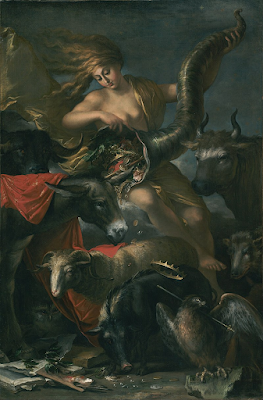
    Salvator Rosa's 1658 work, Allegory of Fortune, features the horn of abundance as Fortuna, the goddess of luck.


    The cornucopia is generally shown in contemporary art as a hollow, horn-shaped wicker basket that is filled with a variety of celebratory fruits and vegetables. 


    The cornucopia has come to symbolize Thanksgiving and the harvest in the majority of North America. 

    The annual November Food and Wine festival in Whistler, British Columbia, Canada, is also known as Cornucopia. 

    Personifying the Americas as the New World by using an alligator, a parrot, and a cornucopia


    Idaho's flag and state seal both include two cornucopias. 

    Liberty stands on the Great Seal of North Carolina as Plenty holds a cornucopia. 

    A North Carolina state seal depicting a Cornucopia.


    The cornucopia, a sign of plenty, is also seen on the coats of arms of Venezuela, Peru, Colombia, Panama, and the State of Victoria in Australia. 

    Columbia's Coat Of Arms


    Chile's Coat Of Arms


    Seal Of The Philippines

    Kharkiv, Ukraine's Coat Of Arms


    Tiffany Aching, a witch in Terry Pratchett's Discworld series of fantasy books, temporarily held the Cornucopia, which is Summer's badge of office, until she developed avatarism and ped fecundis during the events of Wintersmith. 

    By spitting up food and animals, including a large flock of hens, this presents issues. 

    The Hunger Games novel series makes use of the cornucopia concept. 


    A massive horn-shaped cache packed with weapons and equipment is put before the beginning of the series' titular gladiatorial matches. 

    This cache, which is referred to as the "Cornucopia," acts as the center of combat during the first minutes of the match. 

    The national anthem of Panem, the main location of the series, is referred to as "the Horn of Plenty" in the film version, and it is referenced multiple times in the lyrics. 

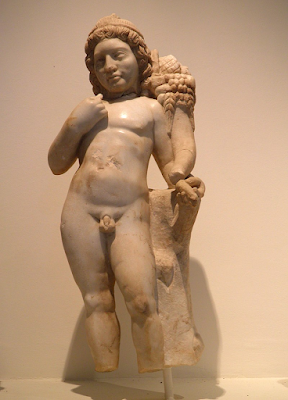
    Harpocrates with a cornucopia, a figurine from the Hellenistic era, is shown at Dion's Archaeological Museum (Dion, Greece)


    As a symbol of fertility, good fortune, and prosperity, the horn of plenty is utilized as body art and at Halloween. 

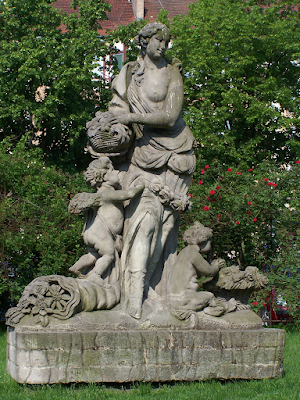
    The Statue of Flora in Szczecin, Poland, has a cornucopia.


    How Is 'Cornucopia' Derived From The Name Of Goddess 'Copia'?

    Rubens' allegorical representation of the Roman goddess Abundantia holding a cornucopia (ca. 1630)


    The cornucopia, also known as the horn of plenty and deriving from the Latin words cornu (horn) and copia (plenty), was a representation of abundance and sustenance in ancient antiquity. 


    It was often a big horn-shaped receptacle filled to the brim with fruits, flowers, or nuts. 

    Western Asia and Europe have long utilized baskets or panniers of this kind to store and transport recently gathered foods. 

    The harvester's hands would be free to pick while the horn-shaped basket was carried on the back or draped over the torso. 


    How Was Goddess Copia Worshiped In Greek and Roman mythology?


    The genesis of the cornucopia is explained in a variety of myths. 


    The birth and upbringing of Zeus, who had to be concealed from his devouring father Cronus, is one of the most well-known. 

    Baby Zeus was taken care of and guarded by a multitude of heavenly attendants in a cave on Mount Ida on the island of Crete, including the goat Amaltheia ("Nourishing Goddess"), who fed him with her milk. 

    As a little child, the future king of the gods possessed extraordinary strength and talents. 

    When he was playing with his nursemaid, he accidently cut off one of her horns, which was endowed with the divine ability to supply endless sustenance just as the god's foster mother had done. 

    In a different tale, the cornucopia was created when Heracles (Roman Hercules) engaged in combat with the river deity Achelous and severed one of his horns; river gods were often shown as having horns. 

    The mural painting Achelous and Hercules by American Regionalist artist Thomas Hart Benton depicts this variation. 


    A number of Greek and Roman gods adopted the cornucopia as their symbol, especially those who were connected to the harvest, prosperity, or spiritual abundance, such as personifications of Earth (Gaia or Terra), the son of the grain goddess Demeter and god of riches, Plutus, the nymph Maia, and Fortuna, the goddess of luck who could bring about prosperity. 

    Abundantia, who represents "Abundance," and Annona, the goddess of Rome's grain supply, were two abstract Roman goddesses who promoted peace (pax Romana) and prosperity in the Roman Imperial religion. 

    Girolamo Campagna's bronze Allegory of Peace, created in the late 16th and early 17th centuries and based on designs from about 1585–86


    Hades, the ancient underworld lord in mystery religions, is often seen holding a cornucopia in artwork. 

    He was a provider of material, spiritual, and natural prosperity.


    References And Further Reading:


    • Joseph Spence. Polymetis: Or, An Enquiry Concerning the Agreement Between the Works of the Roman Poets, and the Remains of the Antient Artists: Being an Attempt to Illustrate Them Mutually from One Another. In Ten Books. R. Dodsley, 1747, p. 148.
    • "Abundantia, Roman Goddess of Abundance". www.thaliatook.com. Retrieved 2020-09-10.
    • Virtue, Doreen (2005). Goddesses and Angels. United States of America: Hay House. p. 215. ISBN 978-1-4019-0473-9.
    • J. Rufus Fears, "The Cult of Virtues and Roman Imperial Ideology," Aufstieg und Niedergang der römischen Welt II.17.2 (1981), p. 812.
    • Ovid, Metamorphoses; 9.87–88, as cited by Fears, p. 821.
    • Universal Technological Dictionary Volume 1. London: Baldwin. 1823.
    • Manfred Claus, The Roman Cult of Mithras: The God and His Mysteries, translated by Richard Gordon (Routledge, 2000, originally published 1990 in German), p. 118.
    • Paul-Marie Duval, "Rosmerta," American, African, and Old European Mythologies (University of Chicago Press, 1993), p. 221.
    • Edward Burnett Tylor, excerpt from Primitive Culture, in Understanding Religious Sacrifice: A Reader (Continuum, 2003, 2006), p. 22.
    • Alan E. Bernstein, "The Ghostly Troop and the Battle over Death: William of Auvergne (d. 1249)," Rethinking Ghosts in World Religions (Brill, 2009), p. 144.
    • Benjamin Thorpe, Northern Mythology (London, 1861), vol. 1, p. 281; Jacob Grimm, Teutonic Mythology (English translation London, 1880), pp. 283–288.
    • Hans Peter Broedel, The Malleus Maleficarum and the Construction of Witchcraft: Theology and Popular Belief (Manchester University Press, 2003), p. 109.
    • Jürg Meyer zur Capellen, Raphael: The Roman Religious Paintings, ca. 1508-1520 (Arcos, 2005), p. 264.
    • David Leeming, The Oxford Companion to World Mythology (Oxford University Press, 2005), p. 13; Robert Parker, Polytheism and Society at Athens (Oxford University Press, 2005), p. 422.
    • Ovid, Metamorphoses 9.87–88, as cited by J. Rufus Fears, "The Cult of Virtues and Roman Imperial Ideology," Aufstieg und Niedergang der römischen Welt II.17.2 (1981), p. 821.
    • Kevin Clinton, Myth and Cult: The Iconography of the Eleusinian Mysteries (Stockholm, 1992), pp. 105–107.


    Goddess Haltia Or Haltija


    Haltia, sometimes known as Haltija, is a Finnish goddess of the hearth and the household.

    Haltia bestows good fortune and health to people who welcome her into their houses; she stays in the homes of her worshippers under a roof beam.

    When a Baltic Finn family moved, they brought the beam with them to guarantee Haltia's blessings would continue.

    Goddess Vasudhara


    Vasudhara: Nepal's Goddess of Abundance.

    Vasudhara is the goddess of fortune and wealth who is in charge of all forms of abundance and prosperity.

    Women pray to her for fertility blessings for their wombs and farms.

    She is shown with six arms carrying holy artifacts and mudras, and is supposed to represent the Hindu Lakshmi's counterpart.


    For more refer to my list Of Hindu, Buddhist, And Jain (South Asian) Goddesses From India, Nepal, And Tibet.


    ~Kiran Atma

    Goddess Nemesis


    Nemesis: The goddess of retribution in Greek mythology.

    Nemesis is the goddess of vengeance and wrath.

    Her name means "She Who Dispenses," and she punishes those who have undeserved happiness or an abundance of good fortune.

    Nemesis is the Greek goddess of karma, who chases out the wicked in order to dispense justice.

    The sword and the scales are her emblems.


    ~Kiran Atma


    Goddess Abundantia


    Abundantia is a Roman goddess of plenty, luck, and wealth. 


    • She is the embodiment of prosperity and riches, bestowing blessings to those who ask for them. 
    • She is typically portrayed as a lovely girl with a cornucopia from which she disperses food and money. 
    • She is known among gamblers as "Lady Fortune" or "Lady Luck."
    • And her picture has been seen on the coinage of Roman emperors.


    Goddess Pajau Yan


    Pajau Yan: Vietnam's Moon Goddess.

    Pajau Yan is a deity who is associated with health and healing.

    She aids the departed on their journey to the underworld by bestowing magical flowers of peace on them.

    She is thought to reside in the moon and brings good fortune to the living.


    ~Kiran Atma


    Goddess Danu


    Danu is a Water deity in Hinduism.

    Danu is the water's primal power.


    She is the embodiment of the ocean, which is the source of all creation in the cosmos.

    She cleanses the land by creating streams and rivers, and she bestows good fortune on anyone seeking riches in her depths.


    For more refer to my list Of Hindu, Buddhist, And Jain (South Asian) Goddesses From India, Nepal, And Tibet.


    ~ Kiran Atma


    Goddess Holda


    Northern European winter goddess.

    Holda is also known as "Mother Holle," and "Snow Queen." 

    She is mostly associated with the winter season, and is said to bless the goodhearted while punishing the weak and indolent.

    With legends of Holda coming to abduct or punish them, children were scared into good conduct.

    Holda is a goddess of nature who is in charge of manipulating snowfall and fog.

    She is represented as a lovely lady dressed in red and white, and it is thought that she rides the wind at Yuletide to bring good fortune and health to those who revere her.


    ~Kiran Atma


    Goddess Of The Sun


    The sun is frequently described as a male emblem, associated with reason, consciousness, and benevolence. The antagonism between the ‘‘masculine" sun and the ‘‘feminine" moon, the latter embodying such attributes as emotion and irrationality (‘‘lunacy" is derived from the Latin word for moon) is commonly described by writers influenced by essentialist views of gender. However, cross-cultural mythical comparisons do not support such arguments. 

    The sun has been regarded as a goddess by more cultures than as a deity. The Celts, pre-Hellenic Greeks, Baltic peoples such as Lithuanians and Latvians, Finns and related Hungarians, Scandinavians and Germans, and Slavic peoples all saw the sun as female in Europe (see Saul, Sól, Beiwe and Xatel-Ekwa, and Solntse in those sections, respectively). 


    Sun goddesses can be found all over the world: 

    In Arabia (Al-Lat), Australia (Bila, Walo), India (Bisal-Mariamna, Bomong, Kn Sgni), and Sri Lanka (Pattin); among the Hittites (Wurusemu), Egyptians (Hathor, Sekhmet), and Babylonians (Shapash); in Native America (Unelanuhi), Natchez (Wal Sil), I The sun goddess is frequently pictured as benevolent and maternal, willingly dispersing her warmth among her earthly children. n. Along the Baltic Sea coasts, Lithuanians imagined the sun as Saul, the adored sun-mother who danced in silver shoes on the hilltops on summer nights. 

    The sun as a spinner or weaver, a lady who casts light strands over the s, is a similar picture. Sól, a Scandinavian, was said to sit at the edge of the globe every dawn, weaving a net of sunlight. 

    The sun goddess was portrayed as active in providing for her children's needs, much like a mother in a subsistence economy. This would be food and clothes in the case of a human mother; in the case of the sun, the goddess gives the light that helps plants to grow and therefore supplies us nourishment. These sun goddesses were sometimes connected with birth, both because of the sun's mother character and because a child sees the sun for the first time at birth; Roman Lucina, "light," was one such goddess, as was Baltic Sa. 


    Sun goddesses may express a variety of emotions, not just maternal love. 

    Hathor, the Egyptian goddess of earthly pleasures, especially the arts and crafts, was represented as a cat. Sekhmet, a kindred goddess, portrayed the luminary's most frightening characteristics, since she could become as enraged and destructive against humankind as the furious desert sun. 

    The daughter of the Hungarian sun goddess XatelEkwa, who baked young males she considered attractive, combines violence and desire. Myths interpret the sun's departure in the winter as a transgression, often an incestuous Saul's Meita, daughter of the Baltic sun goddess, was defiled by her father, the moon. 

    Malina, the Inuit sun goddess, was defiled by her brother and tore off one breast before soaring into the sky to leave him; she became the sun, while he became the moon. Her brother threatened the Khasi goddess Ka Sgni with incest, but she escaped by searing his face with ashes, which may still be seen on the moon today (see image below). 

    The legendary motif is sometimes not rape but the threat of violent violence, such as when the Finnish sun goddess Päivätär was kidnapped from the sky by the winter-winter gods. After being threatened with death by gremlins, the Saami Akanidi (see Finno-Ugric) withdrew from earth. 

    Sometimes, like in the example of the Japanese Amaterasu, who hid in a cave after being insulted by her brother, the sun retreats on her own own. Similarly, the yearly disappearance of the Siberian Kaja é was seen as the goddess's yearly absence. 

    A different version of the disappearance narrative may be found in South America, where the sun-woman Akewa was abandoned in the sky when her sister suns descended to the earth because they were curious about the men who had taken her place. The sun ladies were stuck on earth after a hairy earthling bit the solar ladder in half, and they became moms. As a result, themes of withdrawal and loss are part of the sun goddess. s mythology. 

    From the dawn of time, stories about the sun shifting its location have been told. Miwok Hekoolas, who was stranded on one side of the sky, was hauled into her curre. Among the Cherokee, Kanene Ski Amai Yehi, the spider goddess, was the only animal capable of bringing the sun to this side of the globe in a hand-held vessel. But she placed it too near to the ground, and the animal elders had to push the sun away. Tso, the Tunica sun goddess, relocated herself after realizing she was roasting people with her heat (see North America). 


    Sun goddesses are associated with death and ultimate rebirth, since the luminary fades into darkness each evening but reappears the next morning. 

    The British Sul was personified in hot springs in Bath, where she was said to descend at nightfall to go underneath the ground, heating the thermal waters as she travelled through. Those who bathed at her temple were said to absorb the power and endurance of a goddess who might appear to die again every day. Finally, the eye is a frequent emblem for the sun goddess, as the goddess is pictured as an eye in the sky, able to view everything. She is sometimes connected with fortune reading because of her height, which allows her to view the past, present, and future. Hittite Wurusemu was linked with such activities, as were other sun goddesses; she was also a goddess of fate, regulating everyone's fate.

    Despite the fact that goddesses inextricably linked to the sun may be found in many civilizations, scholarly prejudice in favor of the solar masculine has led to the misinterpretation of many goddesses with solar connotations. 

    The well-known image of the Greek Medusa, whose snake-crowned countenance resembles the rayed sun, has been characterized as representing Several Irish characters, such as Griánne and ine, have solar affinities but are not generally referred to as such. 

    As a result, determining which goddesses may be classified as solar divinities is a worthwhile endeavor.


    ~Kiran Atma

    You may also want to read more about Goddess Symbolism here.


    Goddesses Of Water


    After earth, the symbol most commonly associated with goddesses is water, both as the fresh water of rivers and streams, and as the oceans salty waves. 

    The gendering of water as feminine is not invariable, however. 

    Some mythologies describe the oceans as masculine. 

    The Greeks had a sea god, Poseidon, while a similar figure among the Irish was Manannan mac Lir. 

    In both cases, the ocean was defined as masculine, as dis tinguished from fresh water, which was feminine. 

    Among the Greeks, who despite see ing the ocean as masculine pictured its waves as the innumerable feminine Oceanids, we find the freshwater Nymphs called the Nereids. 

    The Irish knew many river god desses such as Sınann, Berba, and Boand, while outside Ireland we find dozens of Celtic water goddesses including Abnoba, Aveta, Coventina, Natosuelta, and Sabrina. 

    This salt and fresh water distinction, however, is not universal. 

    Some goddesses were described as ruling the oceans, including the Scandinavian Ran who ruled the northern sea, and Chermiss Bu¨t aba and Finnic Mere-Ama (see Finno-Ugric), whose domains were similarly in the arctic waters. 

    Hebrew Miriam (see Eastern Mediterra nean) was connected with the ‘‘bitter waters or the salty seas, although a freshwater stream created by her brother Moses also bore her name. 

    The connection between the oceans salt water and female fertility is emphasized in the Hindu myth of Prakrti (see India), whose amniotic fluid became the oceans after she gave birth to the gods. 

    In many cultures, an ocean goddess controls the fish and mammals that live in her waters and on which humans depend for food. 

    An important example of such a figure is Inuit Sedna (see Circumpolar) who, thrown into the water as a sacrifice, thereafter receives sacrifices herself as the ‘‘great food-dish. 

    Finnish Vellamo (see Finno Ugric), too, is an ocean goddess who determines how many fish humans can take from her waters, taking advice from her many daughters, the waves of the sea. 

    Similarly, the South American sea-mother Mama Cocha brings fish and sea-mammals close to peo ple so that they can be harvested for food. 

    Fishermen often fall under the rulership of ocean goddesses, who like Ma-tsu (see China) protects them when they are faring on the waves. 

    In some cases, the oceanic goddess is depicted as a primordial mother or creatrix, one from whose depths life was born, as with Babylonian Tiaˆmat (see Eastern Mediterranean). 

    Finno-Ugric Luonotar, while not the ocean itself, is intimately con nected with it, having spent much of eternity floating on cosmic waters. 

    The sky woman of the American Iroquois, Ataensic, floated on the oceans waters until earth was created (see North America). 

    Wherever the waters of the Wintu goddess Mem Loimis fell, the earth grew fertile, while areas not endowed with her watery gift were left as desert (see North America). 

    Ocean goddesses could be charming and delightful. 

    Lithuanian Amberella tossed pieces of amber to the shore, to reward those who honored her, and Greek Aphrodite was ravishingly beautiful even when fickle. 

    But they could also be dangerous. 

    Mer maids and sirens, which appear in many mythologies as ocean-dwelling women of great beauty, are threatening water divinities who lure sailors to their death. 

    Such fig ures guarded the boundaries between water and land, like Siberian Sug Eezi (see Circumpolar) who like other mermaids had long hair that mimicked the rippling streams that she inhabited. 

    Celtic Korrigans danced each night, drawing victims to themselves and drowning them. 

    Greek Aphrodite was born of the oceans waves and, although beautiful, could also be pitiless, for love is never without possible threat of loss. 

    In China, the primary goddess Xiwang Mu controlled the worlds waters and was invoked when floods threatened, showing that the activities of such cosmic god desses could be damaging to humanity were she not ritually appeased. 

    Thus ocean goddesses represent both creative possibility and danger. 

    Goddesses associated with fresh water are powers of fertility. 

    Such watershed god desses can be seen as divinities of the land as well as the rivers that drain it. 

    In India, many rivers are imagined as goddesses of earthly abundance, none more so than the Ganges, whose powerful river drains much of the subcontinent and is seen as the actual body of the goddess Gan ga. 

    In Egypt, where the annual inundation of the land by the river Nile was typically associated with the god Osiris, we find the water goddess Anu ket representing the connection between water and the lands increased fertility. 

    In Africa, major rivers were goddesses (Yemaja, Oshun, O ya) who were sometimes in conflict with each other over their shared consort. 

    Such river goddesses were typically maternal forces, providing their human children with sustenance. 

    A similar goddess in Russia, Mokosh (see Slavic), was a motherly figure whose presence was most actively felt in budding springtime. 

    Smaller water sources such as springs and creeks could be seen as threatening rather than helpful. 

    In Slavic lands, supernatural women, once human, haunted quick-flowing streams. 

    Deprived by early death of a chance to have children, the Rusalki drowned sweet babies or fertile young people. 

    The Scandinavian Nixies were similarly danger ous. 

    In tribal India, the Nippong especially targeted young pregnant women, whom they caused to miscarry. 

    Such spirits were often most active in spring and may re present the possibility of flash floods. 

    Tribal Indian Bai Tanki, another destructive river goddess, spreads disease through her water—a mythic narrative with a firm basis in science, for polluted water can indeed spread disease. 

    Fountains and bedrock springs were often seen as locations of inspiration because of the goddesses who inhabited them. 

    The Greek Musae are still known as an image of the force that causes artists to create. 

    In India, the river goddess Sarasvatı was the source of inspiration as well as a cosmic creatrix. 

    Such inspiration could be legal and organizational as well as artistic. 

    Among the Roman water nymphs called the Camenae was Egeria, who oracularly dictated the first laws of Rome and whose name is still used to describe a wise woman advisor. 

    Freshwater goddesses, endowed with the gift of seeing the future, could help those who wished to practice the oracular arts. 

    Babylonian Nanshe (see Eastern Mediterra nean) was a fortune-tellers goddess celebrated at waterborne festivals. 

    Prophecy was not always seen as a gift; the Greek water Nymph Telphusa killed anyone who drank her prophetic waters. 

    Yet most often, prophecy was a positive act, connected with heal ing because the ill and infirm turn to oracles in hopes of receiving predictions of pos itive change. 

    So common was the connection between springs and healing among the Celts that the names of many of their goddesses have been lost, for they were renamed ‘‘Minerva Medici after the Roman goddess of healing, during Imperial occupation. 

    Healing was a common part of the domain of the freshwater goddess, a tradition that continues today with the prayerful use of water from the well at Lourdes, France, dedicated to the virgin Mary (see Eastern Mediterranean). 

    In Africa, we find the lake goddess Idemili and the water spirit Mammywata, both of whom offered healing to their worshipers. 

    The Hindu goddess Narmada (see India) was especially powerful against snakebite, while the healing offered by Gan ga extended beyond this life, for those who died in her waters were freed from the cycle of rebirth. 

    Some important goddesses controlled all water, whether found in rivers or in oceans. 

    Anahita, one of the most important Persian divinities (see Eastern Mediterra nean), ruled everything fluid in the universe, even those of the human body. 

    Similarly, among the Lithuanians (see Baltic), the water mother Jurat˙e controlled all the earths waters. 

    Aztec Chalchihuitlicue (see Mesoamerican) could be found in lakes, rivers, and the ocean. 

    Finally, some goddesses could be described as divinities of what science calls the water cycle, for they ruled the rain that falls on the land, the bodies of water (above ground and underground) that gather the rain and return it to the ocean, and the ocean where clouds are born to return water to the land. 

    Such goddesses connect air and water like the African sky woman Andriana who descended to earth to become a water goddess. 

    Rainbows, those bridges between sky and earth formed by water vapor, often symbolize such goddesses. 

    In Australia, the primal serpent Julunggul ruled ocean, rivers (especially waterfalls), and rain; she was embodied in the rainbow. 

    A similar rainbow-water-snake spirit found in Haiti was Aida Wedo (see African Diaspora). 

    ~ Kiran Atma

    You can learn more about Goddess Symbolism here.


    Goddess Benten Or Banzaiten


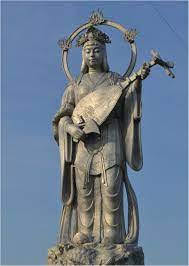
      Japanese goddess of love, Benten, sometimes known as Benzaiten. 


      Benten is the ruler of love, music, and the arts, and is shown as a lovely lady with eight limbs riding a dragon. 


      Benzaiten (shinjitai: or; kyjitai:, or, lit. "goddess of eloquence"), also known as Benten (shinjitai:; kyjitai: /), is widely worshipped as a Japanese Buddhist goddess descended mostly from Saraswati, the Hindu goddess of speech, the arts, and learning, with some qualities derived from Durga, the warrior goddess. 


      Benzaiten is the only female of the seven fortunate gods, and she is as much a Buddhist as she is a Shinto deity. 


      Actors, airline hostesses, artists, beauticians, composers, dancers, designers, directors, dramatists, entertainers, gamblers, models, musicians, painters, photographers, sculptors, sword makers, and writers are among the jobs Chiba associated with her. 

      Author Brian Bocking compares Benzaiten to Ichikishima-hime-no-mikoto, the principal deity of the Enoshima Jinja's three major temples. 


      Benzaiten is named after the Hindu goddess Sarasvati, and it is derived from Chinese translations of Buddhist sutras. 

      Sarasvati is the Hindu Goddess of wisdom, music, and the arts, and she is claimed to have been the wife of Brahma and Vishnu, who along with Siva make up Hinduism's sacred trinity. 


      Sarasvati is first mentioned in the Rig Veda, one of Hinduism's four holy books, which was compiled between 1500 and 1000 BC. 


      This phrase from Hymn 41 is arguably the most appropriate in the Benzaiten context:

      Sarasvat, greatest Mother, best of Rivers, best of Goddesses We have no notoriety, as it were, and dear Mother, grant us renown.

      All generations have a home in thee, Sarasvat, heavenly.

      Benzaiten Jinja in Japan are virtually all located near the sea, rivers, or lakes, or have their own in-ground lakes. 


      The next sentence from Hymn 61 makes a more dubious allusion to Banzaiten:

      Yes, this exquisite Sarasvat, with her golden road, is dreadful.

      Our eulogy refers to you as a foe-slayer.


      Sarasvati's "foe-slayer" might be understood as a reference to Sarasvati's killing of Vritra, the Hindu mythology's three-headed serpent/snake. 

      However, there is no further mention of this, and the conventional story puts Indra as Vritra's killer. 

      The three-headed serpent/snake transforms into a white snake in the Benzaiten mythology, which acts as her messenger. 

      The Kami-shinmei-tenso Jinja is a nice example of this.


      ​

      The Most Important Shrines Dedicated To Goddess Banzaiten


      Enoshima Jinja     江島神社        

      Kanagawa-ken, Fujisawa-shi, Enoshima 2-3-8    

      神奈川県藤沢市江の島2-3-8         


      Zeniarai Benzaiten Ugafuku jinja   銭洗弁財天宇賀福神社   

      Kanagawa-ken, Kamakura-shi, Sasuke 2-25-16

      神奈川県鎌倉市佐助2-25-16                


      Kiyomizu Benzaiten Sha     清水弁財天社

      Nagano-ken, Saku-shi, Iwamurada

      長野県佐久市岩村田


      Tenkawa DaiBenzaiten Sha     天河大辯財天社

      Nara-ken,  Yoshino-gun, Tenkawa-mura Tsubo-no-uchi 107

      奈良県吉野郡天川村坪内107


      The Enoshima Island in Sagami Bay, the Chikubu Island in Lake Biwa, and the Itsukushima Island in the Seto Inland Sea (Japan's Three Great Benzaiten Shrines) are all shrines dedicated to Benzaiten, and she and a five-headed dragon are the central figures of the Enoshima Engi, a history of the shrines on Enoshima written by the Japanese Buddhist monk K According to Kkei, Benzaiten is the third daughter of Munetsuchi's dragon-king, who is known in Sanskrit as Anavatapta, the lake that is at the heart of the globe according to an old Buddhist cosmological theory.

      Shrine pavilions called benten-d or benten-sha, or even whole Shinto temples, such as Kamakura's Zeniarai Benzaiten Ugafuku Shrine or Nagoya's Kawahara Shrine, might be devoted to her.


      Sarasvati to Benzaiten, from India to Japan


      Sarasvati occurs in two sutras translated into Chinese: the Sutra of Golden Light (, Konkmy-ky) and the Lotus Sutra (, Myh-rengei-ky). 


      The former devotes a whole chapter (8) to her and is essentially a lengthy, drawn-out eulogy. 

      Her presence in the Lotus Sutra is referenced in almost every Benzaiten-related publication on the Internet, but I have been unable to locate it. 

      It's unknown when she initially emerged in Japan, although it was probably definitely during the 6th and 8th centuries AD. 

      Much of the Sutra of Golden Light, perhaps reflecting China's Confucian history, emphasizes the necessity for a knowledgeable ruler, and it was this component, defender of the state and people, with which Benzaiten was linked when she first arrived in Japan. 


      Originally, her name was spelled as  辯才天. 


      The first of these three characters denotes eloquence in speaking, and the second, gift. 


      Her name started to be recorded as she grew more naturalized, finally becoming one of the Seven Lucky Gods,  弁財天. 

      The first character of this name,弁, is a simplified version of and so signifies no meaningful difference, but the second character,財, is completely distinct from 才and indicates wealth or riches, which is an admirably appropriate characteristic for a deity of luck. 

      Benzaiten is usually typically shown playing a biwa, which is a short-necked lute, and Lake Biwa, Japan's biggest freshwater lake, is one of her shrines. 


      Benzaiten was worshipped in Japan from the sixth to the ninth century, mostly via Classical Chinese translations of the Golden Light Sutra (Sanskrit: Suvaraprabhsa Stra), which has a portion dedicated to her. 


      Benzaiten became associated or even conflated with a number of Buddhist and local deities from the medieval period onwards, 

      1. including the goddess Kisshten (the Buddhist version of the Hindu Lakshmi, whose role as goddess of fortune was eventually ascribed to Benzaiten in popular belief), 
      2. the snake god Ugajin (the combined form of the two being known as 'Uga Benzaiten'), 
      3. and the kami Ichikishimahime. 

      She was also associated with nagas, dragons, and snakes because to her role as a water goddess. 


      She was later adored as a bestower of monetary prosperity and was included as one of the Seven Lucky Gods, in addition to being a patron of music and the arts (Shichifukujin).


      In Japanese art, Goddess Benzaiten is portrayed in a variety of ways. 


      She is often represented brandishing a sword and a wish-granting diamond (cintmai), similar to how Saraswati is pictured in Indian art with a veena. 

      Meanwhile, Durga's iconography is said to have inspired an iconographic formula depicting Benzaiten with eight arms wielding various weapons (based on the Golden Light Sutra). 

      Ugajin (a human-headed white snake) may also be seen above her head as Uga Benzaiten. 

      Finally, she is sometimes shown with the head of a serpent or a dragon.


      Benzaiten is a Shinto female kami with the name Ichikishima-hime-no-mikoto. 


      Tendai Buddhists believe she is the essence of the kami Ugajin, whose effigy she sometimes wears on her head with a torii. 

      As a result, she is often referred to as Uga Benzaiten or Uga Benten.

      Su, (typically read in Japanese as so) is the bja or seed syllable used to express Benzaiten in Japanese esoteric Buddhism, written in Siddha script. 


      Benzaiten's Mantras:


      Sanskrit: Oṃ Sarasvatyai svāhā

      Japanese: On Sorasobateiei sowaka

      Hiragana: おん そらそばていえい そわか[25]

      ~Kiran Atma


      References And Further Reading:


      1.  Ludvik, Catherine (2007). Sarasvatī: Riverine Goddess of Knowledge. From the Manuscript-carrying Vīṇā-player to the Weapon-wielding Defender of the Dharma. Brill. pp. 1–3.
      2. Kinsley, David (1998). Hindu Goddesses: Visions of the Divine Feminine in the Hindu Religious Tradition. Motilal Banarsidass Publishers. pp. 10–13.
      3. Ludvik (2007). pp. 35-39.
      4. Faure, Bernard (2015). Protectors and Predators: Gods of Medieval Japan, Volume 2. University of Hawaii Press. p. 164.
      5. Faure (2015). pp. 164-165.
      6. Ludvik (2007). p. 48.
      7. Griffith, Ralph T.H. (trans.). "Rig Veda, Book 6: Hymn LXI. Sarasvatī". Sacred Texts. Retrieved 2022-05-21.
      8. Griffith, Ralph T.H. (trans.). "Rig Veda, Book 10: Hymn CXXV. Vāk". Sacred Texts. Retrieved 2022-05-21.
      9. "金光明最勝王經 第7卷". CBETA Chinese Electronic Tripiṭaka Collection (漢文大藏經). Retrieved 2022-05-21.
      10. Faure (2015). pp. 165-166.
      11. Ludvik, Catherine (2004). "A Harivaṃśa Hymn in Yijing's Chinese Translation of the Sutra of Golden Light". Journal of the American Oriental Society. 124 (4): 707–734.
      12. "AryAstavaH - hymn to Arya". Mahabharata Resources Page. Retrieved 2022-05-21.
      13. Ludvik (2007). pp. 265-267.
      14. Faure (2015). pp. 168-169.
      15. "大毘盧遮那成佛神變加持經". CBETA Chinese Electronic Tripiṭaka Collection (漢文大藏經). Retrieved 2022-05-21.
      16. The Vairocanābhisaṃbodhi Sūtra(PDF). BDK English Tripiṭaka Series. Translated by Rolf W. Giebel. Bukkyō Dendō Kyōkai; Numata Center for Buddhist Translation and Research. 2005. pp. 33, 141.
      17. Faure (2015). p. 166.
      18. "大毘盧遮那成佛神變加持經 第1卷". CBETA Chinese Electronic Tripiṭaka Collection (漢文大藏經). Retrieved 2022-05-21.
      19. "大毘盧遮那成佛神變加持經 第2卷". CBETA Chinese Electronic Tripiṭaka Collection (漢文大藏經). Retrieved 2022-05-21.
      20. Pye, Michael (2013). Strategies in the study of religions. Volume two, Exploring religions in motion. Boston: De Gruyter. p. 279. ISBN 9781614511915. OCLC 852251932.
      21. "大毘盧遮那成佛神變加持經 第4卷". CBETA Chinese Electronic Tripiṭaka Collection (漢文大藏經). Retrieved 2022-05-21.
      22.  Bocking, Brian (1997). A Popular Dictionary of Shinto - 'Benzaiten'. Routledge. ISBN 978-0-7007-1051-5.
      23.  Itō, Satoshi: "Ugajin". Encyclopedia of Shinto, Kokugakuin University, retrieved on August 15, 2011
      24.  Ludvik, Catherine. “Uga-Benzaiten: The Goddess and the Snake.” Impressions, no. 33, 2012, pp. 94–109. JSTOR,  www.jstor.org/stable/42597966.
      25. "弁財天 (Benzaiten)". Flying Deity Tobifudō (Ryūkō-zan Shōbō-in Official Website). Retrieved 2022-05-22.
      26. Faure, Bernard (2015). Protectors and Predators: Gods of Medieval Japan, Volume 2. University of Hawaii Press. ISBN 978-0824857721.
      27. Kinsley, David (1998). Hindu Goddesses: Visions of the Divine Feminine in the Hindu Religious Tradition. Motilal Banarsidass Publishers. ISBN 978-8-1208-0394-7.
      28. Ludvik, Catherine (2004). "A Harivaṃśa Hymn in Yijing's Chinese Translation of the Sutra of Golden Light". Journal of the American Oriental Society. 124 (4): 707–734.
      29. Ludvik, Catherine (2007). Sarasvatī: Riverine Goddess of Knowledge. From the Manuscript-carrying Vīṇā-player to the Weapon-wielding Defender of the Dharma. Brill. ISBN 978-9-0474-2036-1.